


ServiceNow and Accenture have launched a forward deployed engineering program that embeds AI experts directly with customers to accelerate the deployment, scaling, and business impact of agentic AI initiatives.
ServiceNow and Accenture have launched a forward deployed engineering program that embeds AI experts directly with customers to accelerate the deployment, scaling, and business impact of agentic AI initiatives.

For 40 years, Larry Ellison used Oracle earnings calls to forecast industry trends, challenge competitors, and champion innovation. His apparent withdrawal from that platform marks the end of one of technology’s most influential public forums.

A 363% surge in Oracle’s RPO demonstrates extraordinary customer demand and positions the company as one of the fastest-growing forces in enterprise AI and cloud computing.

While Microsoft dominates current cloud revenue, Oracle’s rapidly expanding RPO points to a dramatically different competitive landscape ahead.

The combination of 47% cloud revenue growth and 363% RPO growth suggests Oracle’s AI investments are translating into both current revenue gains and unprecedented future demand.

Microsoft is expanding its AI strategy by embedding Copilot directly into Microsoft 365 Business Standard and Premium plans, simplifying licensing and accelerating AI adoption among small and medium-sized businesses beginning July 1.

NVIDIA-powered ‘Dev Box’ delivers horsepower to execute massive AI models from local systems on an ‘unmetered’ basis, while reference designs aim to make AI computing ubiquitous.

Oracle and Alphabet are pioneering new approaches to finance massive AI infrastructure expansion, using debt and equity markets to meet unprecedented customer demand for cloud and AI services.

Oracle and Google Cloud are challenging conventional wisdom by using outside funding to support massive AI infrastructure investments driven by unprecedented customer demand.

ServiceNow CEO Bill McDermott says the company is now AI-native and targeting five high-growth markets worth more than $600 billion, backed by strong momentum in AI, security, CRM, employee experience, and data management.
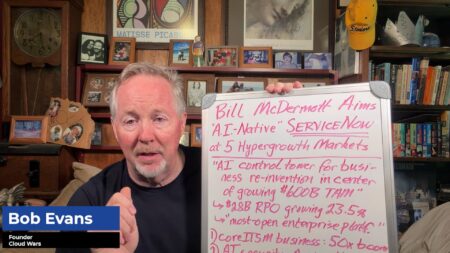
ServiceNow is betting its future on being AI-native, with Bill McDermott outlining five hyper-growth markets that could drive long-term expansion and strengthen its leadership position.

Microsoft updates Finance Agent to provide a command center-type interface, as well as support for natural language prompts to gain and act on financial insights.

Autopilots increase the level of AI autonomy and automation. Build event also places major focus on agentic AI development — and controls — at the desktop.

Support for Compliance API gives Purview visibility into conversations and events, bringing both data types in Claude under broader enterprise controls.

Salesforce delivered strong Q1 results with $11.1 billion in revenue, driven by accelerating demand for Agentforce, AI-powered Slack, and AI-enhanced applications across its portfolio.

Features for controlling the actions of agents — ensuring they don’t misbehave — bring the enterprise-level controls required by IT/security pros and business leaders alike.

Dona Sarkar explains why coding agents succeed first in AI adoption thanks to structured data, clear validation, and measurable outcomes.

Despite strong optimism around AI adoption, Workday found that most enterprise users still act as intermediaries between AI tools, reducing productivity and undermining the promise of automation.
The enterprise AI battleground is shifting from model access to operational context, governance, and differentiated execution infrastructure.

SAP and Palantir are helping redefine enterprise technology, as Christian Klein and Alex Karp both argue that AI-driven execution has moved their companies beyond the traditional definition of software vendors.