

AWS delivered its strongest quarter in years, posting 37% revenue growth, a 154% backlog increase, and $42.2 billion in revenue while overtaking Microsoft in growth and strengthening its AI leadership.
AWS delivered its strongest quarter in years, posting 37% revenue growth, a 154% backlog increase, and $42.2 billion in revenue while overtaking Microsoft in growth and strengthening its AI leadership.

Project Perception scales vulnerability discovery for today’s AI-powered threats. Initially available in Defender, Perception will extend across the company’s security lineup.

Microsoft’s partnership with 3M demonstrates that the next competitive frontier in AI infrastructure extends well beyond GPUs, with networking and optical connectivity emerging as critical strategic differentiators.

Ahead of Microsoft and AWS earnings, Google Cloud has established a commanding growth advantage, with revenue increasing 82% and backlog soaring 390%, signaling strong customer confidence and significant future revenue opportunities.

Customers will be able to capitalize on data from ZoomInfo, Dun & Bradstreet, Gong, and others in the flow of their Dynamics 365 sales processes.

Upgrades include automatically created documents and files, as well as interactive reports. Approvals and other repeatable work can be handled through automation.

AWS is expanding Security Hub with AI-specific protections and Azure support to secure AI and multicloud environments from a single platform.

Microsoft’s latest education findings reveal that AI access is no longer the hurdle—effective implementation and structured training are.

Purview, Defender, and Graph API are all being enhanced to bring agents running on end-user devices under unified governance ‘control plane.’

As Q2 earnings approach, Palantir, Google Cloud, and Oracle lead the Cloud Wars Top 10 in revenue growth, highlighting the extraordinary pace of the AI market and the massive backlog fueling future expansion.
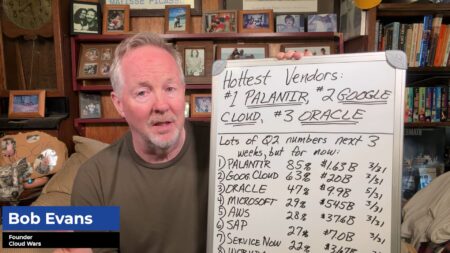
Palantir leads the latest Cloud Wars rankings as Bob Evans previews Q2 earnings and explains why cloud and AI remain the world’s fastest-growing technology market.

Salesforce’s latest AI announcement combines autonomous customer support, responsible AI governance, and a pricing model built around delivering successful business outcomes.
Jalapeño represents OpenAI’s first major move into custom AI hardware, combining the company’s AI architecture expertise with Broadcom’s semiconductor manufacturing capabilities to deliver faster, more energy-efficient inference for large language models.
As AI token demand surges, CEOs must take ownership of allocation strategy to ensure scarce AI resources drive business outcomes, not internal politics.
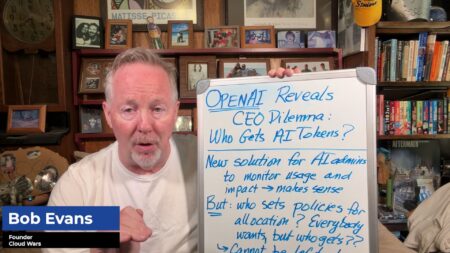
OpenAI’s new token management tool highlights a deeper challenge: CEOs, not AI administrators, must decide how scarce AI resources are allocated across the business.

Google Cloud, OpenAI, and Anthropic are investing heavily in deployment capabilities, ecosystems, and forward-deployed engineers to help customers achieve measurable business outcomes and accelerate enterprise AI adoption beyond model selection.

KPMG and Microsoft are expanding their partnership to help enterprises deploy agentic AI at scale through standardized governance, deployment, and management frameworks.

The Hyperscaler Backlog Sweepstakes defines the top AI factories, ranking Google Cloud, Oracle, Microsoft, and AWS in the top four.
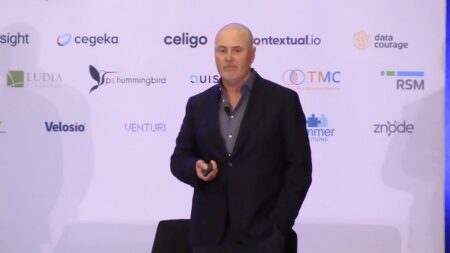
Christopher Lochhead explores how AI shifts the future of work from knowledge accumulation to value creation, arguing that success in the AI era depends on using individual strengths to create impact at scale.

The Hyperscaler Backlog Sweepstakes — including Oracle, Microsoft, Google Cloud, and Oracle — have led to a backlog total of $2.1 trillion.