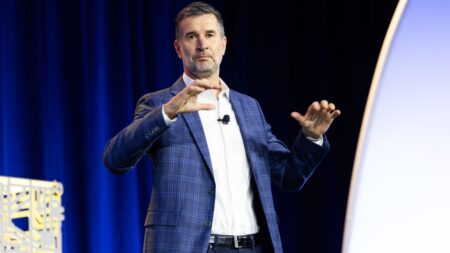


Microsoft has upped the stakes in its ambitious AI model development program. According to Mustafa Suleyman, CEO of Microsoft AI, the company’s latest model outperforms the base model behind OpenAI’s GPT-5.6 on certain tests while requiring only a fraction of the computing resources.
Let’s take a closer look at MAI-Base-2 and investigate how these claims stack up.
New Frontiers
Microsoft has been steadily expanding its frontier AI model family as it works towards providing a full-stack AI service spanning models, infrastructure, and applications. MAI-Base-2 is a significant step in that effort.
Here’s how Suleyman described the ambition of the MAI model family when it was launched back in June this year:
“This is all about long-term self-sufficiency for Microsoft and our partners. It’s about models you can trust. The goal here is to build what we think of as a hill-climbing machine: an organization that can continuously improve, cycle after cycle, as we apply more compute, better data, and sharper evaluation.”
The model has 2.8 trillion parameters, with 80 billion active per token. It was trained on 16,000 NVIDIA GB200 GPUs over 38 days and features multimodal capabilities, with vision integrated into training from the start.
Microsoft says the model was trained on original data rather than knowledge distilled from third-party AI systems. Although pre-training is complete, post-training is still underway, and the company has yet to announce a public release date.
Training efficiency is another key aspect. Microsoft estimates that its approach is between 4.2 and 12.3 times more compute-efficient than the approach used for DeepSeek-V4-Pro-Base — depending on the evaluation. Suleyman has also claimed that MAI-Base-2 outperformed the base model behind GPT-5.6 on specific pattern-understanding and prediction tests, using around 25% of the computing resources OpenAI needed to train its model.
“We now have a stronger pre-trained base model than the model that currently powers GPT 5.6 Sol,” Suleyman reportedly said during an employee town hall meeting. “And in fact, we used one-quarter of the compute that OpenAI used to train their model.”
The company attributes claimed gains to improvements in data quality, model architecture, and training infrastructure. However, while the reported efficiency improvements are promising, the GPT-5.6 comparison has yet to be publicly verified, so we’ll need to see whether Microsoft’s new model can genuinely outperform OpenAI’s equivalent when it goes live.
Regardless, what Microsoft has built is astonishing, especially since it’s a secondary effort behind its software and applications business.
Drifting Apart
Despite an ongoing relationship, Microsoft is looking to establish greater independence from OpenAI by developing its own advanced models. This could lower operating costs and position Microsoft as a more direct competitor, especially if its performance and efficiency claims hold up under independent testing.
More efficient training could really reduce the resources needed to develop future models, which would give Microsoft more control over the performance and costs of its products. However, training efficiency alone doesn’t mean overall cost savings — you also need to consider hardware, data, post-training, and inference costs.
That said, MAI-Base-2 is a clear sign of Microsoft’s ambition to become more than a cloud provider and distributor of other companies’ models.