


Experts including forward-deployed engineers (FDEs) are deemed key factor in accelerating outcomes, reducing risk, and ensuring operational impact of AI.
Experts including forward-deployed engineers (FDEs) are deemed key factor in accelerating outcomes, reducing risk, and ensuring operational impact of AI.
Workday is expanding agentic AI across the contract lifecycle with a new Contract Workflow Agent designed to automate manual work and connect contract tasks with broader business workflows.

Microsoft plans to more than triple data center capacity to 38 gigawatts by 2032, highlighting the extraordinary infrastructure build-out required to meet soaring AI compute demand.

A new AI safety framework for U.S. schools prohibits student and educator data from being used for AI model training while establishing requirements for human oversight, transparency, privacy, and accountability from participating technology providers.

Microsoft is targeting CRM vendor lock-in with Dynamics 365 Activate, an AI-powered migration tool designed to make moving from Salesforce faster, simpler, and less risky.

Salesforce is reportedly considering a nearly $2 billion acquisition of Listen Labs, potentially bringing AI-powered customer research and deeper context into its Agentforce ecosystem.

New functions can support apps that combine Dynamics 365 apps with business context from WorkIQ for complete experiences, Microsoft partners say.
Microsoft is bringing OpenAI’s GPT-6 Astra to Foundry, combining advanced agentic capabilities with enterprise security, compliance, governance, and identity controls.
AI infrastructure spending is reaching unprecedented levels, but rising CapEx is beginning to outpace cash flow, raising questions about how hyperscalers will fund continued AI investment.
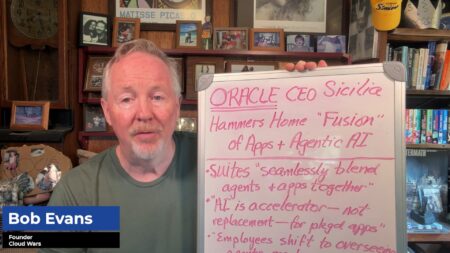
Oracle has been clear in defining where apps end and agents end, with CEO Mike Sicilia driving it home in comments in the Q1 earnings call.

‘Project HydraFusion’ evaluates each request and chooses the least complex workflow required, using additional model calls only when it anticipates a better result.

Oracle delivers a blowout Q1 as cloud infrastructure revenue surges 121% and its $664 billion RPO nearly matches Microsoft’s massive backlog.
In this discussion, John Siefert, CEO, Dynamic Communities & Cloud Wars, is joined by Kelly Holwagner, Executive Vice President, HSO. The two…

Instead of searching across laboratory results, medications, and specialist documentation, clinicians can prompt Epic and receive required information inside ChatGPT using new OpenAI connector.

Microsoft’s strategic collaboration with Saudi AI company HUMAIN demonstrates how localized language models could become central to enterprise AI adoption across the Middle East and Africa.

New tools aimed at enforcing cost discipline include an AI pricing calculator, detection of spending anomalies, and spending caps for individual AI projects.

Meta’s massive Azure spending shows how AI is reshaping tech competition, with rivals increasingly becoming customers as infrastructure emerges as the new battleground.

New features enhance positioning of Teams as a platform to support humans, agents working together to accelerate GitHub-powered dev projects.

Microsoft, Salesforce, and UiPath are taking different approaches to free developer AI capacity as consumption emerges as an increasingly important metric for the enterprise technology industry.

AI monetization is moving upstream as rising agentic development costs push Microsoft and other vendors to charge builders for creating, testing, and executing AI-powered products.