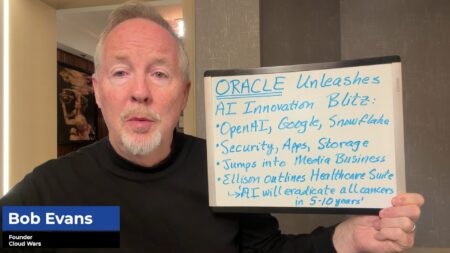


From fusing OpenAI frontier models into Oracle’s solutions and deploying Google TPUs in its AI infrastructure to creating an AI data service with Snowflake and plunging into the media business with its new AI Media Model, Oracle unleashed a wildly ambitious AI-centric business and technology agenda at AI World this week capped off by Larry Ellison’s rollout of an unprecedented AI Healthcare Suite.
And I’m calling it “Oracle 2.0” in the headline not only because this event presented for the first time Oracle’s unconditional end-to-end commitment to AI in everything it does, but also because Oracle this week made it unmistakably clear that CEOs Clay Magouyrk and Mike Sicilia are in complete control. While Ellison will forever be the heart and soul of the company he launched half a century ago, Sicilia and Magouyrk are the leaders, the decision-makers, and the drivers of Oracle’s top-to-bottom AI transformation.
The blitz of new and/or extended partnerships and technologies comes at an ideal time for Oracle, which — depending on your point of view — is either a breathtakingly bold shaper of the AI future or an overly ambitious striver whose data center-buildout eyes are proving to be too big for its cash-flow stomach.
Since I fall into the former camp, I’m framing my initial impressions of the AI World innovation blowout as the ideal antidote Oracle needs to stimulate the revenue growth the company has forecast — $90 billion for fiscal 2027 ending May 31 — and get its cash-flow back into the black to allay investor fears.
And, it would be foolish to forget that Oracle is running nip-and-tuck with Microsoft in generating the largest backlog of contracted business of any company in any industry in human industry: Microsoft’s RPO is $678 billion, and Oracle’s is $664 billion.
And, with its stunningly aggressive slew of announcements at AI World this week, Oracle is clearly showing that it intends to push that backlog much higher, knowing that inevitably that gravity-defying RPO will begin converting into revenue: Oracle has said that over the next three years, about 50% — roughly $332 billion — of that RPO will convert to revenue.
I’ve attended hundreds of the annual customer mega-events put on by tech vendors, and without exception they’ve been marked by some impressive new-product rollouts and strategic roadmaps for the future. But, I have to say that this week’s AI world represents the most-ambitious such event I’ve ever attended with every single part of Oracle’s business surging into the AI Era with new products, services, technologies, and partnerships.
Following up on the several launches I mentioned in my opening sentence above, here’s a comprehensive list with some of my thoughts on each, and you can follow the links for more detail.
The Big Dream for AI. “Today, work is often organized around the software you have”: which app to open, where is the relevant data stored, what steps should be followed, who needs to be contacted for next steps, etc., said CEO Mike Sicilia in his opening keynote. But, Oracle’s approach to AI will send that model to swim with the dodo. “AI should allow you to barely think about the software at all. Instead of spending time navigating applications and managing processes, you simply tell the system what you’d like to accomplish…. So, instead of spending your day operating the software, the software is working and operating for you.”
Oracle’s applied AI “can recognize what’s happening, anticipate what’s needed, and help move the work forward,” Sicilia said. “We’re building intelligence that understands the work you’re doing and helps you to do it better.”
OpenAI models leap into Oracle apps and databases. Under the heading of “Oracle brings frontier AI into the heart of enterprise computing with OpenAI to transform how organizations work,” here’s how Oracle CEO Clay Magouyrk described the greatly intensified collaboration: “OpenAI is transforming how enterprises solve business problems, from chat, to coding, to analytics, to autonomous agents. With this new product suite, we are uniting their transformative AI capabilities with Oracle applications, data, and cloud infrastructure — technology that businesses around the world rely on to run their most critical operations.”
Snowflake partnership expands customer choice, capability. Magouyrk outlined this strategically vital deal as a boost for customers counting on AI to deliver powerful business outcomes: “Organizations are looking for faster, simpler ways to turn their enterprise data into business value with AI. By making Snowflake available as a native OCI service, we’re giving customers more choice in the AI and data capabilities they can use, while simplifying how they deploy, manage, and pay for those services. This is another way Oracle is helping customers accelerate their AI initiatives and turn innovation into measurable business outcomes.”
Wait a minute — Google TPUs now in OCI?!? The AI Revolution is triggering widespread upheavals in business models, business norms, and business relationships. And, in the capacity-constrained world of AI data centers — and bear in mind Oracle’s need to fulfill that $664 billion in RPO — that means being willing to strike a key partnership with the parent company of a hyperscaler competitor because it will lead to better outcomes for customers. Here’s OCI president Mahesh Thiagarajan on why Oracle agreed to be the first hyperscaler other than Google Cloud to deploy Google TPUs: “Different AI workloads have different compute needs. Bringing Google TPUs to OCI gives customers access to multiple leading AI compute architectures in one cloud. That choice gives them the flexibility to choose the right infrastructure for the performance, throughput, and economics of each AI workload.” Ah yes — there’s that “customer choice” thing again.
Prioritizing security in the AI Era. Adding to its broad and deep approaches to world-class security, Oracle launched the AI Security Mesh, which includes OpenAI frontier cyber models. This advance complements what Oracle’s already doing with its identity and zero-trust network protections. “As AI agents take on more responsibility, enterprises need security that can keep pace with how these systems operate,” said Phil Newman, Oracle’s senior vice-president for security and identity. “With Oracle AI Security Mesh and Oracle’s identity and network security capabilities, we’re helping organizations identify and resolve security risks faster while maintaining control over who can authorize sensitive actions and which systems AI workloads can access.”
Oracle dives headlong into media industry. Here’s Magouyrk on his company’s jump into a business where AI is truly changing everything. “Creating content and delivering it to viewers were separate processes. With Oracle Media Fabric, we’re bringing content creation and streaming together, using AI across the entire production and distribution workflow. That helps creators reduce production time and cost, make better use of their existing content, and tailor viewing experiences for different audiences in real-time.”
Larry Ellison on the Oracle Healthcare Suite. Capping off the whirlwind two-day event, chairman Larry Ellison had a riveting conversation with Seema Verma, executive vice-president of Oracle Healthcare and Life Sciences, about the company’s new AI-powered Healthcare Suite. Clearly a project near and dear to Ellison’s heart, this suite has been in the works for a number of years, particularly with the acquisition of Cerner more than four years ago. But, as Ellison noted, to make the suite truly complete and capable of transforming the entire massive healthcare industry from end-to-end, AI was an essential ingredient. As Ellison put it, “We decided to use AI to make our applications much more capable.” I urge you to watch Ellison’s entire conversation with Verma to get a sense not only of what Oracle is doing but also to see what unfettered imagination, bold vision, and fearless ambition can achieve. I’ll offer one stunning prediction made by Ellison: AI will enable researchers to eradicate all cancers within the coming decade — and possibly within the next five years.
Final Thought
I don’t think anything I could say could top that prediction from Ellison, so I’ll just urge you once again to watch his conversation with Verma.