


Oracle is expanding its partner ecosystem through a $1 billion investment supporting AI development, cloud migrations, certifications, and customer success.
Oracle is expanding its partner ecosystem through a $1 billion investment supporting AI development, cloud migrations, certifications, and customer success.
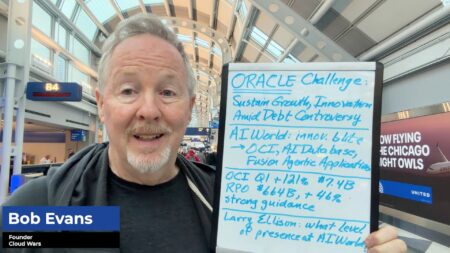
Oracle enters AI World with extraordinary cloud momentum and a $664 billion backlog, but mounting debt concerns and questions about Larry Ellison’s visibility could complicate its growth story.
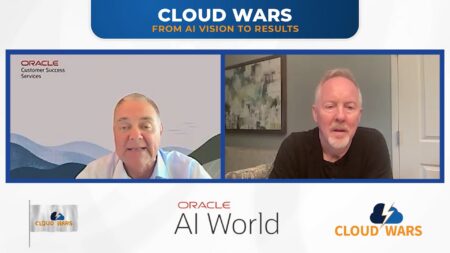
Oracle’s enterprise AI strategy emphasizes measurable business outcomes, scalable agentic innovation, and stronger customer partnerships as organizations accelerate AI adoption while managing costs and security.
Oracle Fusion Claw introduces a governance-first approach to enterprise AI, embedding policies, guardrails, risk limits, and auditable execution records into agentic workflows designed to solve complex business problems across critical enterprise functions.
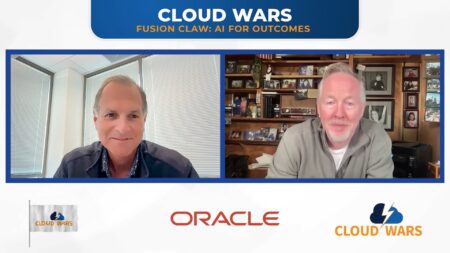
Oracle Fusion Claw combines AI reasoning, deterministic computing, and enterprise governance to execute complex business processes with increasing autonomy.

AI demand is propelling the Cloud Wars Top 10 to extraordinary growth, led by Palantir at 93%, Google Cloud at 82%, and Oracle at 62%, with all three companies also demonstrating sustained quarterly growth acceleration.
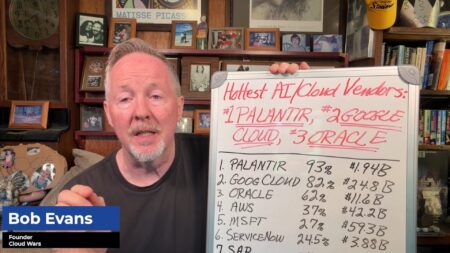
Palantir leads the Cloud Wars Top 10 with 93% growth as Google Cloud, Oracle, and AWS surge and AI platforms drive extraordinary enterprise demand.

During Oracle’s Q1 earnings call, CEO Mike Sicilia’s comments provided great clarity to help customers better understand the interplay between apps and agents.
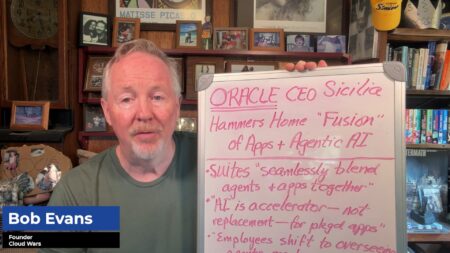
Oracle has been clear in defining where apps end and agents end, with CEO Mike Sicilia driving it home in comments in the Q1 earnings call.

Oracle has become the second-fastest growing hyperscaler, with Q1 revenue and growth rates making a major jump.

Oracle’s Q1 cloud revenue and OCI growth rate have jumped this quarter. How can its business model innovation propel the company to rise even higher?

Despite questions about Oracle’s ability to fund massive AI infrastructure investments, its booming cloud revenue, extraordinary backlog, and accelerating growth guidance suggest customers are making huge long-term commitments to Oracle’s AI and cloud platforms.

Oracle delivers a blowout Q1 as cloud infrastructure revenue surges 121% and its $664 billion RPO nearly matches Microsoft’s massive backlog.

Since returning as CEO, Aneel Bhusri has reshaped Workday’s agentic AI strategy, eliminating or combining simpler agents while prioritizing sophisticated AI systems capable of solving complex HR and finance problems and delivering measurable customer ROI.
OpenAI prominently outlined plans for a unified AI superapp in March, but CFO Sarah Friar’s August description of the company’s AI-native stack makes no mention of it, raising questions about whether OpenAI has changed its strategy.

Google Cloud’s Gemini models are coming to Oracle applications, including Oracle AI Agent Studio for Fusion Applications, giving customers more flexibility to select models while turning AI reasoning into governed workflows, approvals, transactions, and business actions.

Google Cloud and Oracle are emerging as an AI power pair, combining Gemini, Fusion applications, and Oracle AI Database to help customers accelerate enterprise AI transformation.

Oracle is expanding its Google Cloud partnership by bringing Gemini models across its enterprise AI portfolio, strengthening its flexible, multi-model approach to enterprise AI.

Oracle lands a major 10-year Pentagon contract worth up to $7 billion, strengthening its government credentials while creating a potentially significant stream of recurring revenue.

AI’s unprecedented growth is forcing even the world’s best-run companies to rethink traditional risk management and embrace massive, calculated bets on the future.