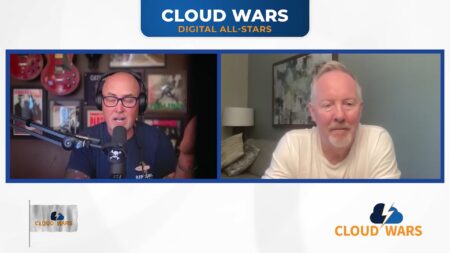



Since the start of the year, Oracle has hosted a whirlwind roster of events around the globe as part of the Oracle AI World Tour 2026. Ahead of the London installment, Cloud Wars founder Bob Evans sat down with Oracle Executive Vice President, Applications Development Steve Miranda to discuss some of the major announcements due at the event and delve deeper into the company’s AI strategy as we head into Q2.
Evans kicked off the discussion by asking Miranda to explain how Oracle was meeting evolving customer expectations in the agentic AI and apps space. “About a year and a half ago, we introduced AI across the applications — that was sort of embedded AI,” says Miranda. “I think at the time, we announced 50, maybe 100 agents. We’ve since gone to well over 1,000 agents.”
Agentic Applications
During the 2025 AI World Tour event in London, Oracle announced the expansion of its AI Agent Studio, which enables customers to orchestrate, modify, and configure their agentic workforce and the launch of its first set of Agentic Applications. “We didn’t look at it as well, here’s your applications, let’s sprinkle some AI in. It was fundamentally rewriting the applications, and that’s what we started to do,” explains Miranda.
Oracle is launching 22 agentic applications that take the company’s pre-built agents and workflows and unite them in new agentic applications, through which end users can instruct agents to achieve specific outcomes. “You give a business outcome and a goal and the agents recommend optimizations, or how you get there,” says Miranda. “Then you, as a user or human in the middle of this process, actually instruct those agents on which of the plans to execute.”
Regarding the term “agentic apps,” Evans notes: “Your terminology here says this is one thing, working together, but doing things that were, until now, never before, possible.”
“We’ve never had a quote feature where you can ask the system, “Hey, I need to optimize supply chain.” It gives you four options, and you tell it, “Oh, I like option B, let’s go ahead and execute that,” remarks Miranda.
He explains how Oracle, with Fusion Agentic Applications, is taking back-end data, business rules, customer business logic, and legislative processes and adding an agentic layer on top of it as an application.
Community Summit North America
The largest independent innovation, education, and training event for Microsoft business applications delivered by Expert Users, Microsoft Leaders, MVPs, and Partners.
Register
First-Wave Applications
The first 22 agentic applications focus primarily on enhancing business process flow. After gathering feedback from an initial rollout, Miranda’s team analyzed how customers were utilizing AI and the specific tasks they were applying it to. Based on these insights, Oracle adjusted the first wave of agentic applications to ensure they met these demands.
In terms of pricing, Fusion Agentic Applications are included with existing licenses. “Just like, you know, the thousands of customers we have that get quarterly updates — they get new features all the time,” says Miranda. “Now they have a really powerful set of new features.”
So, asks Evans, how difficult is it to get started with this new category of applications? “Do they have to send a team off to do six months of training? Do you need a lot of big fat manuals to use these?” he asks.
No, says Miranda, “It’s basically, you know, turn it on and you’re ready to go because again, it’s a feature within supply chain, it’s a feature within sales force automation, it’s a feature within marketing.
“There’s nothing fancy there, even when you’re doing ‘development.’”
“We of course still have our traditional data entry applications and the traditional, you know, heavy lifting batch processes and other things that we run most of the world’s businesses on today, but over time, the agentic apps will be where it’s at.”