


Oracle is expanding its partner ecosystem through a $1 billion investment supporting AI development, cloud migrations, certifications, and customer success.
Oracle is expanding its partner ecosystem through a $1 billion investment supporting AI development, cloud migrations, certifications, and customer success.

Nscale’s massive AI data center backlog contrasts with its reported revenue and losses, raising questions about financing, hardware availability, and the risks of scaling AI infrastructure.
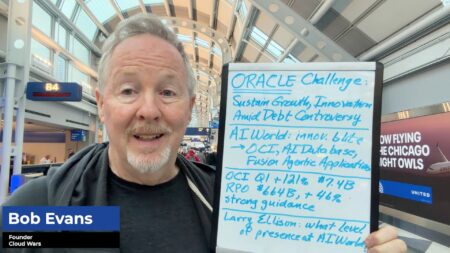
Oracle enters AI World with extraordinary cloud momentum and a $664 billion backlog, but mounting debt concerns and questions about Larry Ellison’s visibility could complicate its growth story.

SAP CEO Christian Klein explains how AI drove 26% cloud revenue growth and 28% backlog expansion through RISE with SAP, Business AI, and Business Data Cloud.
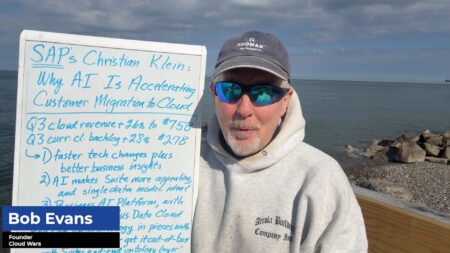
Christian Klein’s AI-driven strategy is helping SAP outperform enterprise application competitors by combining unified business data, faster cloud migrations, and an unwavering focus on customer success.

Microsoft claims its MAI-Base-2 AI model outperforms the base model behind OpenAI’s GPT-5.6 on selected tests while using 75% less training compute, signaling growing competition between the technology giants as Microsoft pursues greater AI independence.

Microsoft’s new Copilot enables legal professionals to perform in-depth work in Word and Cowork, while providing a wide range of pre-built industry functions as reusable skills.
Agents are laying the foundtation for finance teams to put AI to work without needing to give up control in Dynamics 365 Finance.
SAP’s Q3 results highlight accelerating cloud revenue growth, a 28% increase in current cloud backlog to $27 billion, and growing enterprise demand for its AI-powered Autonomous Enterprise vision.

SAP’s remarkable Q3 performance challenges skeptics as Christian Klein’s cloud and AI strategy delivers accelerating revenue growth and increasingly strong competitive positioning.

Google’s latest European research initiative signals a shift toward collaborative AI innovation, where technology developers provide the tools and scientific institutions establish the priorities for discovery.

After achieving 82% revenue growth in Q2, Google Cloud could double its year-over-year revenue in Q3.
Oracle Fusion Claw introduces a governance-first approach to enterprise AI, embedding policies, guardrails, risk limits, and auditable execution records into agentic workflows designed to solve complex business problems across critical enterprise functions.

Google Cloud could deliver extraordinary Q3 revenue growth of 90% to 100%, fueled by AI momentum, accelerating quarterly gains, and an expanding ecosystem that continues to outperform major cloud competitors.

Microsoft launches a real-time speech transcription model delivering partial results in just over 100 milliseconds, setting the stage for faster, more accurate, and more intelligent AI voice agents.

As part of Community Summit NA, RSM and Community Summit brought together business, finance, and technology leaders for an exclusive…

Artificial intelligence is creating new business categories, disrupting traditional e-commerce, and empowering entrepreneurs to build products and services with unprecedented capabilities.
Workday accelerated its agentic AI transformation at Rising 2026, unveiling six major innovations spanning autonomous agents, unified data, governance, and workforce intelligence while strengthening its competitive position against SAP, Oracle, and Microsoft.

Proactive AI agents are transforming how businesses operate and sell products. Microsoft’s Dona Sarkar explains why companies must restructure innovation teams, simplify websites for AI-powered purchasing, and prepare for agents to become customers.

Workday doubles down on agentic AI at Workday Rising, unveiling Sana, four autopilot agents, and new intelligence capabilities designed to accelerate enterprise automation and strengthen its competitive position.