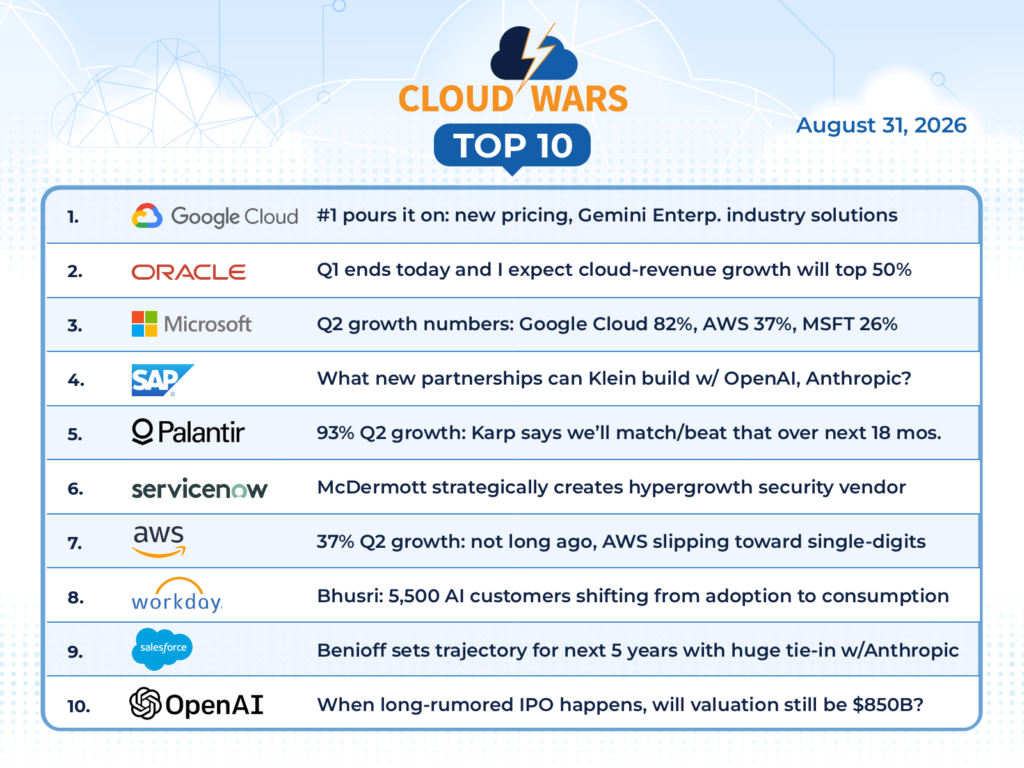


While Workday CEO Aneel Bhusri is generally low-key and avoids the grandiose rhetoric that some tech-industry execs savor, the early success and near-term potential of his company’s AI products and strategy inspired Bhusri to be unconditionally bullish on last week’s Q2 earnings call.
“I’m an unabashed optimist, but I’m not leaning on optimism here,” Bhusri said in concluding his opening remarks on the Q2 call. “We’re shipping AI products, our customers are adopting them rapidly, and it’s happening across the board from the agents we built ourselves to the ones we’ve acquired.
“This is Workday’s moment and I’ve never felt better about where we’re headed.”
From that Q2 call, I’ve extracted eight strategic factors behind Bhusri’s optimism and I’ll share those in a moment, but first, here’s a quick look at key Q2 numbers:
- Subscription revenue up 13.9% to $2.47 billion;
- 12-month subscription-revenue backlog up 14.2% to $9.03 billion; and
- Projected FY27 subscription revenue: expected to grow 13% to about $9.945 billion.
Community Summit North America
The largest independent innovation, education, and training event for Microsoft business applications delivered by Expert Users, Microsoft Leaders, MVPs, and Partners.
Register
Workday also had some impressive AI-related numbers to report from Q2, and several of those are covered in my list of eight reasons why Bhusri is feeling more bullish than he has in his 20+ years at the company.
1. AI solutions drove $100M of new annual contract value, representing 25% of all new ACV closed in quarter.
2. AI products have reached an annualized revenue run rate of almost $600 million, up more than 200% year-over-year and up over 20% from last quarter.
3. 5,500 Workday customers are now using one or more of its organic agents.
4. The power of trust: “Last quarter, I told you I hadn’t met a single customer looking to replace Workday with something they’re building internally or buying from a start-up,” Bhusri said. “One quarter later, that hasn’t changed.
“The reason is the deterministic rails I’ve talked about before. Our agents are lawful. They work inside the permissions, policies and business processes a company already runs on. That’s why our customers can trust them with the work that matters, and it’s why we’re seeing our organic agents really take off this year.”
5. The power of “enterprise context”: “I don’t think it’s fully understood that Workday is not just an enterprise-apps company. We’re an enterprise context platform, and we were built that way from the start. Agents need context to do anything useful — who reports to whom, what the policies are, how money moves. So whether a customer runs our agents or builds their own on top of Workday, we win either way.”
6. Rising AI adoption rates: President and chief commercial officer Rob Enslin said, “Over half of our net new wins in Q2 signed up for one or more AI solutions, and we’re seeing even faster AI adoption across our base as customers leverage our unmatched HR and finance context to truly unlock the value of AI in the enterprise.”
7. Built for AI: “Customers are making five-year, seven-year decisions on new platforms and AI is a huge decision point for them,” Bhusri said. “And if anything, it’s impacting our win rates on the platform because we’re viewed as the much stronger player in terms of an AI vision and AI agents than our legacy competitors that we all know so well.”
8. Fast-paced self-improving agents: “The difference on these agents versus traditional applications is that they iterate and become better so much faster,” Bhusri said. “So, I’m very optimistic that we’re going to see ramping up usage of these agents faster than we ever saw of our apps.”
Final Thought
Bhusri returned to the CEO role at the beginning of this year and promised to accelerate the pace of new-product introductions (that’s happening) and to reinvigorate the culture in a way that harkens back to Workday’s roots as a scrappy start-up.
So, it was a powerful testament to the new culture within the company when Bhusri noted that while the pace of product innovation and the pace of growth are both rising, headcount is flat or down.
And Bhusri also highlighted what he believes is the significant difference in AI capability Workday holds over what he always refers to as his “legacy” competitors: “These legacy companies might have six or seven different versions and as a result they can’t aggregate the data model to drive the AI models.
“So, we are just way ahead of where they can be, not just where they are now, but where they can ever be from that AI perspective in terms of driving outcomes using AI.”