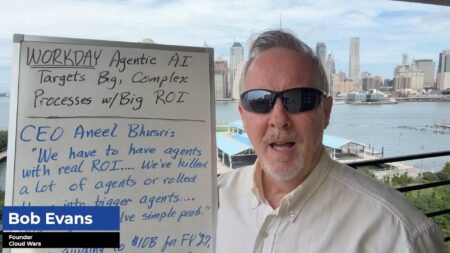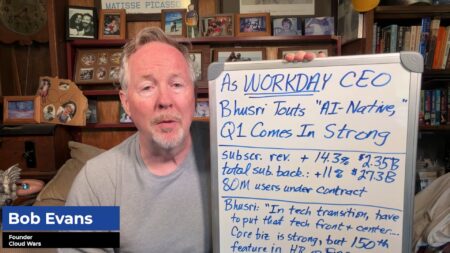

Workday’s strong Q1 performance highlights CEO Aneel Bhusri’s push to transform the company into an AI-native enterprise focused on agentic AI innovation, lawful governance, and accelerated product development to compete with SAP, Oracle, and Microsoft.
Workday
Returning CEO Aneel Bhusri says technology transitions require companies to make emerging technologies their absolute top priority.
The biggest AI opportunity in enterprise software may be reducing implementation friction, not simply adding generative features.
Despite strong optimism around AI adoption, Workday found that most enterprise users still act as intermediaries between AI tools, reducing productivity and undermining the promise of automation.
A conversation about enterprise AI readiness, governance challenges, and the next major growth opportunity in intelligent business applications.
Workday and Achievers are bringing AI-powered behavioral intelligence into HCM, helping enterprises strengthen engagement, productivity, and employee retention through integrated recognition tools.
While many predict AI will destroy enterprise software vendors, SAP’s Q1 2026 results tell a different story: cloud revenue rose 27%, Cloud ERP Suite grew 30%, and backlog climbed 25%, proving strong momentum.
Marc Benioff’s vision of the Agentic Enterprise places Slack at the core, transforming it into an operating system where AI agents collaborate with humans to drive productivity, innovation, and faster decision-making.
New AI platforms are eliminating data silos by integrating multiple enterprise systems into unified, intelligent workflows.
Agentic AI is transforming ERP implementations by automating design, testing, and support, reducing costs and accelerating delivery timelines significantly.
Rather than replacing SaaS, AI is becoming its most powerful accelerator. Oracle’s approach embeds agentic AI across Fusion applications, enabling faster deployments, reduced operational complexity, and dramatically improved customer outcomes.
Facing unprecedented pressure from customers navigating AI transformation, SAP, Oracle, and Workday are restructuring their sales organizations. Each company is simplifying customer engagement, flattening leadership structures, and aligning sales with services to deliver faster decisions and stronger outcomes.
In a rare alignment, SAP, Oracle, and Workday are simplifying sales models to reduce complexity and accelerate digital transformation for customers navigating the AI revolution.
Rejecting “SaaSpocalypse” fears, Aneel Bhusri argues AI will enhance enterprise applications rather than replace them. Workday’s strategy focuses on AI agents embedded within its HR and finance platform to drive new growth and customer value.
Workday is betting its future growth on blending AI agents with its existing HR and finance platforms, rejecting the notion that large language models alone can replace enterprise software.
Returning CEO Aneel Bhusri used Workday’s Q4 earnings call to dismantle claims that AI will replace ERP and HR systems, outlining instead a hybrid future where deterministic enterprise apps and probabilistic AI work together.
Workday cofounder Aneel Bhusri has returned as CEO following Carl Eschenbach’s departure, vowing to lead the company through what he calls its “most pivotal moment” as AI reshapes enterprise software and competitive dynamics.
Amid leadership change and fierce competition, Aneel Bhusri’s return underscores Workday’s need for product-centric vision during a defining shift toward AI-powered enterprise software.
SAP outperformed competitors like Oracle and Salesforce, growing its cloud business by 200% more than some rivals.
According to Workday’s AI study, only 14% of companies consistently get clear results from AI. Investing in people, not just tech, is what truly drives long-term value and productivity.