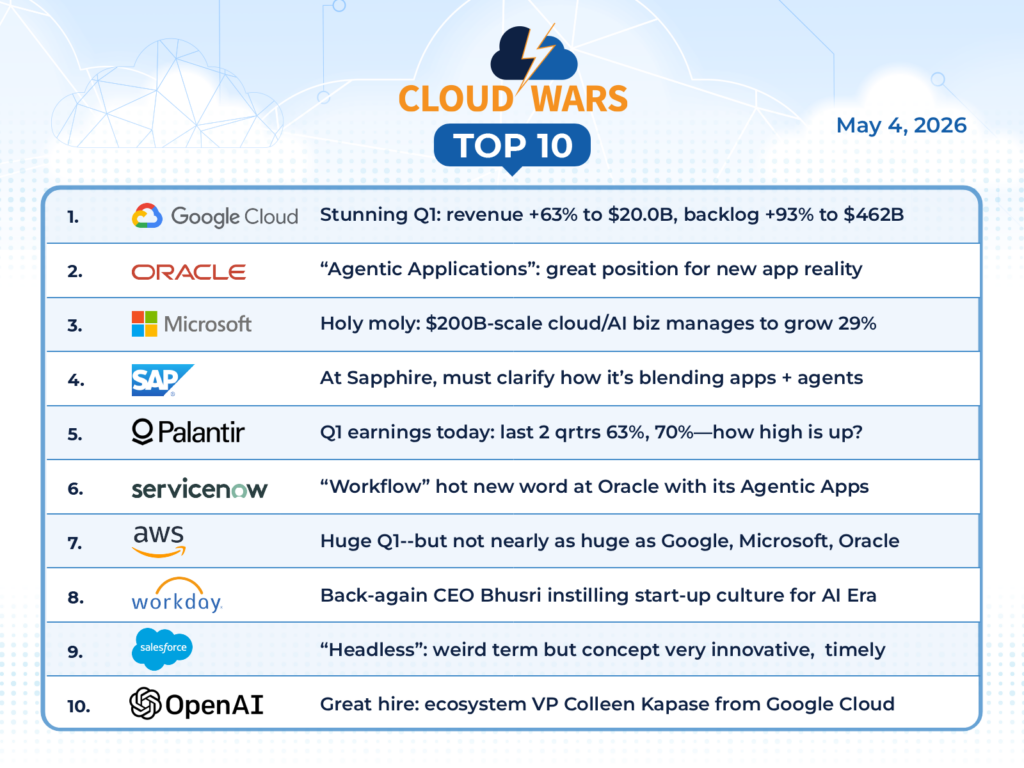



The combined backlogs of Google Cloud, Oracle, Microsoft, and AWS now total more than $2 trillion as the AI Revolution reshapes the global economy, transforms industries, radically changes the nature of work, and creates a growth market unprecedented in human history.
In the face of such staggering numbers, it’s important to note that each of the four hyperscalers has said that customer demand continues to outstrip data-center capacity, which further reflects not only the industry’s current scale but also its astonishing growth potential.
Because backlog and/or RPO represent fully contracted business that has not yet been recognized as revenue, these figures offer a powerful view into future demand and more specifically how those hyperscaler vendors are performing relative to one another as customers pick their strategic AI and cloud vendors for the future.
| Company | Q1 Growth Rate | Q1 Cloud Revenue | Backlog/RPO Growth | Backlog/RPO Total |
|---|---|---|---|---|
| Google Cloud | 63% | $20.0B | 93% | $462B |
| Oracle | 44% | $8.9B | 325% | $553B |
| Microsoft | 29% | $54.5B | 99% | $627B |
| AWS | 28% | $37.6B | 49% | $364B* |
| Total | $121B | $2.01T |
*AWS backlog of $364 billion does *not* include recent $100B Anthropic deal
It’s also important to bear in mind what these numbers are, and what they are not:
- They are: precise indicators of fully contracted business that will be converted to revenue in 2027 and beyond. Customers are legally required to pay the specified amounts, and vendors are legally required to deliver specified services and capacity.
- They are not: market estimates, representations of TAMs, projections, or guesstimates.
Just as the quarterly revenue figures reveal customer demand and the ability to meet it for the previous three months, so too do backlog and RPO numbers reflect future customer demand.
So, let’s take a look at the relative performances of the four hyperscalers (Google Cloud, Microsoft, and AWS numbers are for the quarter ended March 31, and Oracle’s for the quarter ended Feb. 28).
Google Cloud: Q1 marks the second straight quarter in which Google Cloud’s backlog has soared: in Q4, its backlog jumped 55% to $240 billion, and in Q1 those numbers both jumped dramatically: up 93% to $462 billion. This reflects a huge surge in customers making massive commitments to Google Cloud for its AI solutions as well as its core cloud-infrastructure and related technologies and services.
Community Summit North America
The largest independent innovation, education, and training event for Microsoft business applications delivered by Expert Users, Microsoft Leaders, MVPs, and Partners.
Register
Oracle: The RPO growth here is particularly impressive given Oracle’s relatively small revenue base as shown in the table above: $8.9 billion for its latest quarterly cloud revenue but an RPO total of $553 billion. For me, this raises a competitive-analysis question: how/why is a company with a relatively small current market presence like Oracle able to generate such massive customer commitments for the future? I believe this disparity reveals that while Microsoft and AWS dominated the cloud business of the past, Google Cloud and Oracle are going to be the leaders into the future.
Microsoft: Nadella & Co. deserve a great deal of credit for generating outstanding quarterly growth in not only revenue — up 29% to $54.5 billion — but also RPO — up 99% to $627 billion. But again, we see a big shift in perspective when we compare Microsoft’s dominance over Google Cloud and Oracle in quarterly revenue relative to its lead over them in backlog/RPO: Microsoft’s revenue for calendar Q1 is 2.7X bigger than Google Cloud’s and 6X bigger than Oracle’s, yet Microsoft’s lead over each of them in backlog/RPO is much, much smaller. And I say that’s not an aberration — rather, it is a clear sign of the shape of things to come.
AWS: For this, I’m going to ask you to take a quick hop over to my analysis from late last week — the headline is “Google Cloud Blows AWS Away on Q1 Backlog, Revenue Growth” — because it offers a lot of detail and analysis on AWS’s Q1. It also offers my rather obvious conclusion that AWS, by any measure, had an excellent Q1 — but as we’re learning here in the Cloud Wars and the AI Revolution, excellent is sometimes just not good enough.