


Google’s latest European research initiative signals a shift toward collaborative AI innovation, where technology developers provide the tools and scientific institutions establish the priorities for discovery.
Google’s latest European research initiative signals a shift toward collaborative AI innovation, where technology developers provide the tools and scientific institutions establish the priorities for discovery.

After achieving 82% revenue growth in Q2, Google Cloud could double its year-over-year revenue in Q3.

Google Cloud could deliver extraordinary Q3 revenue growth of 90% to 100%, fueled by AI momentum, accelerating quarterly gains, and an expanding ecosystem that continues to outperform major cloud competitors.

Google Cloud showcases 12 powerful Gemini Enterprise customer success stories, demonstrating how businesses are turning AI investments into cost savings, operational efficiency, and competitive advantage.
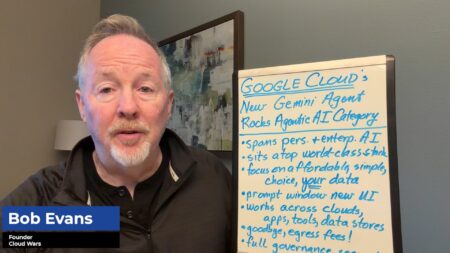
Google Cloud’s Gemini agent launch signals a broader shift in enterprise AI, as business leaders increasingly demand technology partners who understand operational priorities rather than simply promoting technical capabilities.

Explore how Google Cloud and Thales, alongside SAP and NVIDIA, are embedding security and governance into agentic AI workflows — and why industry collaboration could be key to building a safer, more trustworthy AI ecosystem.

Rather than forcing enterprises to integrate numerous complex modernization technologies themselves, Google Cloud is combining existing tools and new agentic AI capabilities into an end-to-end architecture designed to dramatically accelerate legacy technology transformation.

Google Cloud is simplifying enterprise modernization with an AI-driven, end-to-end approach that can shrink complex business-case processes from weeks to minutes.

AI demand is propelling the Cloud Wars Top 10 to extraordinary growth, led by Palantir at 93%, Google Cloud at 82%, and Oracle at 62%, with all three companies also demonstrating sustained quarterly growth acceleration.
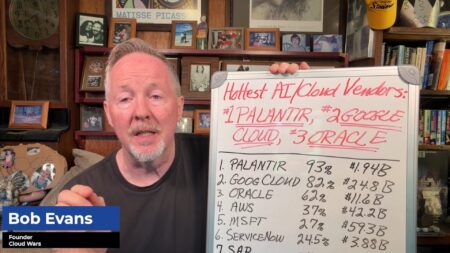
Palantir leads the Cloud Wars Top 10 with 93% growth as Google Cloud, Oracle, and AWS surge and AI platforms drive extraordinary enterprise demand.

AI leaders are accelerating their push into vertical industries through customer-designed products, deeper data integration, and industry-specific skills.
Extended, powerful partnerships will prove to be just as important as the expanding AIforce, as Salesforce challenges the traditional mindset with its approach to the future of tech.
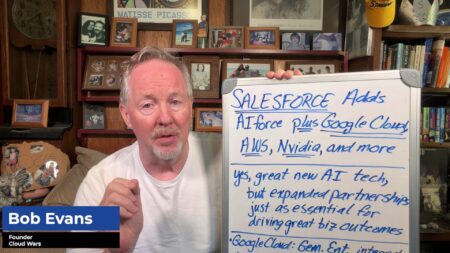
CEO Marc Benioff explained in his Dreamforce keynote how Salesforce unlocks value for customers beyond its AIforce through extended partnerships.

Google’s Fairwind Program combines CodeMender with Gemini-powered cybersecurity AI to help 650+ trusted organizations discover vulnerabilities, generate verified patches, and automate security remediation.

Google Cloud CEO Thomas Kurian says general-purpose AI alone cannot meet complex industry requirements, prompting the company to surround Gemini Enterprise with specialized skills, trusted data connections, agentic workflows, governance, and partner solutions.
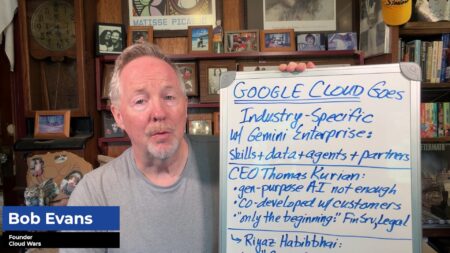
Google Cloud is taking Gemini Enterprise deep into vertical industries, beginning with financial services and legal and combining skills, data, agents, and partners into one AI system.

Law firms that collaborated in platform design highlight industry AI opportunities to eliminate manual work and drive innovation for better client service.

On the strength of customer design partnerships and an expansive ecosystem, Google Cloud delivers AI platforms that could unlock AI innovation in support of vertical use cases.

Google Cloud and Mahindra are bringing Gemini Enterprise directly into vehicles, demonstrating how AI is moving beyond traditional digital environments and becoming embedded in physical-world endpoints.

Google Cloud’s Gemini models are coming to Oracle applications, including Oracle AI Agent Studio for Fusion Applications, giving customers more flexibility to select models while turning AI reasoning into governed workflows, approvals, transactions, and business actions.