


Despite investor concerns over rising CapEx, Alphabet believes aggressive AI infrastructure spending will generate multiyear returns as enterprise AI adoption accelerates across industries.
Despite investor concerns over rising CapEx, Alphabet believes aggressive AI infrastructure spending will generate multiyear returns as enterprise AI adoption accelerates across industries.

Alphabet is embracing massive AI infrastructure investments despite investor backlash, betting that today’s spending will secure tomorrow’s cloud leadership.

Google Cloud’s $4.8 billion sequential revenue increase establishes a new benchmark for Microsoft Cloud and AWS as investors prepare for their upcoming earnings reports.

Explosive Q2 results suggest Google Cloud is outperforming rivals where it matters most—winning new AI business and accelerating faster than Microsoft Cloud and AWS.

Google Cloud and Palantir are accelerating faster than many AI competitors because customers value measurable business transformation over technical benchmarks such as model size or context windows, creating exceptional momentum in the rapidly expanding AI economy.

Google Cloud and Palantir are entering Q2 earnings with industry-leading growth, driven by AI-native strategies, customer trust, and differentiated execution.

As Q2 earnings approach, Palantir, Google Cloud, and Oracle lead the Cloud Wars Top 10 in revenue growth, highlighting the extraordinary pace of the AI market and the massive backlog fueling future expansion.

Palantir leads the latest Cloud Wars rankings as Bob Evans previews Q2 earnings and explains why cloud and AI remain the world’s fastest-growing technology market.

The world’s largest cloud providers are embracing innovative financing, partnerships, and infrastructure strategies as unprecedented AI demand drives what may become the largest industrial construction effort in modern history.

Google Cloud is separating itself from Microsoft and AWS by relying entirely on partners to deliver enterprise AI deployments and agentic transformation.

The new AI Deployment Wars reveal that enterprise customers need more than technology: they need strategy, process modernization, secure integration, and change management.

The world’s leading AI companies are investing nearly $10 billion to ensure AI deployments generate measurable business outcomes rather than simply impressive technology.

Google Cloud, OpenAI, and Anthropic are investing heavily in deployment capabilities, ecosystems, and forward-deployed engineers to help customers achieve measurable business outcomes and accelerate enterprise AI adoption beyond model selection.
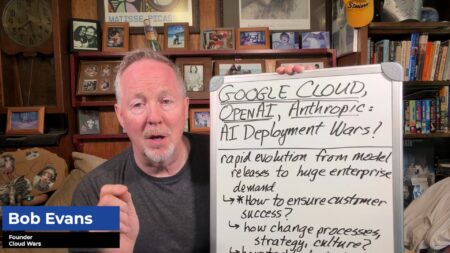
The race to transform enterprises through AI is creating unprecedented demands for deployment expertise, customer success, and organizational change management.

IBM and Google Cloud have launched a new Google Cloud Practice designed to help organizations accelerate AI deployments by combining IBM Consulting expertise with Google Cloud’s Gemini Enterprise Agent Platform, cybersecurity capabilities, and advanced data technologies.

Google Cloud and Palantir are expanding their partnership to help businesses combine AI, data, and analytics for faster decision-making and stronger industry-specific outcomes.

Google Cloud and Palantir have formed a strategic partnership that combines enterprise data, AI, and industry expertise to help organizations accelerate digital transformation and AI adoption.

The Hyperscaler Backlog Sweepstakes defines the top AI factories, ranking Google Cloud, Oracle, Microsoft, and AWS in the top four.

The Hyperscaler Backlog Sweepstakes — including Oracle, Microsoft, Google Cloud, and Oracle — have led to a backlog total of $2.1 trillion.

Google Cloud’s agreement with EQT could accelerate AI adoption faster than conventional sales strategies by reaching hundreds of companies through a single partnership.