

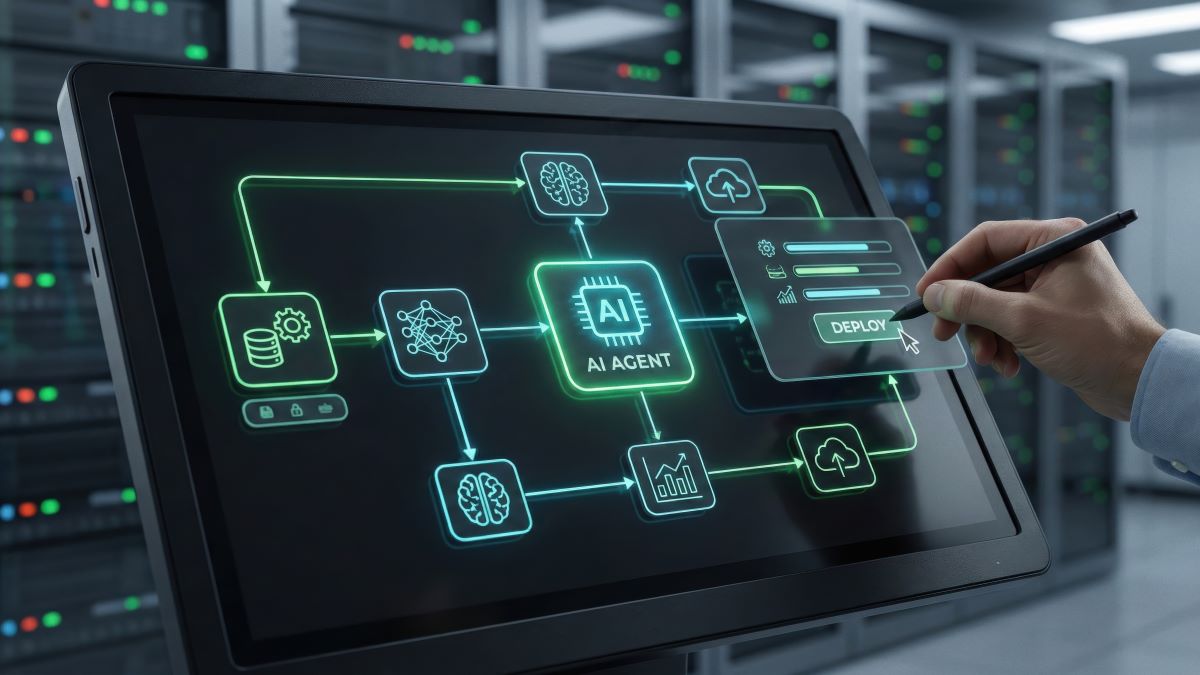
Counterbalancing the dizzyingly rapid pace of AI-tech innovation, the three leading AI model providers have each launched massive efforts to ensure enterprise customers achieve significant and quantifiable business outcomes with the help of vendor-employed FDEs and AI-expert ecosystem partners.
While business customers are certainly open to increasingly powerful and capable AI models, that’s not their top AI priority — instead, their primary concern is ensuring that their organizations are:
- focusing every dollar of AI investment to clear business outcomes;
- prioritizing those investments based on optimal business impact;
- re-imagining not just business processes but also business models, product strategy, customer-engagement models, and more;
- addressing powerful cultural upheavals that AI deployments will trigger;
- envisioning and planning for new roles, new org structures, and new compensation models; and
- shaping a new type of corporate culture that pursues and embraces AI-powered opportunities rather than trying to jam AI into old ways of operating.
Now, that’s clearly a daunting to-do list, and the challenge only heightens when we introduce the factor of speed, because all of that has to be achieved in months or perhaps a quarters because across the global economy the pace of change is soaring.
And that’s why the three companies with the leading enterprise AI models — Google Cloud, OpenAI, and Anthropic — have all taken huge steps in building out new deployment models that blend:
- strategic thinking that looks at where a business is today, where it wants to be tomorrow, and what it intends to look like when it gets there;
- extremely deep technical knowledge, particularly around AI but also enterprise architecture, security, data management, integration, networking, and more;
- industry-specific expertise to map deployments to not only market requirements and regulations but also fast-changing realities; and
- unswerving commitment to surpassing customers’ expectations.
Against that backdrop, let’s take a look at how each of these extraordinary companies intends to translate the immense technical capabilities of their AI technologies into widespread and ongoing customer transformation and success.
1. Google Cloud
The AI Deployment Wars got started earlier this year when Google Cloud — the #1 company on the Cloud Wars Top 10 — announced a $750-million fund to support agentic-AI development across the company’s world-class partner ecosystem. While Google Cloud is expanding and enhancing its overall program and I’ll be exploring those new offerings next week, here’s an excerpt from my April 29 analysis headlined “Agentic AI Wars: Will Microsoft, AWS Match Google Cloud’s $750 Million Ecosystem Investment?“.
As you read this overview, keep in mind that Google Cloud is differentiating itself from both OpenAI and Anthropic in putting the vast majority of its deployment investments into its ecosystem partners, rather than creating vendor-owned deployment companies as OpenAI and Anthropic are doing:
Here’s Kevin Ichhpurani, president of Google Cloud’s global ecosystem, on why the company is enhancing and intensifying its go-to-market efforts in parallel with the company’s remarkable pace of agentic AI tech innovation:
“Our partners play a critical role in enabling the Agentic Enterprise, and today we are also announcing new resources, technologies, and deep technical partnerships to ensure we offer customers the industry’s most capable partner ecosystem for the agentic era, including:
- A $750 million partner fund for agentic development applicable across global consulting firms, software partners, and our channel partners.
- New ways for customers to deploy partner agents in Gemini Enterprise.
- Deeper and more technical partnerships with global consulting firms to support customers, including with new teams of Google forward deployed engineers.
- Integrating Gemini models more deeply into enterprise platforms from Palantir, Salesforce, SAP, ServiceNow, and more.
- More AI-powered features in Google Cloud Partner Network to help our partners deliver high quality services.“
And in today’s AI-obsessed business world, what are Google Cloud’s priorities for the $750 million its pumping into its partner ecosystem? Here’s how Ichhpurani framed it:
“This funding will support a wide range of activities including:
- Hands-on support for software companies to build AI agents into their products with the Gemini Enterprise Agent Platform and bring them to market through our Agent Marketplace and through the new Agent Gallery in Gemini Enterprise.
- Expert Google forward deployed engineers (FDEs) who will partner with major systems integrators to help their customers solve deep technical challenges and deploy Google AI more rapidly.
- Deployment and usage incentives to help services partners thrive in the agentic era.
- Training, technical development initiatives, and workshops to help partners build and deploy agents for customers using Gemini Enterprise Agent Platform.“
Community Summit North America
The largest independent innovation, education, and training event for Microsoft business applications delivered by Expert Users, Microsoft Leaders, MVPs, and Partners.
Register
2. OpenAI
After recruiting Salesforce executive Denise Dresser as CRO earlier this year, OpenAI hired ecosystem leader Colleen Kapase from Google Cloud to build out its partner program. To meet the highly demanding deployment needs of its clients, OpenAI has rolled out a two-part program involving OpenAI forward-deployed engineers as well as a large and fast-growing ecosystem under Kapase.
I explored the OpenAI plan in detail recently in an analysis headlined OpenAI Deployment Blitz Pumping $4.15 Billion into Partners, FDEs, and this excerpt shares some of the key elements of the OpenAI strategy:
I was heartened to see that while OpenAI is one of the world’s pre-eminent AI-technology companies, the focus of its partner network will be on driving quantifiable customer outcomes rather than deep debates over technology superiority. From the OpenAI press release:
“Instead, it’s how organizations repeatably identify the right use cases, redesign workflows, integrate with existing systems, and drive adoption and change management at scale.
Helping every organization adopt OpenAI frontier models and products and turn them into measurable impact requires an ecosystem of trusted partners with deep industry expertise, global delivery capacity, and customer relationships….
Organizations across every industry are ready to transform how they operate with AI. But executing that change well requires both access to frontier models and clear strategy, secure integration with enterprise systems and data, workflow redesign, responsible deployment, and change management that helps people adopt new ways of working.
To help the partners within its new network match the speed and intensity of OpenAI’s aspirations, the Partner Network has a $150-million investment fund to “help partners bring the benefits of AI to more organizations more quickly.”
One other insight into OpenAI’s aspirations is the company’s commitment to having 300,000 certified consultants in place by the end of the year. Assuming the current number of certified consultants is pretty low, that’s a torrid pace OpenAI is mapping out: about 50,000 per month, or about 170 newly certified OpenAI partner consultants every single day, seven days a week, through the end of 2026.
3. Anthropic
It is certainly not coincidental that OpenAI and Anthropic announced their deployment-company plans at almost exactly the same time. As the companies emerge from the deep-tech lab phase of their development to sophisticated customer engagements rewriting how the global economy operates, each has enormous incentive to gain first-mover status.
Like OpenAI, Anthropic says its deployment strategy includes a combination of its own FDEs in a new deployment company and also a broad partner ecosystem. Here’s a relevant excerpt from the Anthropic announcement:
Anthropic, Blackstone, Hellman & Friedman, and Goldman Sachs announced the formation of a new AI services company. The organization will work with mid-sized companies across sectors to bring Claude into their most important operations. Applied AI engineers from Anthropic will work alongside the firm’s engineering team to identify where Claude can have the most impact, build custom solutions, and support customers over the long term.
Alongside the founding partners, the new company is backed by a consortium of leading alternative asset managers including General Atlantic, Leonard Green, Apollo Global Management, GIC, and Sequoia Capital.
Why we’re building this
Putting Claude to work in an organization’s core operations takes hands-on engineering and deep familiarity with how each business runs. Systems integrators in the Claude Partner Network lead that work for the world’s largest enterprises today, and we are continuing to invest deeply in those partnerships as Claude reaches more customers. This new firm extends that delivery capacity further. Companies from community banks to mid-sized manufacturers and regional health systems stand to gain from AI, but lack the in-house resources to build and run frontier deployments.
“Enterprise demand for Claude is significantly outpacing any single delivery model. Our partnerships with the world’s leading systems integrators are central to how Claude reaches large enterprises,” said Krishna Rao, Chief Financial Officer of Anthropic. “This new firm brings additional operating capability to the ecosystem and capital from leading alternative asset managers. We are proud to build it alongside Blackstone, Hellman & Friedman, Goldman Sachs, and our other partners.”
Final Thought
Big dreams almost always call for big funding, and these three can certainly toe that line. The market cap of Google Cloud parent Alphabet has been above $4 trillion for several months, while OpenAI and Anthropic are both preparing for IPOs that should each raise more than $1 trillion.
To me, the biggest differentiator among the three is Google Cloud’s unwavering focus on giving its world-class ecosystem the opportunity and responsibility for meeting the agentic AI deployment needs of large and midsized customers across the globe. That approach is fully consistent with everything Google Cloud has done since Thomas Kurian became CEO seven years ago and turned it into the world’s leading AI and cloud provider, culminating in Q1 growth of 63% to $20 billion.
That’s not to say that the blended approach from both OpenAI and Anthropic is either wrong or misguided — at this stage of their overall development, it makes sense for them to add their own FDEs into the mix.
Ultimately, while this extreme competition will certainly be heavily influenced by technical superiority, I think the real measure of success will come in these re-imagined deployments for customers betting their futures on leveraging AI — and particularly agentic AI —for sustained innovation and growth.