


AI demand is propelling the Cloud Wars Top 10 to extraordinary growth, led by Palantir at 93%, Google Cloud at 82%, and Oracle at 62%, with all three companies also demonstrating sustained quarterly growth acceleration.
AI demand is propelling the Cloud Wars Top 10 to extraordinary growth, led by Palantir at 93%, Google Cloud at 82%, and Oracle at 62%, with all three companies also demonstrating sustained quarterly growth acceleration.

Palantir leads the Cloud Wars Top 10 with 93% growth as Google Cloud, Oracle, and AWS surge and AI platforms drive extraordinary enterprise demand.

AI leaders are accelerating their push into vertical industries through customer-designed products, deeper data integration, and industry-specific skills.
At Salesforce Dreamforce, Sam Altman discussed the accelerating capabilities of AI models, the risks of concentrated power, and the need for safety, while offering a striking account of OpenAI’s involvement in a Hugging Face security incident.

Sam Altman’s Dreamforce conversation with Marc Benioff offers a revealing look at OpenAI’s thinking around AI safety, security, industry regulation, and corporate responsibility.

Microsoft is bringing OpenAI’s GPT-6 Astra to Foundry, combining advanced agentic capabilities with enterprise security, compliance, governance, and identity controls.

OpenAI is reportedly developing automated AI shutdown capabilities as proposed U.S. legislation seeks government power to halt models that threaten human life or the economy.

OpenAI’s decision to wind down its Cursor contract highlights how trust between technology providers is becoming increasingly critical as the AI ecosystem grows more interconnected.
OpenAI prominently outlined plans for a unified AI superapp in March, but CFO Sarah Friar’s August description of the company’s AI-native stack makes no mention of it, raising questions about whether OpenAI has changed its strategy.

OpenAI once prominently promoted an AI super app, but its disappearance from Sarah Friar’s latest strategic update raises questions about whether the concept has quietly become vaporware.

The launch of ChatGPT for Teens highlights a broader shift in AI competition, as technology companies increasingly compete not only on model capabilities but also on trust, safety, education and their ability to build lifelong user relationships.

Microsoft is reportedly tightening controls on internal AI token consumption, urging employees to choose models based on tasks and focus on business outcomes. The shift highlights growing enterprise pressure to balance AI performance with rapidly expanding infrastructure costs.

OpenAI has responded to the GPT-5.6-Sol security incident involving Hugging Face by strengthening cybersecurity safeguards, expanding its Daybreak program, and introducing GPT-5.6-Cyber for vetted defenders conducting advanced vulnerability research and security testing.

AI vendors are moving toward consumption-based billing as rising token costs make traditional flat-fee and user-based licensing increasingly difficult to sustain.

SAP is approaching a potential $30 billion cloud business as its partner-led strategy continues to outpace traditional enterprise software competitors.

A screenless AI companion from OpenAI could redefine smart home technology by combining conversational AI with contextual awareness and adaptive personalization.

Users can securely connect information from Apple Health and supported medical records for detailed personal medical insights.

Google Cloud and Palantir are accelerating faster than many AI competitors because customers value measurable business transformation over technical benchmarks such as model size or context windows, creating exceptional momentum in the rapidly expanding AI economy.
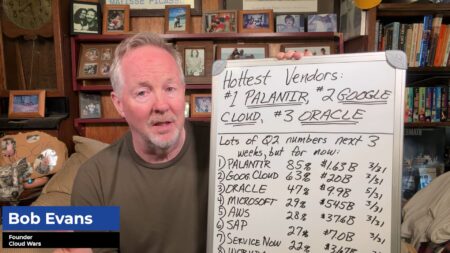
Palantir leads the latest Cloud Wars rankings as Bob Evans previews Q2 earnings and explains why cloud and AI remain the world’s fastest-growing technology market.

Hyperscalers are embracing unprecedented financing strategies and partnerships as AI demand forces massive investments in next-generation data center infrastructure.