


Google Cloud’s $750 million investment in partner training and certification reflects its belief that customers benefit most when trusted partners lead AI transformation initiatives.
Google Cloud’s $750 million investment in partner training and certification reflects its belief that customers benefit most when trusted partners lead AI transformation initiatives.
OpenAI has enhanced ChatGPT Health with GPT-5.5 Instant, delivering more accurate health guidance through physician-led evaluations, improved reasoning, and better recognition of urgent medical situations for hundreds of millions of users.

The new AI Deployment Wars reveal that enterprise customers need more than technology: they need strategy, process modernization, secure integration, and change management.

The world’s leading AI companies are investing nearly $10 billion to ensure AI deployments generate measurable business outcomes rather than simply impressive technology.
Jalapeño represents OpenAI’s first major move into custom AI hardware, combining the company’s AI architecture expertise with Broadcom’s semiconductor manufacturing capabilities to deliver faster, more energy-efficient inference for large language models.

Enterprise AI growth increasingly depends on implementation expertise rather than model capabilities alone.

The AI market is entering a new chapter where execution and business outcomes matter more than proving technological capabilities.
As AI token demand surges, CEOs must take ownership of allocation strategy to ensure scarce AI resources drive business outcomes, not internal politics.
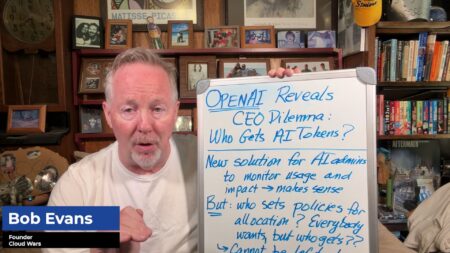
OpenAI’s new token management tool highlights a deeper challenge: CEOs, not AI administrators, must decide how scarce AI resources are allocated across the business.

Google Cloud, OpenAI, and Anthropic are investing heavily in deployment capabilities, ecosystems, and forward-deployed engineers to help customers achieve measurable business outcomes and accelerate enterprise AI adoption beyond model selection.
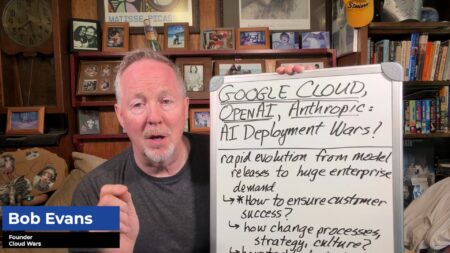
The race to transform enterprises through AI is creating unprecedented demands for deployment expertise, customer success, and organizational change management.
OpenAI has launched a global partner network backed by a $150 million fund, signaling a major commitment to enterprise AI adoption through ecosystem-driven customer transformation, workflow redesign, systems integration, and change management.
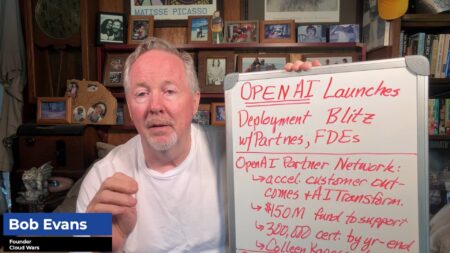
OpenAI is accelerating its enterprise AI ambitions with a new partner network, deployment company, and plans to certify 300,000 consultants by year-end.

A 363% surge in Oracle’s RPO demonstrates extraordinary customer demand and positions the company as one of the fastest-growing forces in enterprise AI and cloud computing.

OpenAI’s enterprise business is emerging as the company’s primary growth engine, already accounting for 40% of revenue and expected to reach 50% by the end of 2026, according to CRO Denise Dresser.
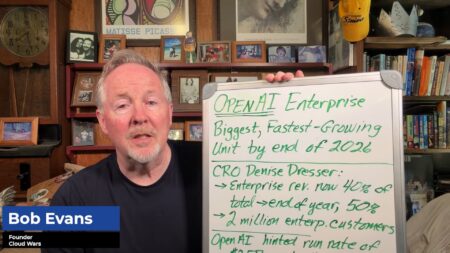
OpenAI’s enterprise business now accounts for 40% of revenue and could reach 50% by year-end, signaling a major shift toward enterprise AI leadership.
Case involving Nippon Life Insurance and OpenAI highlights ChatGPT’s status as a non-person AI tool, not a lawyer, amid alleged legal misuse.

SAP and Palantir are helping redefine enterprise technology, as Christian Klein and Alex Karp both argue that AI-driven execution has moved their companies beyond the traditional definition of software vendors.

OpenAI’s expanded AWS partnership signals a major shift toward cooperative AI ecosystems where competitors increasingly collaborate to accelerate enterprise adoption.

OpenAI’s latest Codex upgrades show the company rapidly evolving from standalone AI tools toward a unified “super app” where persistent AI agents can work across apps, retain memory, automate workflows, and increasingly act on behalf of users.