

While OpenAI, Microsoft, AWS, and Anthropic are launching new services companies to drive successful AI deployments for customers, Google Cloud is standing alone by choosing to funnel 100% of its booming AI-transformation business through its global partner ecosystem.
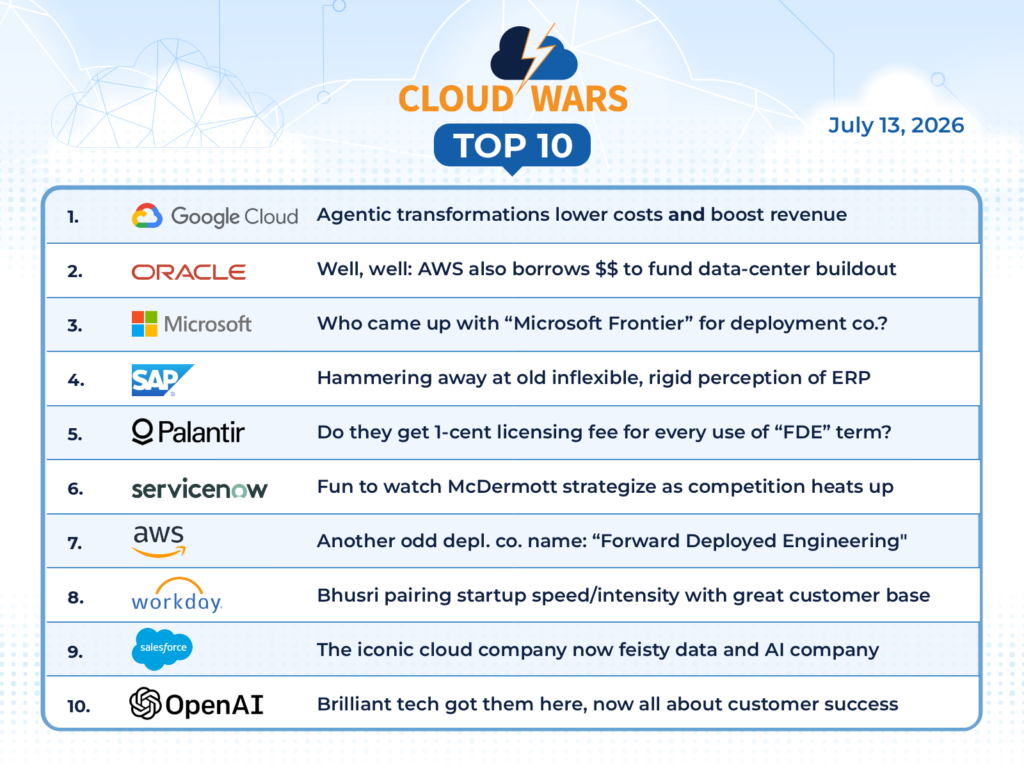
This distinctive differentiation buttresses my decision early this year to make Google Cloud the #1 company on my Cloud Wars Top 10 weekly rankings because it reveals yet again Google Cloud’s willingness to complement its market-leading AI technologies with highly innovative and effective go-to-market motions.
I can fully understand why the two relative newcomers to the enterprise market — OpenAI and Anthropic — would feel the need to buttress their customer-success aspirations by launching their own deployment organizations as well as relying heavily on ecosystem partners. After all, while OpenAI and Anthropic continue to demonstrate extraordinary innovation around AI technology that has captured the attention of business leaders across industries and across the globe, those two companies have precious little experience in turning all that tech wizardry into quantifiable business outcomes via production-level and highly secure integrations and deployments.
But, I’m scratching my head at the moves by AWS and Microsoft because their creation of FDE-powered deployment companies raises some basic questions:
- Is all this wild new AI technology so arcane that armies of specialists have to be brought in to bring it to heel?
- Both companies regularly boast about the world-class capabilities of their ecosystems — so why can’t those partners hire all the FDEs and lead the projects?
- Services businesses are never as profitable as software — is the deployment situation so dire that both AWS and Microsoft feel the need to jump into lower-profit businesses in order to ensure customers’ AI projects are scoped and implemented properly?
- Will the startup costs of those businesses keep growing over time? AWS is putting $1 billion into its new Forward Deployed Engineering company while Microsoft Frontier Company is being bankrolled by $2.5 billion. Will customer fees be enough to cover the considerable deployment-management expenses over time or will AWS and Microsoft have to pump more funds into their deployment startups?
Google Cloud Stands Alone
In contrast to those deployment-companies-plus-partners approaches from AWS and Microsoft, Google Cloud says its partners are taking and will continue to take the lead on all AI deployments.
On a recent analyst briefing, Kevin Ichhpurani, president of global ecosystem for Google Cloud, outlined that distinction and described his company’s total reliance on partners for deployments.
“The ecosystem is really a critical pillar in how we drive agentic transformation with our customers, and our strategy is quite a bit different than our competitors’,” Ichhpurani said.
“Rather than go down the process of building a Deploy Company, we have actively taken a very different approach in the marketplace of doubling down with our ecosystem to help drive this agentic transformation with our clients.”
In a series of slides, Ichhpurani quantified the results of Google Cloud’s decision to rely exclusively on its ecosystem for agentic deployments. The slide below shows the remarkable growth in partner-related revenue last year — up 80%, with an even steeper growth rate for partner bookings of 100%. Plus, partner solutions sold through the Google Cloud Marketplace soared 90% last year.
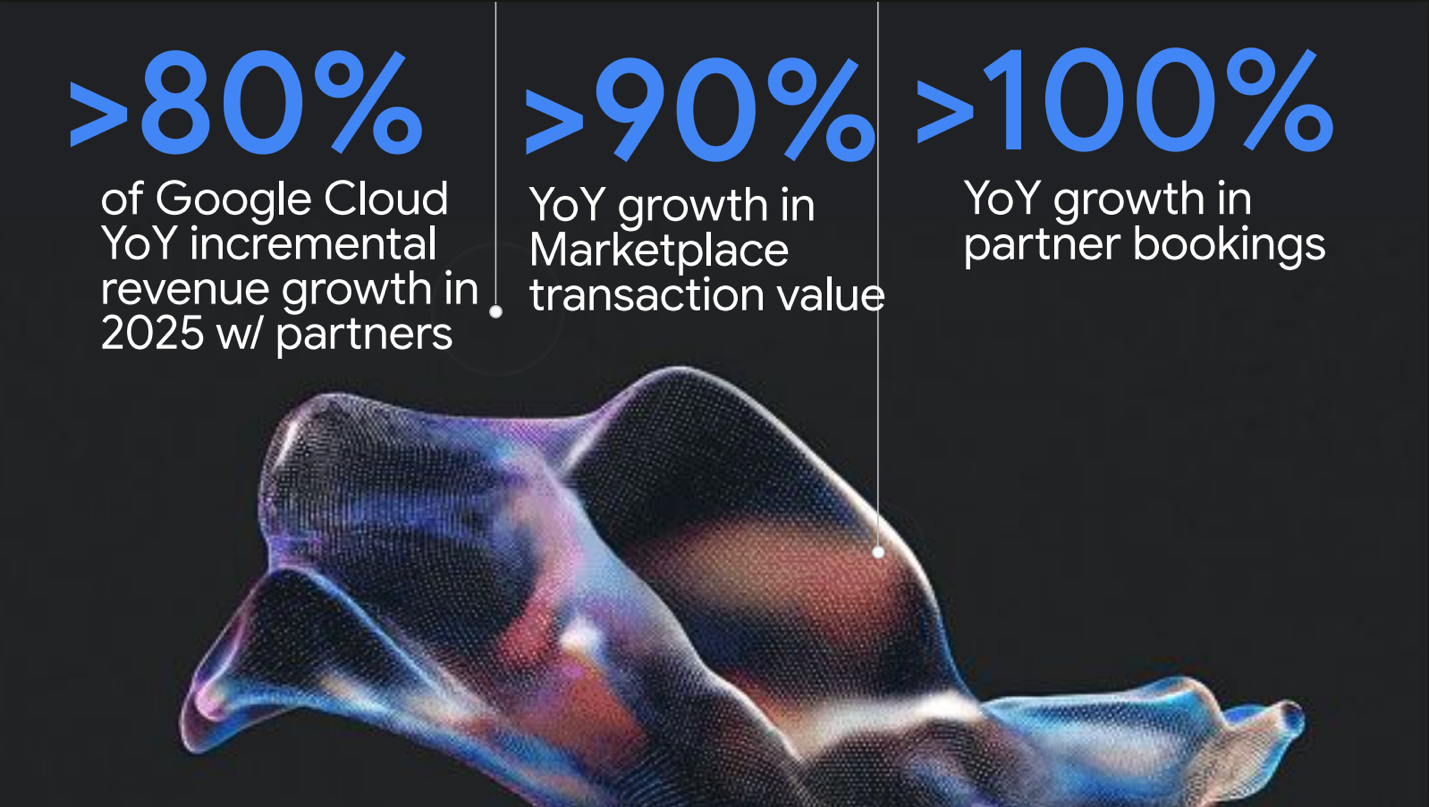
As you consider those figures from 2025, bear in mind that while Google Cloud experienced impressive growth last year, so far here in 2026 it is growing even more rapidly, which likely means that the numbers shown in the slide above could well be higher for 2026.
Partners as FDEs
While AWS and Microsoft, as well as OpenAI and Anthropic, are aggressively hiring, transferring, and training their own FDEs for their new deployment companies, Google Cloud believes the best way forward is to help build those forward-deployed capabilities within its partners ecosystem, along with expertise in industries, business processes, and change management.
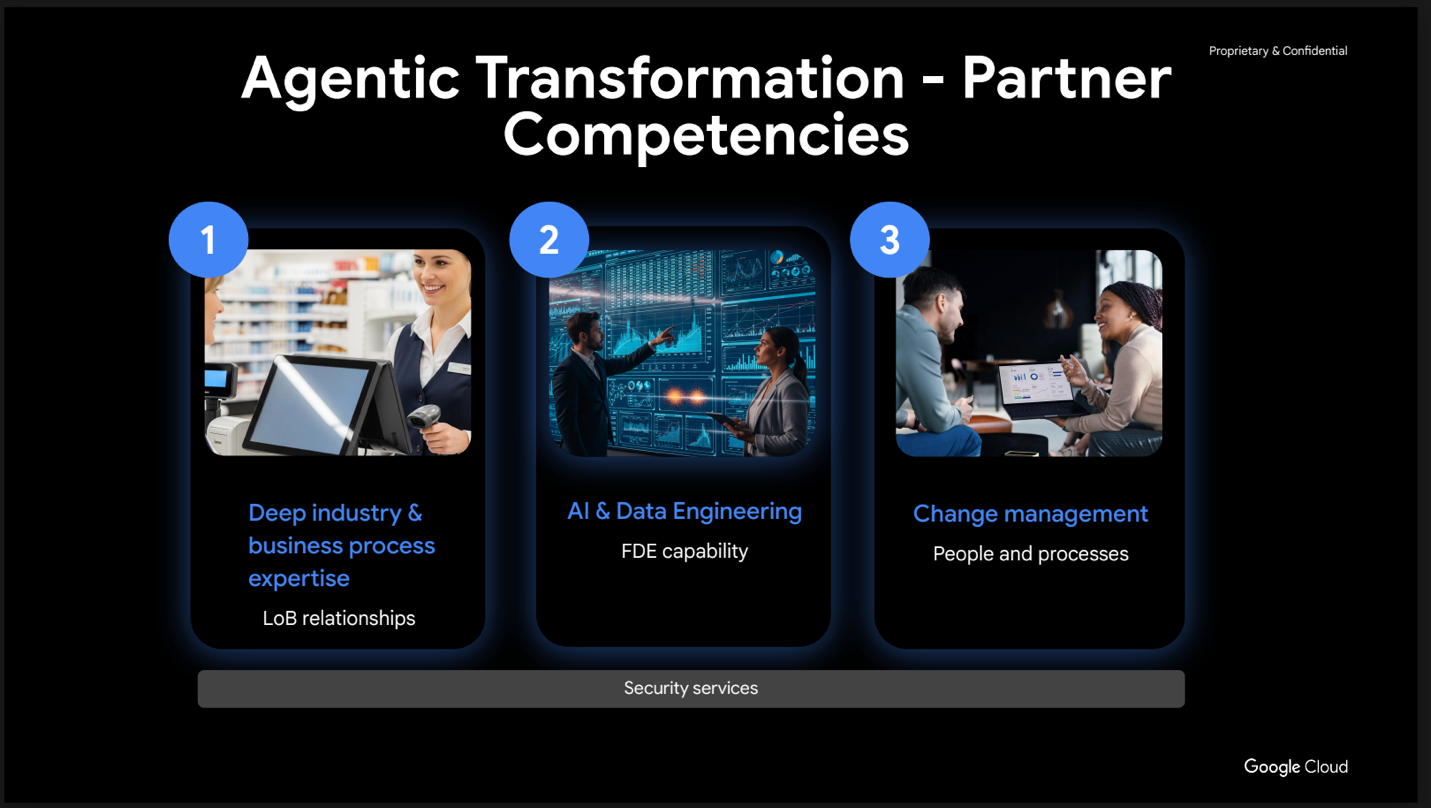
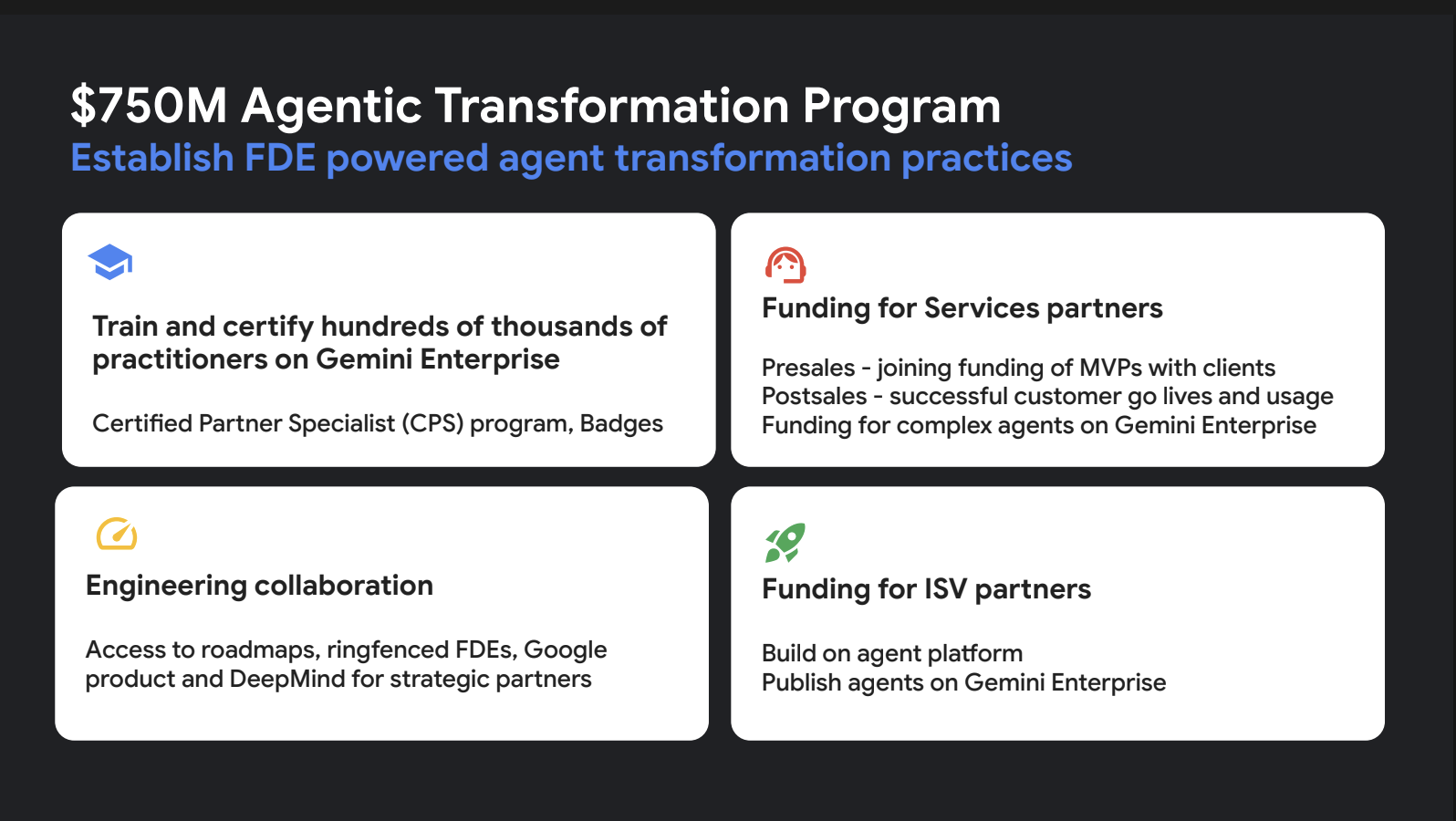
Recognizing that those skills are desperately needed, Google Cloud earlier this year established a $750-million fund to support agentic training and certification efforts across its ecosystem. As outlined in the slide below, Ichhpurani said Google Cloud is working in a variety of ways to help its partners become fully capable of delivering the agentic transformation customers are eager to undertake.
Ichhpurani used Verizon as a great customer example of how Google Cloud technology and partner expertise combined to deliver agentic transformation.
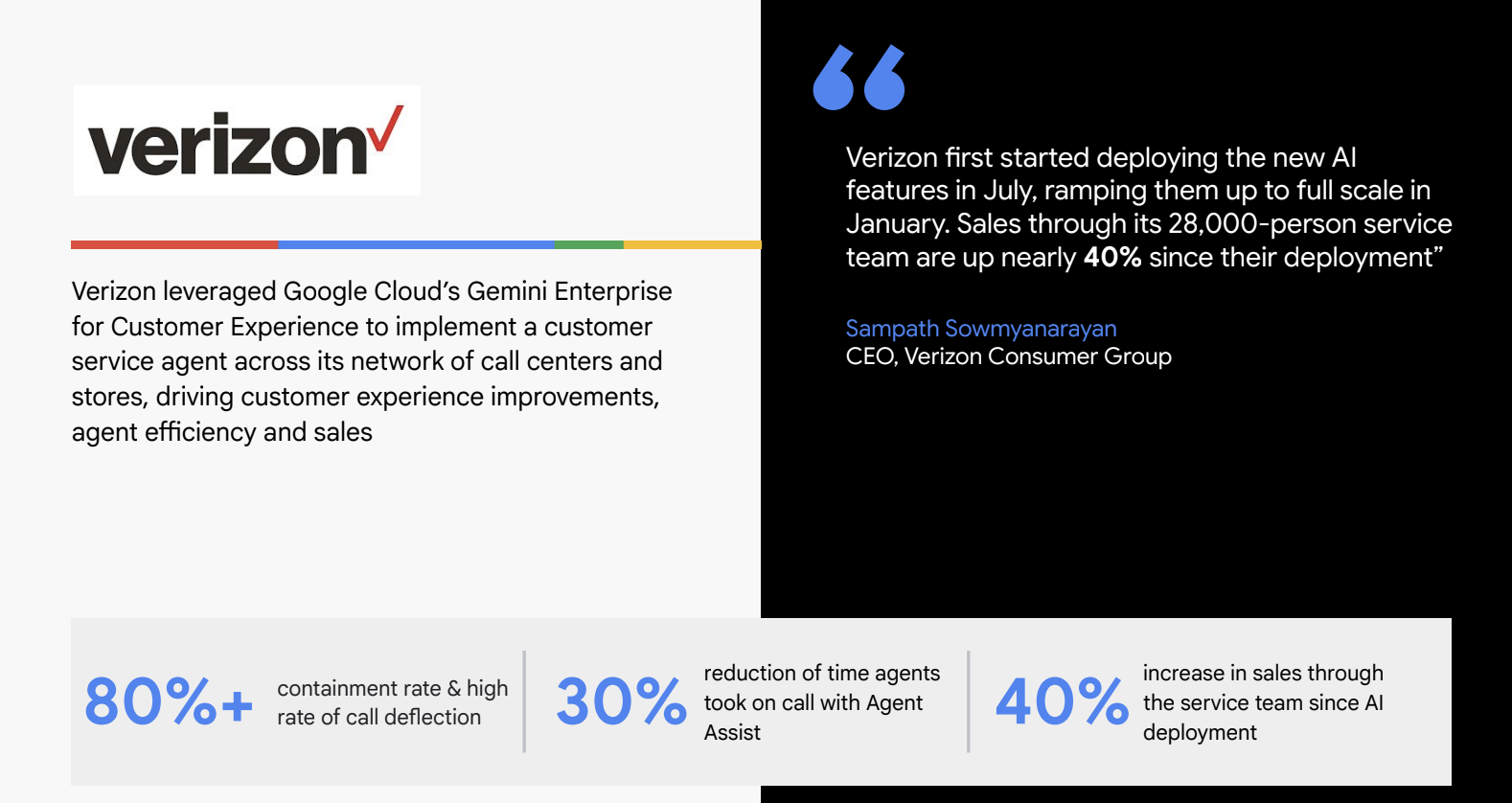
“One of Verizon’s big objectives was how do we transform all of the inbound calls and chats and automate the deflections rather than everything going to a live agent,” Ichhpurani said (you can see the results in the slide below).
“And we brought them from a 40% deflection rate to 80%. And why does that matter?
“Think of hundreds of millions of calls per year coming into a large telco and the typical cost per call is between $10 and $14. So the ROI gets into the billions of dollars,” he said.
“But we not only improved the deflection rate to 80% with our agents, but when somebody hits pound-zero and says ‘I want to talk to an agent,’ we can give turn-by-turn instructions to that live agent to make them more productive by 30%.
“And you can see the quote from the head of Verizon’s business that we have actually improved sales by 40% because we’re not just focused on cost take-out but also how do you dynamically cross-sell and up-sell those customers by providing better guidance to the sellers,” Ichhpurani said.
“So cost take-out combined with topline growth: this is really what we’re focused on with many customers.”
Final Thought
This nascent field of agentic transformation will be massive, with plenty of room for different approaches. But in looking at how five of the world’s largest and most-influential enterprise-AI companies are tackling the Deployment Dilemma, I’m struck by how four the five decided they needed an entirely new approach while the fifth — Google Cloud, the #1 company on the Cloud Wars Top 10 — decided that the best way forward is to double down on the approach that saw it grown a whopping 63% in Q1.