

Google Cloud has launched Google AI Threat Defense, an AI-powered cybersecurity platform designed to help organizations proactively identify, prioritize, and remediate threats while keeping pace with increasingly sophisticated AI-driven cyberattacks.
AWS
OpenAI’s expanded AWS partnership signals a major shift toward cooperative AI ecosystems where competitors increasingly collaborate to accelerate enterprise adoption.
AWS’s AI business has surged to a $20B run rate in just three years, vastly outpacing its early cloud growth. However, competitors like Google Cloud and Microsoft are growing faster, raising questions about AWS’s long-term dominance.
Hyperscalers hit a $2 trillion backlog milestone, signaling unprecedented AI demand while exposing capacity constraints that could reshape infrastructure strategies across Microsoft, AWS, Google Cloud, and Oracle.
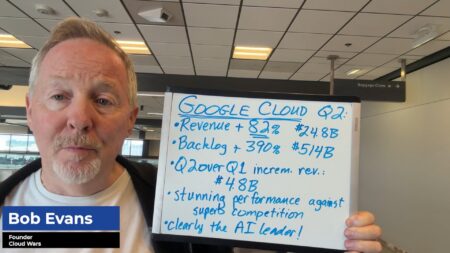
Google Cloud’s explosive AI-driven growth is reshaping cloud momentum, challenging AWS’s long-held leadership despite its larger market scale.
Google Cloud’s explosive Q1 growth and backlog dominance highlight a major shift in cloud leadership, overtaking AWS as AI-driven demand reshapes competitive dynamics among hyperscalers.
Google Cloud doubles down on the agentic AI race with a $750M ecosystem investment designed to accelerate partner innovation, enterprise adoption, and competitive momentum against Microsoft and AWS.
Google Cloud’s $750M ecosystem investment and major AI push signal an aggressive move to lead the agentic AI transformation race among hyperscalers.
Multi-cloud partnerships reveal a deeper divide in cloud leadership, where Oracle’s early moves enabled seamless cross-platform deployment, leaving AWS positioned as a delayed follower.
Google Cloud is rapidly gaining momentum in the AI-driven cloud market, outpacing AWS and Microsoft in growth rates while reshaping competitive dynamics despite still trailing both rivals in total revenue scale.
Despite Microsoft and AWS dominating in scale, Google Cloud’s Q4 performance suggests it may be capturing a disproportionate share of new enterprise cloud and AI workloads.
Multi-cloud databases are enabling faster AI adoption by bringing enterprise data closer to cloud-native tools and services.
The Cloud Wars Growth Chart shows extraordinary expansion across leading vendors as AI services drive demand. Palantir’s 70% growth leads the pack, while Google Cloud and Oracle also post dramatic gains.
AWS is seeing stronger-than-expected growth in non-AI workloads as enterprises accelerate cloud migrations. Jassy says both core infrastructure and AI services are driving demand, requiring rapid capacity expansion across data centers and power infrastructure.
With $500 million per day flowing into AWS, Amazon is making the largest infrastructure bet in corporate history to dominate the AI-driven cloud era.
By combining AWS AI capabilities with NTT DATA’s delivery scale, the partnership accelerates legacy modernization and responsible AI adoption in highly regulated sectors worldwide.
Hyperscalers are facing soaring AI demand, with Microsoft, Oracle, AWS, and Google Cloud reporting a massive $1.63 trillion backlog in contracted business not yet recognized as revenue.
The hyperscalers’ record-breaking CapEx surge reflects real AI demand, not a bubble, as backlog growth across the Cloud Wars Top 10 hits historic highs.
Google Cloud’s explosive Q4 growth surpassed Microsoft in incremental revenue, signaling a major shift in customer cloud spending and reshaping the Cloud Wars Top 10 rankings.
Despite a record-setting $35.6B quarter, AWS slid to #7 in the Cloud Wars as Google, Oracle, and Microsoft gained ground.