

As it grows more than twice as fast as rivals Microsoft and AWS and expands its innovative leadership in enterprise AI, Google Cloud has strengthened its #1 spot on the Cloud Wars Top 10 by launching an AI-powered and end-to-end cybersecurity solution offering “transformative vulnerability management.”
With cybercriminals aggressively adopting AI to devise and launch attacks that are increasingly sophisticated and damaging, the new Google AI Threat Defense goes beyond standard cybersecurity approaches from the pre-AI Era that are no longer intelligent enough, fast enough, or powerful enough to cope with this new wave of threats.
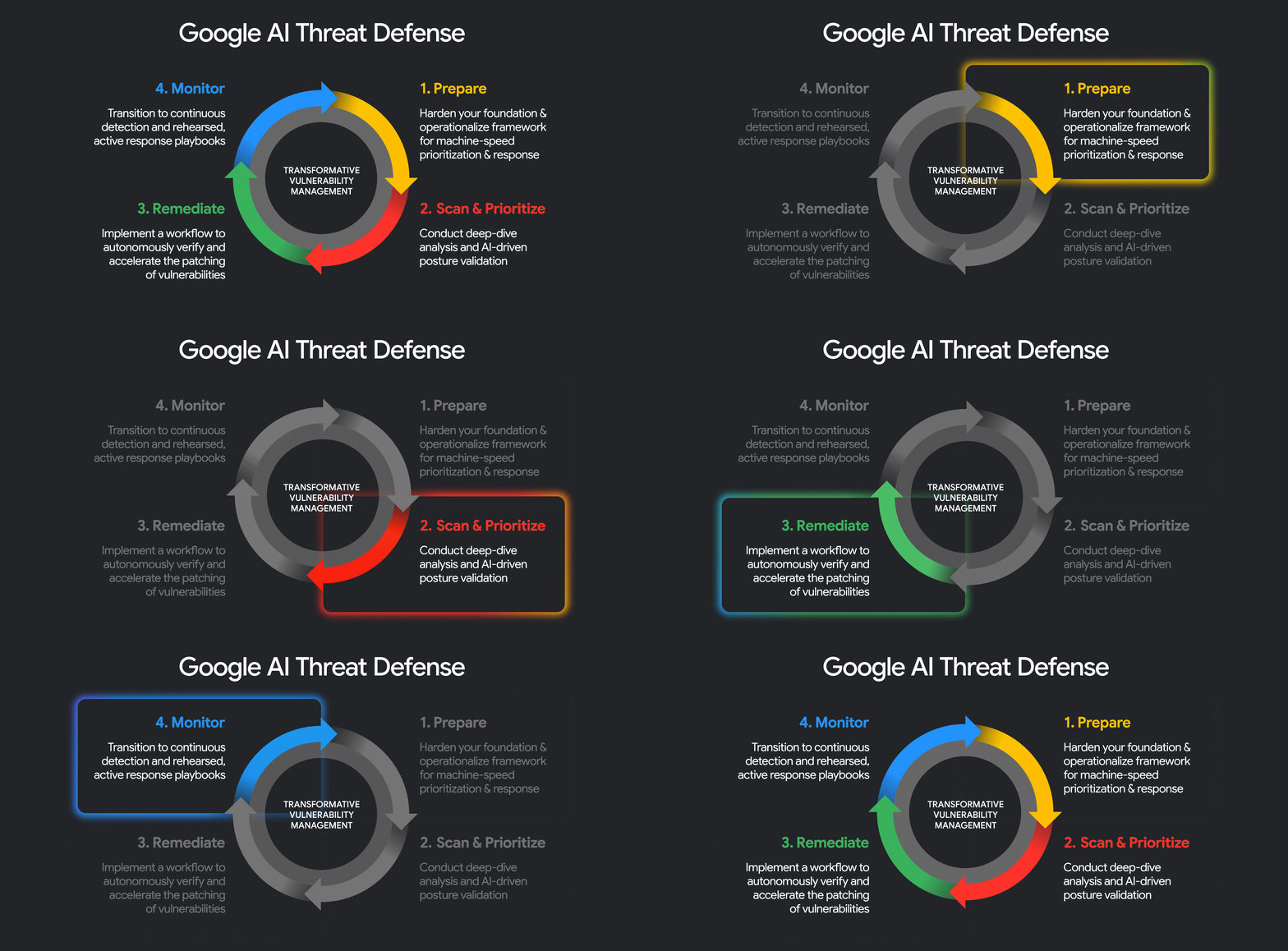
As shown in the diagram below, Google AI Threat Defense is designed to help businesses not simply react to attacks that are already underway, but also to give those customers an ongoing process centered on integrated preparation and analysis, real-time prioritization of threats, autonomous remediation, and nonstop monitoring and evaluation.
This highly advanced new cybersecurity is the brainchild of Google Cloud’s Francis deSouza, who is not only COO of the red-hot company — Q1 revenue soared 63% to $20 billion — but also president of Security Products.
In a blog post introducing Google AI Threat Defense, deSouza said the comprehensive new solution enables customers to “fight AI with AI” and will “ensure that your enterprise doesn’t just keep pace with automated adversaries, but consistently outpaces them.”
More from that deSouza’s post:
AI has changed the threat landscape; cybercriminals are using it to find security cracks faster than cybersecurity teams can manually fix them. Attacks that used to take weeks to carry out can now happen in mere hours or days. Organizations need to be able to keep pace and protect themselves against AI agent-driven, high-speed attacks — but they can no longer rely on legacy, manual methods.
To defend against this range of threats, organizations need more than one model or agent. No single model will catch everything, you want to use a collection of models for multiple passes. And you need a solution that can analyze your systems, prioritize the most significant threats, patch vulnerabilities quickly, and continuously monitor for new attacks.
While Google Cloud is relatively much smaller in revenue ($20 billion) than Microsoft Cloud ($54.5 billion) and AWS ($37.6 billion), as noted above, it is growing much more rapidly than its rivals and, for each of the past two quarters, has been winning as much or more incremental new revenue than either Microsoft Cloud or AWS.
As I have contended for the past two years, while AWS and Microsoft Cloud are clearly the biggest hyperscalers, the innovation leadership in both technology and go-to-market approaches has swung to Google Cloud and Oracle. Their stunning growth rates prove that contention as customers are recognizing that in the tumultuous AI Revolution, the latest and most-vaulable innovations are coming from Google Cloud and Oracle.
With Google AI Threat Defense, Google Cloud has yet again leapfrogged its larger but slower-moving competitors, particularly Microsoft. Two years ago, Microsoft CEO Satya Nadella and Security EVP Charlie Bell both revealed publicly that their security products, culture, and mindset had fallen so woefully behind that the company was completely revamping everything about its Security business. For more on that, please see “Microsoft Cybersecurity Failings Triggered Fall from #1 on Cloud Wars Top 10” and “Microsoft Cybersecurity Disaster Triggers Customer Doubt, Competitor Opportunity.”
In fact, Microsoft was so desperate for a completely new approach to cybersecurity that, earlier this year, it recruited Google Cloud executive Hayette Gallot to take over the large but troubled Security business.
Final Thought
This powerful move by Google Cloud is yet another indication of the enormous impact CEO Thomas Kurian has had on the company since joining as CEO seven years ago. From his earliest remarks at Google Cloud, Kurian described how customers needed and would continue to need stronger cybersecurity capabilities.
Kurian’s biggest step in addressing that need was the acquisition of Mandiant and its threat intelligence solutions three years ago, and the company recently completed its acquisition of Wiz, whose technologies are clearly the cornerstone of the new Google AI Threat Defense solution.
Community Summit North America
The largest independent innovation, education, and training event for Microsoft business applications delivered by Expert Users, Microsoft Leaders, MVPs, and Partners.
Register