


With Q2 cloud revenue up 24% and current cloud backlog up 26% to $26.3 billion, SAP expects to reach the consequential figure of $30 billion in cloud revenue for calendar 2026, underscoring its status as by far the fastest-growing major enterprise-apps and agents vendor.
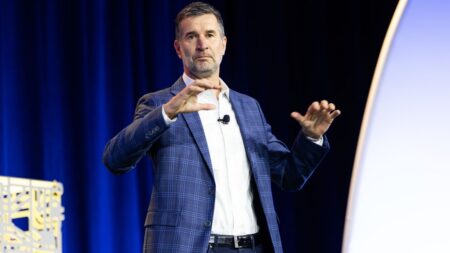
CEO Christian Klein cited the company’s revamped global partner ecosystem as a major factor behind that ongoing growth in both revenue and backlog as the 54-year-old company relentlessly overhauls both its product portfolio and go-to-market strategy to help customers move smoothly and rapidly into the nascent AI Economy.
Quick review of key Q2 numbers:
- Cloud revenue up 24% to $7.2 billion, including Cloud ERP Suite up 27% to $6.4 billion
- Current cloud backlog up 26% to $26.3 billion
- Full-year cloud-revenue guidance of about $30 billion, up 23% to 25%.
“Our indirect channel continues to be a strong growth pillar as its Q2 growth again significantly outpaced direct-channel cloud revenue, reflecting our successful go-to-market transformation over the last two years,” Klein said near the top of his opening remarks on last week’s earnings call.
The shift toward enhanced ecosystem involvement reflects an industrywide trend toward an intense focus on successful AI deployments, with the companies on the Cloud Wars Top 10 taking different approaches on how to deliver that AI-deployment success:
- Several companies have launched internal business units staffed with the now-ubiquitous Forward-Deployed Engineers, with Microsoft, AWS, and OpenAI (plus Anthropic, which is not yet on the Top 10) all going that route.
- Google Cloud has taken a different path by committing to having its global ecosystem take the lead on all AI deployments. Google Cloud president of global ecosystems Kevin Ichhpurani has said that the ecosystems’ expertise across technological, functional, and industry lines optimizes the chances that those deployments will result in great business outcomes for customers.
SAP appears to be leaning toward the ecosystem-led approach taken by Google Cloud, and SAP chief partner officer Karl Fahrbach has spent the last several years building a superb global network of SIs, ISVs, AI experts, and partners with functional and/or industry expertise to help ensure great business outcomes for customers.
Inside SAP, Klein said, the company is shifting people away from services now being handled by the ecosystem so that those SAP employees can focus on building AI capabilities. Klein made that point in discussing the factors behind companywide Q2 revenue rising 11% to $11.4 billion.
“This comes despite a slight decline in services revenue as we reallocate consultants to build agents and foster AI adoption,” Klein said.
Here are some other key Q2 highlights shared by Klein:
- AI in most large deals: “AI and SAP Business Data Cloud were embedded as key pillars in more than 90% of our 50 largest deals, giving us strong confidence for the second half of the year.”
- Cloud ERP migrations accelerate: A big factor behind the 24% growth in cloud revenue was “a solid execution of on-premise to cloud ERP migrations in our installed base.”
- Agents drive faster ERP migrations: “To accelerate our customers’ journey to the autonomous enterprise, we are also releasing three additional ERP migration assistants with 10 underlying agents later this quarter.
- Boosting developer productivity by 30%: “We are moving with full speed to turn SAP into an autonomous enterprise. In engineering and technology, we are transforming our operating model from software development to building AI at scale. We are doubling down on our ontology development with our best domain experts working on knowledge graphs for every industry and LOB…. By applying tools like low-code, we are also increasing overall developer productivity by up to 30%.
- Building agents in weeks: “We are accelerating innovation, targeting complete agent delivery in under three weeks.”
Final Thought
Earlier in this piece, I mentioned that SAP is now 54 years young, a stage at which many companies struggle to adapt and evolve with rapid changes in the world outside. Under Klein’s leadership, there’s been no chance for that sort of stifling stasis to set in — he’s shuffled his top executives, overhauled the flagship ERP portfolio, moved boldly and unconditionally into AI, and as noted above has unleashed SAP’s global ecosystem to become world leaders in customer success and sales growth.
Looking ahead, while there’s no doubt that old nemesis Oracle presents a major ongoing challenge to SAP’s leadership, I think the biggest threats to SAP come from OpenAI and Anthropic, although the nature and shape of those threats are still unclear.
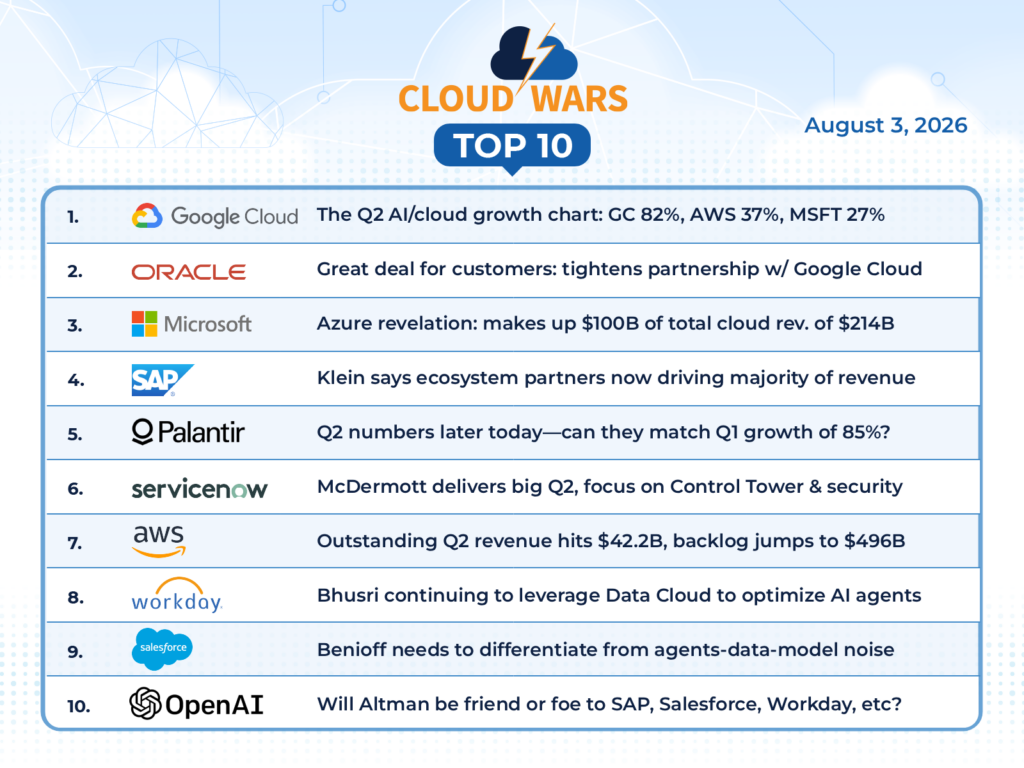
So, we should all expect Christian Klein to continue driving enormous change throughout the #4 company on the Cloud Wars Top 10 as he remakes his iconic company for driving customer success in the AI Economy.