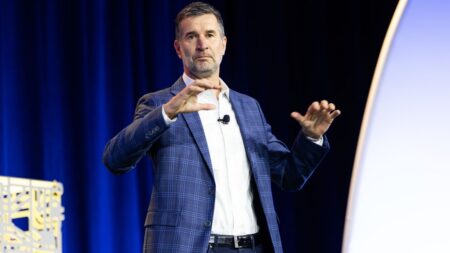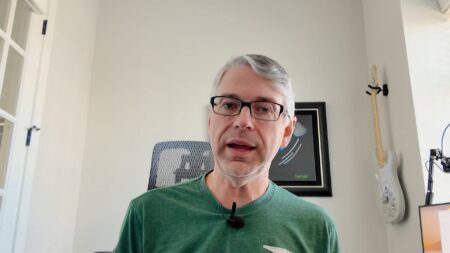



Bob Evans speaks with Chris Leone, Executive Vice President of Applications Development at Oracle, about Fusion Claw and Oracle’s push toward increasingly autonomous enterprise applications. Leone explains how Fusion Claw combines AI reasoning with deterministic enterprise computation to tackle complex, long-running work involving optimization, simulation, reconciliation, and planning.

The Rise of Fusion Claw
The Big Themes:
- From Assistance to Execution: Oracle’s vision for enterprise AI is moving beyond assistants that help employees complete individual tasks toward systems that can actually perform substantial portions of business work. Chris Leone describes Fusion Agentic Applications as being organized around outcomes rather than traditional application functions. Instead of navigating separate processes and modules, organizations can define an objective — such as paying employees accurately and on time — and allow agentic applications to continuously work toward it. Fusion Claw extends this model to harder, specialist-grade problems requiring reconciliation, optimization, simulation, or extensive computation.
- Reasoning and Execution Separate: A central architectural idea behind Fusion Claw is separating probabilistic AI reasoning from deterministic enterprise computation. Leone argues that running millions of transactions and calculations through an LLM would be economically inefficient and would struggle to provide the precision enterprises require. Instead, AI interprets the objective, reasons about the problem, creates a plan, and assembles the necessary tools. Oracle says the result is an architecture capable of combining AI’s reasoning abilities with scalable, precise enterprise execution rather than expecting an LLM to perform every stage of the process.
- CEOs Can Refocus on Outcomes: Leone argues that the outcomes CEOs care about have not fundamentally changed. Companies still want to close their books faster and accurately, pay employees correctly, improve margins, reduce supply chain costs, and optimize profitability. What may change is how organizations pursue those objectives. Historically, employees often exported information into spreadsheets or specialized applications, performed analysis externally, and then returned to transactional systems to implement their decisions. Fusion Claw is intended to bring more of that optimization work inside the enterprise application environment.
The Big Quote: “The more control you put into the system, the more autonomous you can let the system run. So, the more control and governance we can put into these systems, the more autonomous execution we can allow.”
More from Chris Leone:
Follow Chris on LinkedIn or learn more about Fusion Claw and AI governance.