

In a category jammed with world-class competitors, Google Cloud established itself as the runaway leader in the AI Wars by growing Q3 revenue 3.5X faster than Microsoft Cloud and reaching a scale of acceleration never before seen in the rarefied atmosphere of the greatest growth market the world has ever known.
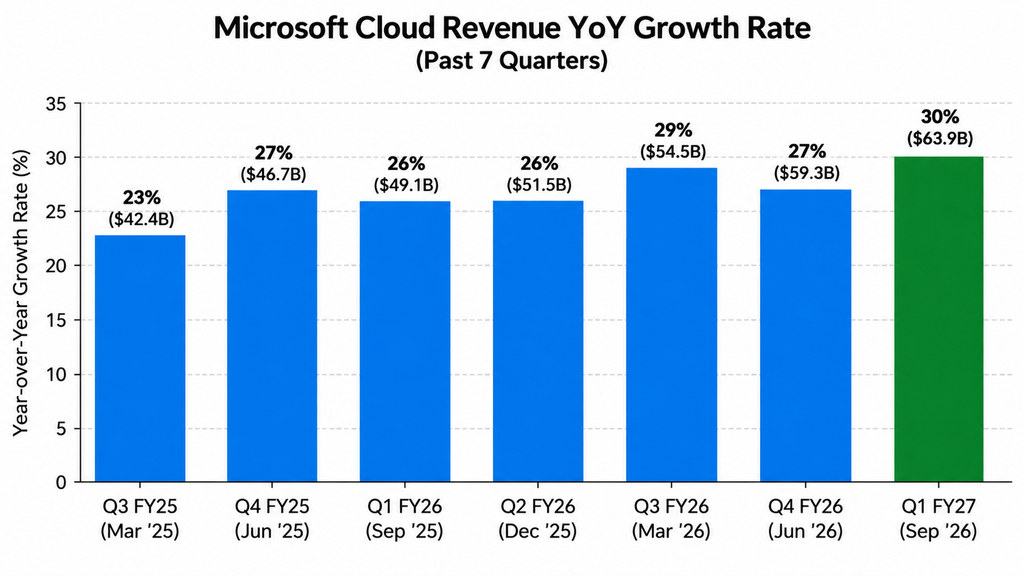
Google Cloud’s extraordinary breakaway occurred despite an excellent fiscal-Q1 performance from Microsoft Cloud, whose revenue was up 30% to an eye-popping $63.9 billion, which puts it on an annualized run rate of more than $250 billion.
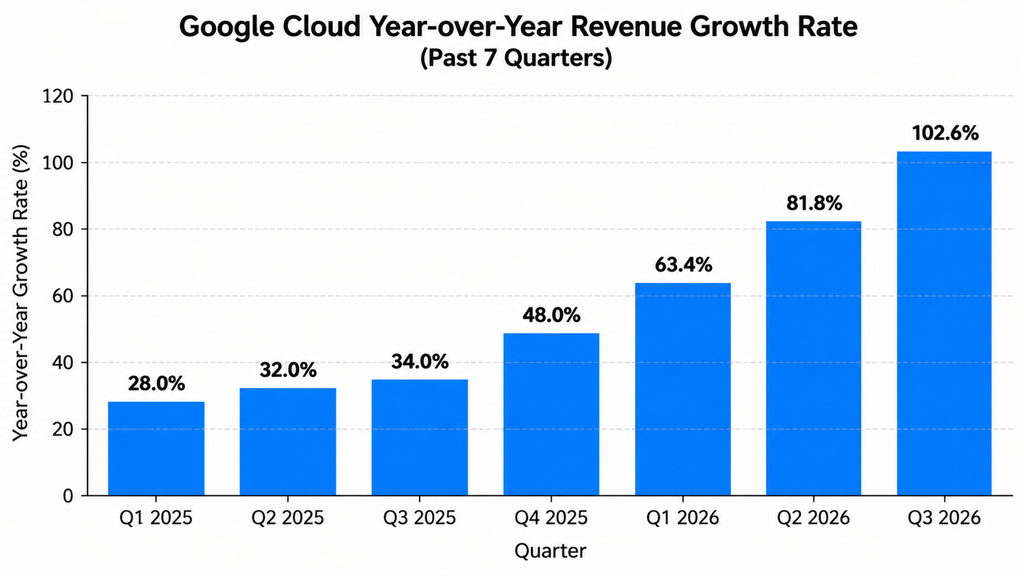
For the same three months ended Sept. 30, Google Cloud revenue soared 103% to $30.7 billion, and my slide rule tells me that 3.5 times 30% is 105%, and I’m willing to accept that round-up from 103%.
So, what do those numbers mean?
Well, let’s look at them first from the perspective of Microsoft supporters, some of whom will try to shout down this comparison with a few arguments:
- “It’s an unfair comparison because we don’t sell the same set of products.” Okay, but by that logic, it’s unfair to compare any two companies on Earth because no two companies sell exactly the same stuff. The better way to look at the competitive dynamic is this: with their eyes on an enterprise AI and cloud market projected to be in the trillions, both Microsoft and Google Cloud have been free for the past few years to approach it in any way they’d like — and as a result of the choices each company has made about how to try to seize the lead in the enterprise AI category, Google Cloud is outgrowing Microsoft Cloud by 3.5X.
- “It’s an unfair comparison because Google Cloud’s revenue is so much smaller than Microsoft Cloud’s.” It is certainly true that Microsoft Cloud revenue is more than 2X that of Google Cloud (for Q3, $63.9 billion versus $30.7 billion). And given that variance, perhaps that argument could account for a hypothetical outsized Google Cloud growth rate of 40% or even 50%. But, it sure as hell does not account for a disparity of 103% versus 30%. However, flawed though that line of thinking is, I can understand why some Microsoft supporters would try to make that case because it is, after all, the best argument they can try to make.
- “It’s an unfair comparison because Google Cloud has Gemini and we don’t have a comparable model — and they’re selling TPUs on the open market, and we’re not.” This is the lamest of a weak set of arguments — after all, who’s responsible for that strategic failure in Microsoft’s AI portfolio — Google Cloud?
How Important Is Microsoft Cloud to Microsoft?
CEO Satya Nadella made that unmistakably clear to the world on this week’s fiscal-Q1 earnings call when his very first words were about the stellar performance of his cloud business:
“It was a fast start to our fiscal year. Microsoft Cloud revenue surpassed $63 billion, with growth accelerating to 30% year-over-year.”
Accordingly, there can be no question about where Nadella’s and Microsoft’s focus has been and continues to be as AI remakes the way businesses operate today and think about the future.
Yet, in spite of that intense focus and the hundreds of billions Microsoft continues to pour into its AI and cloud business, Google Cloud is pulling away — dramatically — as you’ll see in the next section.
Whose Growth Trajectory Reflects Breakaway Leadership?
To get a sense of which company’s AI and cloud strategies have been capturing the hearts, minds, and wallets of enterprise customers since the beginning of 2025, let’s compare quarterly growth rates for the past seven quarters, spanning Jan. 1, 2025, through Sept. 30, 2026. First Microsoft Cloud and then Google Cloud — what do the distinct trajectories tell you?
Final Thought
Those results tell me a couple of things:
First, throughout the early days of the AI Revolution, Google Cloud has been unquestionably ascendant as not only are its growth rates increasing quarter to quarter, but the magnitude of those increases is getting larger over time even as the company’s revenue base is rapidly expanding:
- Q1′ 25 to Q2 ’25: up 4 points
- Q2′ 25 to Q3 ’25: up 2 points
- Q3′ 25 to Q4 ’25: up 14 points
- Q4′ 25 to Q1 ’26: up 15 points
- Q1 ’26 to Q2 ’26: up 19 points
- Q2 ’26 to Q3 ’26: up 21 points
Conversely, while I’m certainly not sneezing at a company of Microsoft Cloud’s size growing in the high 20’s across seven tumultuous quarters, its overall acceleration across those 21 months has been negligible and stands in extremely sharp contrast to the explosive acceleration at Google Cloud.
Second, let’s look at incremental growth quarter to quarter to see who’s winning new business: from the quarter ended June 30 to the quarter ended Sept. 30, Microsoft Cloud added $4.6 billion in incremental revenue (from $59.3B to $63.9B), while Google Cloud added $5.9 billion ($24.8B to $30.7B).
So, big kudos to Microsoft Cloud for its superb performance in growing 30% off last year’s fiscal-Q1 base of $49.1 billion.
And huge kudos to Google Cloud for not only growing 103% and extending an astonishing multi-quarter acceleration, but mostly for earning the clear #1 spot in the AI Revolution that is radically changing how the world lives and works.
Well done, Google Cloud!