


Balancing the thrill of explosive demand for its AI and cloud services with the scourge of having to borrow to fulfill that promise, Oracle has vowed to get that negative cash-flow monkey off its back by December of 2027 when its booming cloud business is likely to reach an annualized run rate of about $60 billion.
Here’s the structure of the bold bet Oracle is making:
- It’s built an astonishing backlog of $664 billion for its AI and cloud services.
- As that backlog/RPO begins to convert to revenue, Oracle’s cash-flow position will rapidly improve.
- But, to successfully deliver on that conversion, Oracle must build out AI data center capacity on a scale and at a pace beyond anything that’s been done in human history.
- If it can pull off that construction miracle — involving not only concrete and steel but also some of the world’s most advanced technology, daunting demands for energy, regulatory challenges, and pockets of politically charged skepticisms over data centers — then AI-hungry customers will be delighted and big portions of that $664 billion RPO will begin to convert to revenue.
And should that come to pass, watch for the legions of current-day Oracle skeptics to suddenly become rabid evangelists for The Oracle Way, vowing that they never had a doubt!
By the Numbers
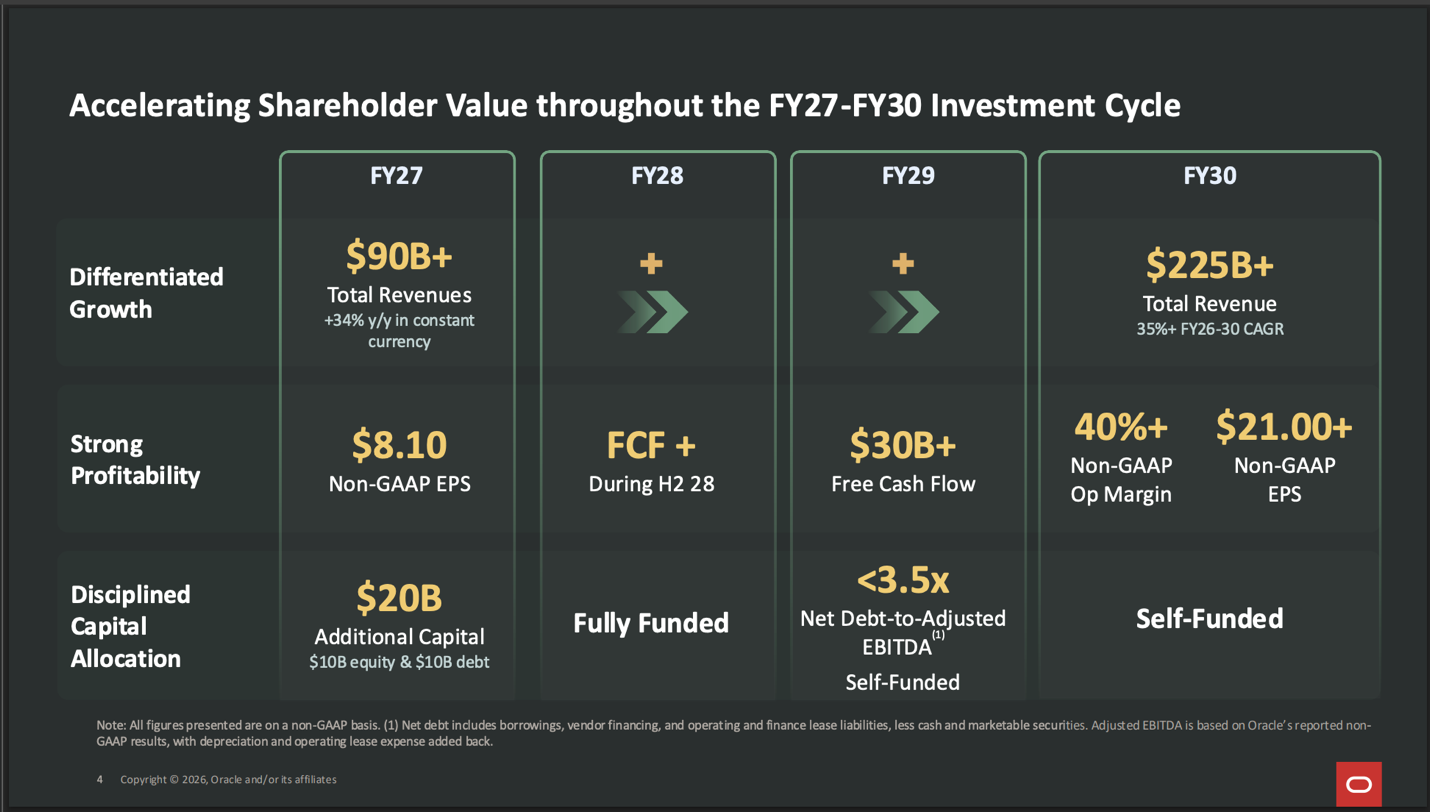
The chart below shows key financial milestones for Oracle as total revenue — not cloud revenue, but company-wide — is expected to grow from $90 billion for FY27 ending May 31 to $225 billion for FY30. In the nearer term, as shown in the graphic, Oracle expects its cash flow will turn positive at the end of the second quarter of FY28, which ends Nov. 30, 2027.
Final Thought
People fall into two camps with regard to their feelings about Oracle: some think it’s a fearless visionary that is audaciously and courageously taking on three much larger competitors — Google Cloud, Microsoft, and AWS — and holding its own via superior strategy and innovation; and then there are those who feel Oracle has foolishly jumped in way over its head and is recklessly adopting unproven approaches that no one else has ever tried — and that Oracle was simply crazy to think it could take on and run with three of the world’s biggest, wealthiest, best-known, most-innovative, and most-influential companies.
For the former group, the next 13 months will show that the road less-traveled (or even never-traveled) will prove to be the best approach. And the latter expect those 13 months will be stark lesson to all those silly enough to believe in Browning’s belief that “a man’s reach should exceed his grasp, or what’s a heaven for?”
I am squarely in the believer camp, and think that 13 months from now Oracle will be hitting (or exceeding) all of its targets and will have overcome all of the objections that all of its skeptics and detractors have raised. And as evidence of why I believe that, I urge anyone with any interest in the future of this business to watch the 13-minute presentation by OCI president Mahesh Thiagarajan during Investor Day at Oracle’s recent AI World.
Because Thiagarajan’s vision will show that it’s not just about having your reach exceed your grasp — it’s about knowing what to do with that reach.