


The phenomenal impact of the AI Revolution has pushed the growth rates of the Cloud Wars Top 10 companies to unprecedented levels with Google Cloud jumping into the top spot on our periodic Cloud Wars Growth Chart with Q3 growth of 103%, followed by Palantir at 96% and Oracle at 62%.
You can see the full results in the Cloud Wars Growth Chart below, but first here are some notable highlights:
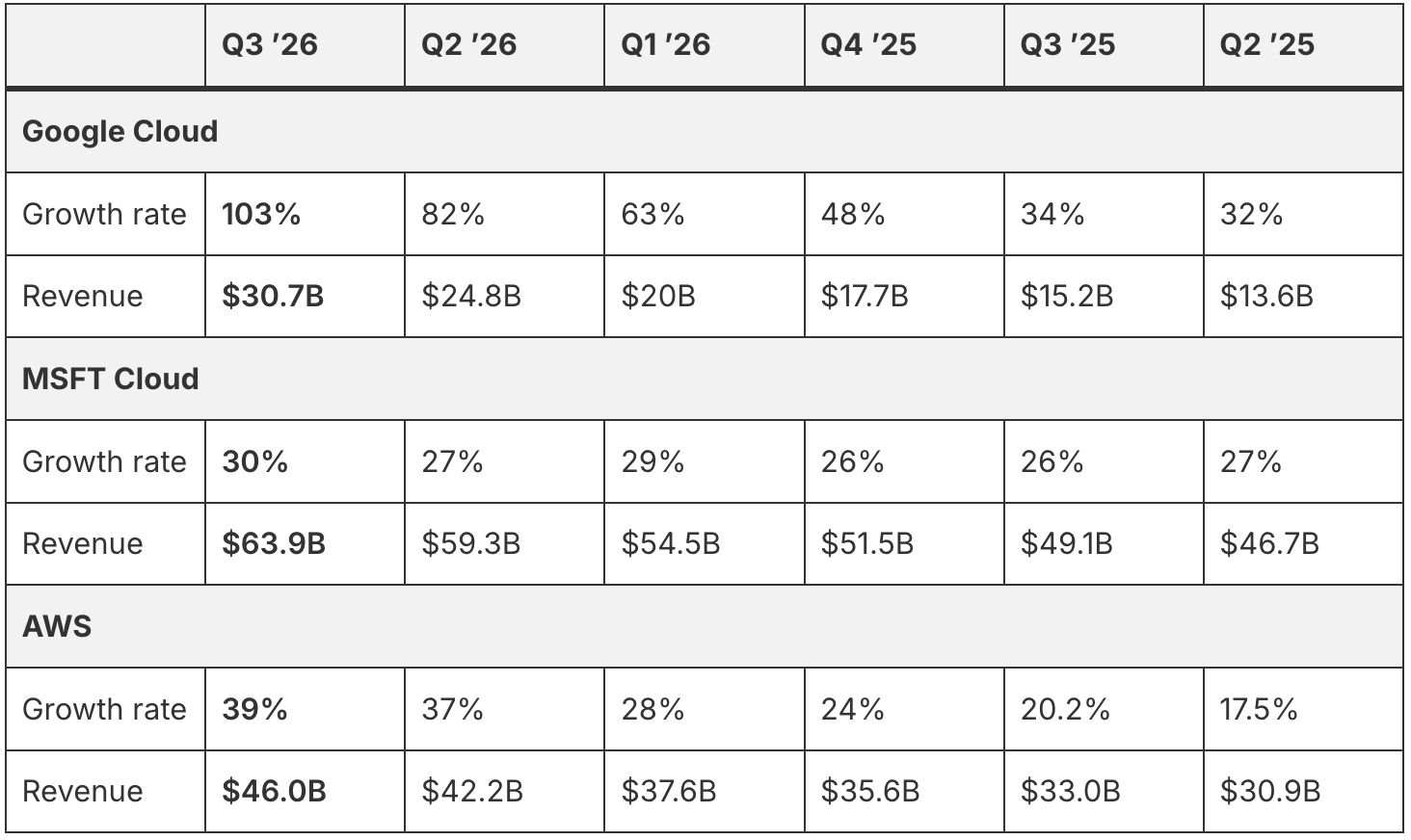
- Google Cloud: While its 103% growth is certainly eye-popping — and I don’t recall a Cloud Wars Top 10 company posting triple-digit growth in the 10 years I’ve been doing this — an argument could be made that perhaps we should not have been surprised because Google Cloud’s growth trajectory over the past several quarters was aimed — theoretically, of course — directly at 100% or above. Going back to early 2025, Google Cloud’s quarterly growth rates have been 32%, 34%, 48%, 63%, and in Q2 82%. And, while that trajectory must at some point level off, the fundamentals of Google Cloud’s business are superb, and we’ll see if it can somehow manage to remain close to the 103% mark in the incredibly rarefied air of triple-digit growth.
- Palantir: In a similar fashion, the creator of the white-hot Sovereign AI category has been on a hockey-stick acceleration for the past several quarters with Q2 coming in at 93%. But, what’s most significant about Palantir’s explosive growth is that while its government business was by far its dominant source of revenue for the first 21 years of its 23-year existence, the U.S. commercial business is growing at a phenomenal rate — 148% in Q3 — and has now overtaken the public sector as the largest part of Palantir’s business with $984 million in Q3 revenue versus government’s $953 million and 96% growth rate. But, should we expect that soaring trajectory to somehow manage to defy gravity? Well, here’s what CEO Alex Karp said in his Q3 letter to shareholders: “This moment, remarkable as it is for us, remains the first scene of a first act. It is our firm and unwavering intent to take the entire market, the whole thing. We think it is more likely than not that our raw concentration of creative and technical talent will continue to define the genre and craft the definitive story of software itself over the coming decades.” God bless ambition.
- Oracle: Speaking of extremely rarified triple-digit air, while Oracle’s overall cloud revenue grew 62% in Q3, the Oracle Cloud Infrastructure portion spiked by 121% for the quarter ended Aug. 31. Oracle expects its OCI business to continue at a torrid pace for the next few years, and has stated that 50% of its $664 billion RPO will convert to revenue over the next three years. At its Investors Day late last month, Oracle released some compelling details about its plans for the next few years and you can read my analysis of that at “Oracle Bets It Can Get Cash-Flow Monkey Off its Back in 13 Months.”
- AWS: While it’s a bit premature to dub this comeback The Return of the King, there’s no question that the one-time king of the cloud has regained some very serious momentum and, after 2-3 lacklustre years including a CEO change, is once again influencing the broad hyperscaler agenda. Check out my analysis of the AWS resurgence and their stellar Q3 performance — 39% growth to $46 billion — at “AWS Q3 Growth of 39% Will Surge into Hypergrowth in 2027 and 2028.”
- Microsoft: Stunning fiscal-Q1 numbers: cloud revenue up 30% to $63.9 billion, equating to a $265-billion business generating outlandish growth. However, if I might lean one more time on the “rarified air” thing, those numbers — stellar as they are on their own — don’t look quite so lustrous when stacked up against those of major rivals Google Cloud and AWS. I dig into that wildly competitive race in “Microsoft Hammered by Google Cloud, AWS, Oracle on Key Growth Metrics,” and the table below gives you comparisons over the past several quarters for both quarterly revenue growth and RPO/backlog totals.
- Publicly traded: Perhaps you noted in the headline that I included the word “Public” to modify the current crop of hottest AI and cloud providers. I inserted that word because I realize that LLM kingpins Anthropic and OpenAI probably have growth rates far above what my list includes — but since neither Anthropic nor OpenAI is yet a public company, we don’t have certified results to evaluate.
Complete Cloud Wars Top 10 Growth Chart
Against that backdrop, here’s the breakdown for how the Cloud Wars Top 10 companies performed in their most-recent quarters. And, while we who are immersed in this business on a daily basis can tend to become a little familiar with or even a tad jaded by our constant exposure to those extraordinary numbers, I think it’s worth stepping back to reflect on the fact that no industry has ever generated the innovation, opportunity, and growth as these results reflect.
| Company | Latest Quarterly Growth | Latest Quarterly Revenue | Quarter Ended |
|---|---|---|---|
| Google Cloud | 103% | $30.7 billion | 9/30/26 |
| Palantir | 96% | $2.31 billion | 9/30/26 |
| Oracle | 62% | $11.6 billion | 8/31/26 |
| AWS | 39% | $46.0 billion | 9/30/26 |
| Microsoft | 30% | $63.9 billion | 9/30/26 |
| SAP | 26% | $7.5 billion | 9/30/26 |
| ServiceNow | 21% | $3.99 billion | 9/30/26 |
| Workday | 14% | $2.47 billion | 7/31/26 |
| Salesforce | 11% | $11.3 billion | 7/31/26 |
| OpenAI (estimated) | 100%? (estimated) | $6 billion (estimated) | 9/30/26 |
Final Thought
Because the Top 10 companies do not all report on the same quarterly cycle, I try to post these Growth Chart updates at times when I can include as many quite-recent results as possible. As shown above, the numbers for Workday and Salesforce are a bit stale as each of those companies are expected to release their fiscal-Q3 results in late November or the first week of December.