

Thales explains how organizations can use AI-driven competitive intelligence to identify market weaknesses, exploit operational gaps, and respond faster than competitors.
Thales explains how organizations can use AI-driven competitive intelligence to identify market weaknesses, exploit operational gaps, and respond faster than competitors.

Workday’s strong Q1 performance highlights CEO Aneel Bhusri’s push to transform the company into an AI-native enterprise focused on agentic AI innovation, lawful governance, and accelerated product development to compete with SAP, Oracle, and Microsoft.

Amazon Bedrock AgentCore Payments marks a major step toward economically active AI agents capable of discovering, evaluating, and paying for digital resources without human intervention.

AI and Microsoft expert Paul Swider details a personal health assistant he’s built called Tula that unifies all of a patient’s data and aims to level the healthcare playing field.

The biggest AI opportunity in enterprise software may be reducing implementation friction, not simply adding generative features.

Salesforce is targeting one of enterprise AI’s biggest barriers: outdated manual workflows that prevent agentic AI from operating efficiently at scale.

Case involving Nippon Life Insurance and OpenAI highlights ChatGPT’s status as a non-person AI tool, not a lawyer, amid alleged legal misuse.
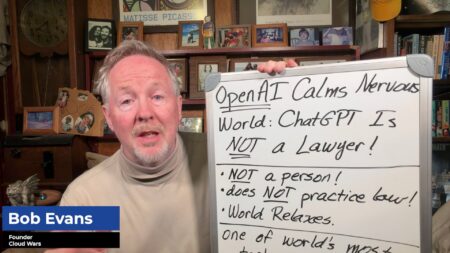
A recent court case pushed OpenAI to specifically define ChatGPT as “not a lawyer.” How does this impact the future of AI?

Despite strong optimism around AI adoption, Workday found that most enterprise users still act as intermediaries between AI tools, reducing productivity and undermining the promise of automation.

Microsoft says the future of AI success depends less on individual readiness and more on organizational culture, management support, and redesigned workflows.
The enterprise AI battleground is shifting from model access to operational context, governance, and differentiated execution infrastructure.

Palantir’s 70% growth highlights how outcome-based AI pricing and rapid enterprise expansion are creating a new playbook for cloud success.

Enterprise AI has shifted from experimentation to urgent execution, forcing cloud providers to deliver measurable business outcomes faster than ever.
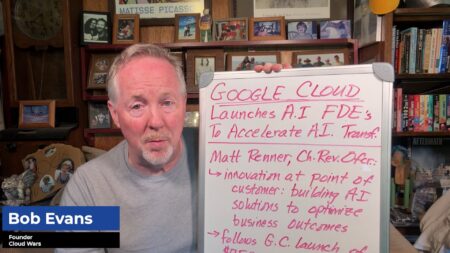
Google Cloud is accelerating enterprise AI adoption with specialized AI engineers and a $750 million ecosystem fund, signaling a more aggressive customer execution strategy.

SAP and Palantir are helping redefine enterprise technology, as Christian Klein and Alex Karp both argue that AI-driven execution has moved their companies beyond the traditional definition of software vendors.
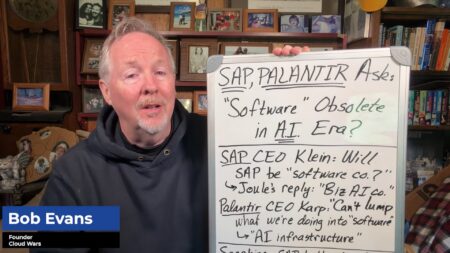
SAP and Palantir argue that agentic AI is transforming their businesses beyond traditional software into something more akin to business AI platforms and AI infrastructure providers.

Enterprise AI success depends not just on innovation speed, but on governance, interoperability, migration readiness, and organizational change.
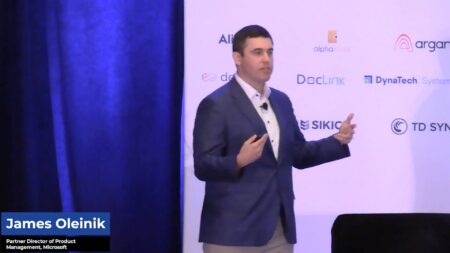
Microsoft’s James Oleinik explains how enterprise software is shifting from app-centric workflows to AI agent-driven systems where intent replaces manual navigation.

SAP is positioning industry-specific AI as a stronger differentiator than generic horizontal enterprise AI tools.
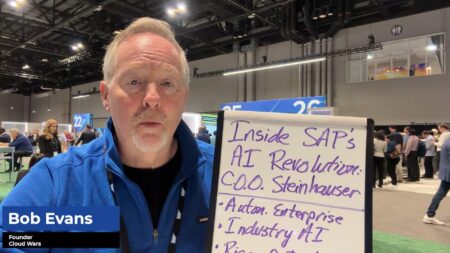
SAP is accelerating its autonomous enterprise strategy with agents, Business Data Cloud, and industry-specific innovation in what could be its most ambitious transformation yet.