


Amid one of the most ambitious product rollouts in SAP’s storied 54-year history, CEO Christian Klein opened and closed his Sapphire keynote with a question that has enormous implications for not only SAP and the tech industry but also for its 440,000 customers: Is SAP still a software company?
When Klein voiced that question early in his keynote, it was met with scattered laughter from the Sapphire audience, almost as if they thought it was some sort of trick question. After all, SAP created the world-shaping enterprise-applications category 54 years ago and its software touches 75% of the global economy.
And in a world where everything seems to be changing in front of our eyes, surely one eternal truth is that SAP has always been a software company and will always be a software company…. Right??
Well, actually, no, it won’t, according to Klein, who happens to be the person with the most skin in that game.
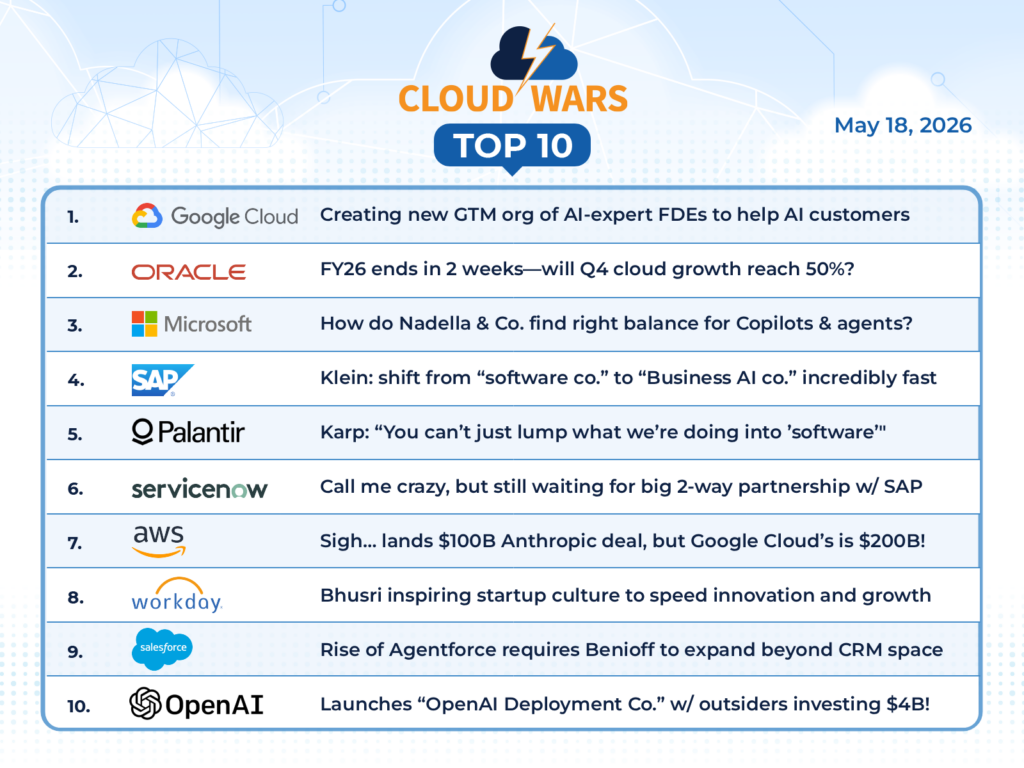
At the end of his keynote presentation, which was augmented by several SAP executives and customers outlining radical AI-first changes to the SAP portfolio, Klein raised again the question that he posed at the beginning of his presentation, but this time he posed the question directly to SAP’s Joule AI assistant:
- Klein: “Will SAP be a software company in the future?”
- Joule: “SAP is becoming a Business AI company.”
Now I’m sure some people are saying, “Who cares? It’s just a silly word game.”
But I beg to differ: I believe we’re witnessing something much more profound here for not only SAP and not only most other tech companies but also across huge swaths of the global economy.
And the catalytic agent — as foretold by Joule — is the unprecedented transformational power of AI.
1. The SAP Evolution
At the heart of SAP’s move from software to AI are two core components: the Autonomous Suite —formerly Cloud ERP Suite — and the Business AI Platform, which unites and harmonizes Business Data Cloud, Business Technology Platform, and Business AI. From the press release:
“For the mission-critical processes of our customers, ‘almost right’ just isn’t good enough,” said Christian Klein, CEO of SAP SE. “By uniting SAP Business AI Platform with SAP Autonomous Suite, we anchor AI agents in the business processes, data and governance so they can deliver accurate, compliant and secure outcomes, unlocking new sources of revenue and meaningful cost savings.”
The Autonomous Enterprise includes a unified AI platform for building, contextualizing and governing agents, an autonomous suite that executes core business operations and a new user experience that redefines how people work with enterprise software.
Now, while the legacy term “software” is included as the final word in that excerpt, it’s no accident that the word “applications” does not appear anywhere in Klein’s strategic overview of SAP’s extremely important launches that define precisely where the company’s headed.
Clearly for SAP, it’s no longer an apps world, and more and more it’s becoming less and less of a “software” world. The new center of the SAP universe is agentic AI fueled by data — and Klein described the scope of this huge transformation for SAP.
“For 50 years, SAP delivered ‘systems of execution,’ where it was always the responsibility of the users to tell the system what to do,” Klein said in his keynote.
“But today, those systems of execution have evolved into the SAP Autonomous Suite, representing the biggest product evolution ever for SAP.”
From all that I heard and saw at Sapphire, here are a few other pointers about SAP’s evolution away from software and into Business AI:
- the fastest-growing product in SAP history is not one of its storied applications — rather, it’s the Business Data Cloud, which fuels the SAP AI that drives better outcomes for customers;
- in rolling out the Autonomous Suite, while SAP said very little (nothing?) about new applications, it spoke passionately about its 221 new agents and 51 new assistants;
- when I asked COO Sebastian Steinhaeuser if agents are software, he said with a big smile, “part software and part wisdom”;
- at Sapphire a year ago, Klein spoke about SAP’s commitment to provide customers with highly qualified enterprise architects to help plan out a very different technology future, and at this year’s Sapphire Klein spoke about complementing those technical experts with industry-specific domain experts, meaning new carbon-based intelligence rather than software;
- the company launched an ambitious rollout of Industry AI, in which the stars of the show were again agents rather than applications; and
- SAP has established a $120-million fund to support and inspire partners to build AI agents —lots and lots of AI agents.
Community Summit North America
The largest independent innovation, education, and training event for Microsoft business applications delivered by Expert Users, Microsoft Leaders, MVPs, and Partners.
Register
2. Similar Tectonic Shifts Across Tech Sector
Earlier this month, the CEO of explosively growing Palantir, Alex Karp, very specifically questioned whether “software company” is the appropriate descriptor for Palantir. Here’s the powerful perspective from Karp via my May 7 analysis headlined “Palantir’s 85% Q1 Growth Reshapes AI Expectations, Creates Wild AI Categories“:
And as for whether what Palantir creates should be called “software” or the new term proposed by Karp, I can understand why some people might shrug their shoulders dismissively and say “who cares?”. But I think that misses the larger point: customers are buying what Palantir is creating in outsized proportions, and perhaps that means that vendors and customers should think long and hard about why “software” might no longer be the right way to talk about what AI does — and more important, what it can do.
“Now, I do think we are going to end up with a different term for software — you cannot just lump what we’re doing into ‘software’,” Karp said on the earnings call.
“We are really providing infrastructure and also the installation of AI infrastructure. If your [tech] company is largely running around and offering steak dinners with something that someone can hack and rebuild in a week, yes, you are going to have a huge problem. Business models that do not make sense are under huge pressure.”
Note that Karp explicitly cites how Palantir is shifting from not only creating new technology — “AI infrastructure” — but also by taking on “the installation of AI infrastructure.”
Outside of those beyond-software visions expressed by SAP and Palantir, we’ve got plenty of other examples of how the term “software company” might still be accurate but is nevertheless hardly adequate:
- this calendar year, Microsoft, Oracle, and Google Cloud will plow more than $400 billion in CapEx into their data-center buildouts;
- Google Cloud has acquired an energy company, and Microsoft is funding the overhaul and re-start of the Three Mile Island nuclear power plant;
- OpenAI has established the “OpenAI Deployment Company” and has taken on outside investments totalling $4 billion in the new venture; and every single company in the Cloud Wars Top 10 has begun speaking fervently about its embrace of “forward-deployed engineers,” better known as FDEs (and they all claim to have been doing FDEs for decades).
3. The Global Economy Is Next
And courtesy of a 123-year-old “car company,” I’ll leave you with this not-so-little glimpse at the shape of things to come:
Ford launches energy business to capitalize on AI demand
Edited by Laura Stewart, Editor at LinkedIn News
Ford’s stock jumped to a six-year high Thursday following the launch of Ford Energy, a grid-battery business that will allow the 122-year-old company to capitalize on the AI boom. Ford will invest $2 billion in the business, with plans to repurpose its existing EV battery manufacturing site in Kentucky. CEO Jim Farley says the company is already seeing interest in its battery energy storage systems. The systems, which will go into production next year, could be a “high growth, high margin, anti-cyclical market development for Ford,” Farley says.
…see more.