


AI coding squads are reshaping software development as GitHub Copilot and Claude Code move beyond individual assistants toward collaborative agent teams that share tasks, communicate, and deliver higher-quality results.
AI coding squads are reshaping software development as GitHub Copilot and Claude Code move beyond individual assistants toward collaborative agent teams that share tasks, communicate, and deliver higher-quality results.
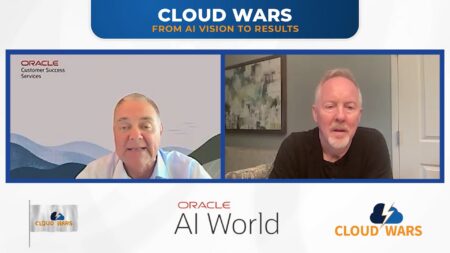
Oracle’s enterprise AI strategy emphasizes measurable business outcomes, scalable agentic innovation, and stronger customer partnerships as organizations accelerate AI adoption while managing costs and security.

Workday doubles down on agentic AI at Workday Rising, unveiling Sana, four autopilot agents, and new intelligence capabilities designed to accelerate enterprise automation and strengthen its competitive position.

Google Cloud showcases 12 powerful Gemini Enterprise customer success stories, demonstrating how businesses are turning AI investments into cost savings, operational efficiency, and competitive advantage.

Google Cloud’s Gemini Agent combines personal AI capabilities with enterprise-grade governance, multicloud connectivity, and model flexibility. CEO Thomas Kurian believes these integrated features will help organizations deploy sophisticated AI agents more efficiently and affordably.

Workday launches Total Benefits, an AI-powered platform that simplifies benefits administration, empowers employees with personalized guidance, and signals a shift toward continuous, agentic AI-driven HR experiences.

Five months after unveiling Autonomous Enterprise, SAP is accelerating its agentic AI strategy with Joule solutions spanning finance, supply chain, HR, procurement, and customer experience while increasingly targeting high-value, industry-specific business scenarios.

Enterprises are getting better at identifying valuable AI projects, putting pressure on pilots, products, and vendors that cannot demonstrate meaningful returns on investment.
Marc Benioff’s AI-centered vision combines enterprise data, autonomous software, major technology partnerships, and new use cases spanning logistics, IT service management, government, and other business functions.

Work IQ could address one of enterprise AI’s biggest obstacles: agents that lack business context. Microsoft is using existing applications, processes, semantic models, and institutional knowledge to create a reusable intelligence foundation for Copilot and agents.

Google Cloud CEO Thomas Kurian says general-purpose AI alone cannot meet complex industry requirements, prompting the company to surround Gemini Enterprise with specialized skills, trusted data connections, agentic workflows, governance, and partner solutions.
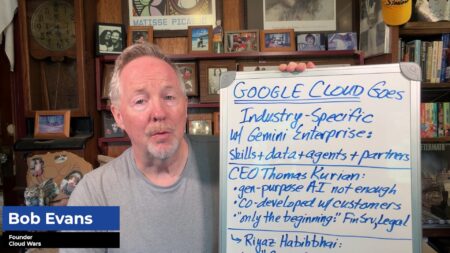
Google Cloud is taking Gemini Enterprise deep into vertical industries, beginning with financial services and legal and combining skills, data, agents, and partners into one AI system.

Workday is betting that fewer, more capable AI agents connected across enterprise systems and data will create greater customer value and differentiate it from larger rivals.

Google Cloud and Mahindra are bringing Gemini Enterprise directly into vehicles, demonstrating how AI is moving beyond traditional digital environments and becoming embedded in physical-world endpoints.

Marc Benioff’s Salesforce is betting that combining Anthropic’s AI momentum with its massive enterprise presence can unlock new opportunities for customers and accelerate its AI strategy.

AI tokens are getting dramatically cheaper, but agentic reasoning is consuming far more of them, creating a surprising new challenge for enterprise AI economics.

AI security is becoming an ecosystem problem, and Workday is joining forces with major technology companies to share knowledge and strengthen protections across enterprise AI.

Enterprise AI’s next breakthrough will come from evaluating agents against real business workflows and continuously improving their performance with proprietary organizational knowledge.

Agentic reasoning loops promise better AI answers, but could dramatically increase token consumption and costs as enterprise adoption grows.

AI vendors are moving toward consumption-based billing as rising token costs make traditional flat-fee and user-based licensing increasingly difficult to sustain.