


The new AI Deployment Wars reveal that enterprise customers need more than technology: they need strategy, process modernization, secure integration, and change management.
The new AI Deployment Wars reveal that enterprise customers need more than technology: they need strategy, process modernization, secure integration, and change management.
Palantir makes the argument that while some ERP standardization can be beneficial, an over-reliance on it can lead to squandered opportunity with emerging tech.
Jalapeño represents OpenAI’s first major move into custom AI hardware, combining the company’s AI architecture expertise with Broadcom’s semiconductor manufacturing capabilities to deliver faster, more energy-efficient inference for large language models.

Working with DynaTech Systems, Solmax standardized global business processes and created a single source of truth, helping eliminate data silos and improve financial and operational decision-making across multiple regions.

Enterprise AI growth increasingly depends on implementation expertise rather than model capabilities alone.

Google Cloud, OpenAI, and Anthropic are investing heavily in deployment capabilities, ecosystems, and forward-deployed engineers to help customers achieve measurable business outcomes and accelerate enterprise AI adoption beyond model selection.

Google Cloud and Palantir are expanding their partnership to help businesses combine AI, data, and analytics for faster decision-making and stronger industry-specific outcomes.

The Hyperscaler Backlog Sweepstakes defines the top AI factories, ranking Google Cloud, Oracle, Microsoft, and AWS in the top four.

The Hyperscaler Backlog Sweepstakes — including Oracle, Microsoft, Google Cloud, and Oracle — have led to a backlog total of $2.1 trillion.
Pinterest has signed a $4 billion infrastructure agreement with AWS through 2031, marking the largest technology commitment in its history. The partnership will support AI innovation, improve discovery experiences, and provide scalable infrastructure for hundreds of millions of users.
OpenAI has launched a global partner network backed by a $150 million fund, signaling a major commitment to enterprise AI adoption through ecosystem-driven customer transformation, workflow redesign, systems integration, and change management.

DynaTech Systems enabled Solmax to modernize finance and supply chain operations while delivering real-time reporting and greater operational efficiency.

A 363% surge in Oracle’s RPO demonstrates extraordinary customer demand and positions the company as one of the fastest-growing forces in enterprise AI and cloud computing.

While Microsoft dominates current cloud revenue, Oracle’s rapidly expanding RPO points to a dramatically different competitive landscape ahead.
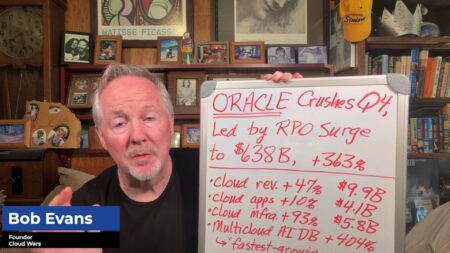
Oracle delivers a blockbuster Q4 with cloud revenue up 47%, OCI soaring 93%, and a staggering $138 billion increase in RPO, signaling unprecedented demand for AI infrastructure and cloud services.

Oracle and Alphabet are pioneering new approaches to finance massive AI infrastructure expansion, using debt and equity markets to meet unprecedented customer demand for cloud and AI services.

OpenAI’s enterprise business is emerging as the company’s primary growth engine, already accounting for 40% of revenue and expected to reach 50% by the end of 2026, according to CRO Denise Dresser.
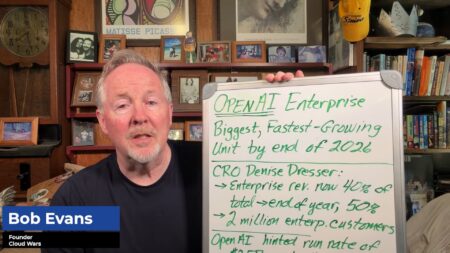
OpenAI’s enterprise business now accounts for 40% of revenue and could reach 50% by year-end, signaling a major shift toward enterprise AI leadership.

Google Cloud has launched Google AI Threat Defense, an AI-powered cybersecurity platform designed to help organizations proactively identify, prioritize, and remediate threats while keeping pace with increasingly sophisticated AI-driven cyberattacks.

Google Cloud’s latest security launch combines AI-driven defense with the company’s expanding portfolio of cybersecurity assets.