


Google Cloud is taking Gemini Enterprise deep into vertical industries, beginning with financial services and legal and combining skills, data, agents, and partners into one AI system.
Google Cloud is taking Gemini Enterprise deep into vertical industries, beginning with financial services and legal and combining skills, data, agents, and partners into one AI system.

New tools aimed at enforcing cost discipline include an AI pricing calculator, detection of spending anomalies, and spending caps for individual AI projects.

Law firms that collaborated in platform design highlight industry AI opportunities to eliminate manual work and drive innovation for better client service.

On the strength of customer design partnerships and an expansive ecosystem, Google Cloud delivers AI platforms that could unlock AI innovation in support of vertical use cases.

Google Cloud and Mahindra are bringing Gemini Enterprise directly into vehicles, demonstrating how AI is moving beyond traditional digital environments and becoming embedded in physical-world endpoints.

Google Cloud’s Gemini models are coming to Oracle applications, including Oracle AI Agent Studio for Fusion Applications, giving customers more flexibility to select models while turning AI reasoning into governed workflows, approvals, transactions, and business actions.

Google Cloud and Oracle are emerging as an AI power pair, combining Gemini, Fusion applications, and Oracle AI Database to help customers accelerate enterprise AI transformation.

Google Cloud’s infrastructure strategy gives frontier AI lab Mirendil the flexibility and scale needed to speed up the AI research loop.

Google Cloud’s Q2 revenue reached $24.8 billion, up $4.8 billion sequentially. Microsoft Cloud also added $4.8 billion, while AWS added $4.6 billion, suggesting remarkably close competition for incremental customer spending among the three hyperscalers.

Google Cloud delivered standout Q2 momentum, adding as much new quarterly revenue as Microsoft and more than AWS despite operating from a significantly smaller revenue base.

SAP delivered 24% cloud revenue growth in Q2 while expanding its cloud backlog to $26.3 billion, with CEO Christian Klein crediting the company’s global partner ecosystem and AI strategy for accelerating customer adoption and positioning SAP for $30 billion in cloud revenue next year.

While Microsoft generated $59.3 billion in quarterly cloud revenue, Google Cloud’s much faster growth suggests the AI revolution is rapidly reshaping the competitive landscape.

Microsoft’s consistency contrasts sharply with Google’s accelerating growth, revealing two very different momentum stories in today’s cloud infrastructure market.

Ahead of Microsoft and AWS earnings, Google Cloud has established a commanding growth advantage, with revenue increasing 82% and backlog soaring 390%, signaling strong customer confidence and significant future revenue opportunities.

Google Cloud’s 82% growth highlights a dramatic shift in customer demand as Microsoft and AWS prepare to report earnings in a rapidly evolving AI market.

Despite investor concerns over rising CapEx, Alphabet believes aggressive AI infrastructure spending will generate multiyear returns as enterprise AI adoption accelerates across industries.

Alphabet is embracing massive AI infrastructure investments despite investor backlash, betting that today’s spending will secure tomorrow’s cloud leadership.

Google Cloud’s $4.8 billion sequential revenue increase establishes a new benchmark for Microsoft Cloud and AWS as investors prepare for their upcoming earnings reports.
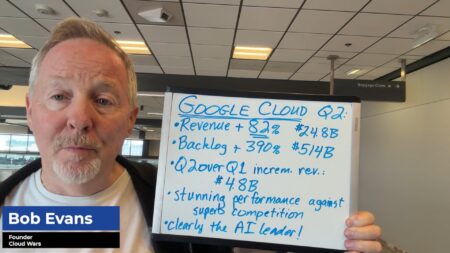
Explosive Q2 results suggest Google Cloud is outperforming rivals where it matters most—winning new AI business and accelerating faster than Microsoft Cloud and AWS.

AWS is expanding Security Hub with AI-specific protections and Azure support to secure AI and multicloud environments from a single platform.