

AWS is strengthening agentic AI security through identity controls, authorization, auditability, and governance frameworks designed to support trusted autonomous business processes.
AWS is strengthening agentic AI security through identity controls, authorization, auditability, and governance frameworks designed to support trusted autonomous business processes.

SAP’s Q3 results highlight accelerating cloud revenue growth, a 28% increase in current cloud backlog to $27 billion, and growing enterprise demand for its AI-powered Autonomous Enterprise vision.
Oracle’s enterprise AI strategy emphasizes measurable business outcomes, scalable agentic innovation, and stronger customer partnerships as organizations accelerate AI adoption while managing costs and security.

SAP’s remarkable Q3 performance challenges skeptics as Christian Klein’s cloud and AI strategy delivers accelerating revenue growth and increasingly strong competitive positioning.

Google’s latest European research initiative signals a shift toward collaborative AI innovation, where technology developers provide the tools and scientific institutions establish the priorities for discovery.

After achieving 82% revenue growth in Q2, Google Cloud could double its year-over-year revenue in Q3.

Google Cloud could deliver extraordinary Q3 revenue growth of 90% to 100%, fueled by AI momentum, accelerating quarterly gains, and an expanding ecosystem that continues to outperform major cloud competitors.

Artificial intelligence is creating new business categories, disrupting traditional e-commerce, and empowering entrepreneurs to build products and services with unprecedented capabilities.

Google Cloud CEO Thomas Kurian revealed 12 powerful Gemini Enterprise customer success stories, highlighting extraordinary AI ROI, productivity gains, and cost savings as nearly 90% of Fortune 100 companies adopt the platform.

Google Cloud showcases 12 powerful Gemini Enterprise customer success stories, demonstrating how businesses are turning AI investments into cost savings, operational efficiency, and competitive advantage.

Google Cloud’s Gemini Agent combines personal AI capabilities with enterprise-grade governance, multicloud connectivity, and model flexibility. CEO Thomas Kurian believes these integrated features will help organizations deploy sophisticated AI agents more efficiently and affordably.
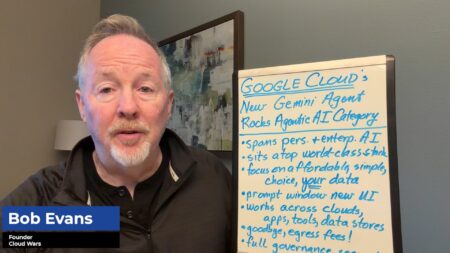
Google Cloud’s Gemini agent launch signals a broader shift in enterprise AI, as business leaders increasingly demand technology partners who understand operational priorities rather than simply promoting technical capabilities.

Rather than forcing enterprises to integrate numerous complex modernization technologies themselves, Google Cloud is combining existing tools and new agentic AI capabilities into an end-to-end architecture designed to dramatically accelerate legacy technology transformation.

Google Cloud is simplifying enterprise modernization with an AI-driven, end-to-end approach that can shrink complex business-case processes from weeks to minutes.
Oracle Fusion Claw combines AI reasoning, deterministic computing, and enterprise governance to execute complex business processes with increasing autonomy.

AI demand is propelling the Cloud Wars Top 10 to extraordinary growth, led by Palantir at 93%, Google Cloud at 82%, and Oracle at 62%, with all three companies also demonstrating sustained quarterly growth acceleration.

Palantir leads the Cloud Wars Top 10 with 93% growth as Google Cloud, Oracle, and AWS surge and AI platforms drive extraordinary enterprise demand.

AI leaders are accelerating their push into vertical industries through customer-designed products, deeper data integration, and industry-specific skills.

Experts including forward-deployed engineers (FDEs) are deemed key factor in accelerating outcomes, reducing risk, and ensuring operational impact of AI.

Extended, powerful partnerships will prove to be just as important as the expanding AIforce, as Salesforce challenges the traditional mindset with its approach to the future of tech.