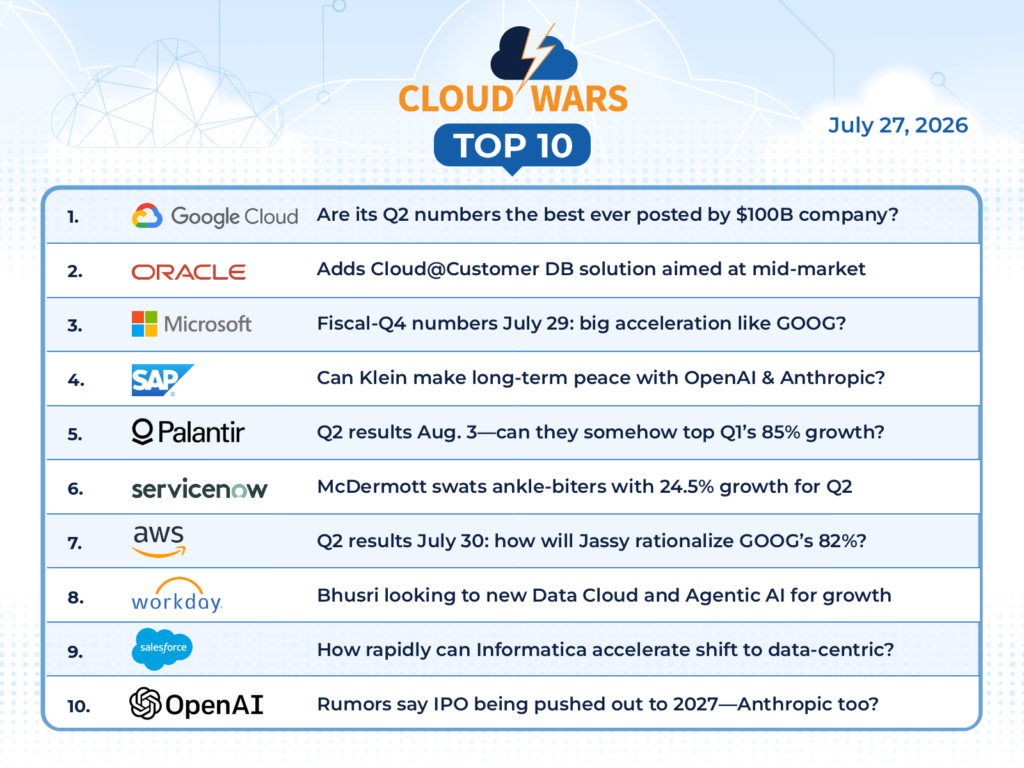



Wall Street’s bizarre decision to hammer Alphabet’s market cap because Google Cloud posted one of the most extraordinary quarters ever seen in the tech industry or any other industry offers a perfect illustration of just how different the cloud/AI market is from anything else we’ve ever seen.
While Alphabet reported excellent numbers across the board led by Google Cloud’s 82% jump in Q2 revenue and 390% jump in backlog, investors decided that — at least in the very short term — that juice isn’t worth the squeeze because fulfilling all that demand is supposedly too darn expensive.
In releasing those extraordinary Q2 growth numbers last week, Alphabet also reported that it is raising CapEx spending for 2026 to about $200 billion in a commitment that will result in negative cash flow.
And presto-change-o, investors hammered Alphabet’s market cap, knocking it down by about $250 billion — yes, “billion” with a “b.” I mention this not to veer into the off-limits territory of investing but rather to show that this industry, like the starship Enterprise, is “boldly going where no man has gone before.”
What puzzles me is the logic behind that market-cap slash: do people really doubt that Alphabet — one of the world’s largest, most-innovative, and most-profitable companies — has suddenly lost its ability to manage its finances? Yes, Alphabet reported negative Q2 cash flow of $5.9 billion as a result of the demands to invest heavily to meet the market opportunity — but, it also said it has $242.5 billion in cash and marketable securities on hand.
Plus, CEO Sundar Pichai, who’s typically highly restrained on earnings calls, expressed great optimism about the huge growth opportunities AI has opened up for the company:
“We are seeing strong diversified demand across products, customers, geographies and industries. Our product differentiation is driving expansion in three ways:
- We are winning new customers, more than doubling our acquisition velocity year-over-year.
- We are deepening our relationships with existing customers, who are expanding their usage and exceeding their commitments by more than 50%, also an acceleration over last quarter.
- And we are driving growth with partners, with transactions on Google Cloud Marketplace growing over 7x year-over-year.”
In that context of growth and momentum and opportunity, let’s dig into the “third party” innovation flagged in the headline because it underscores my strong belief in how badly misplaced all this wailing and gnashing of teeth about investing courageously for an extraordinary opportunity actually is.
Alphabet leadership did *not* say that their only alternative is to keep pumping more and more money into CapEx — rather, in another sign of their wisdom and their ability to bring fresh ideas to unprecedented challenges, Alphabet leaders say they expect to close this capacity-gap by tapping into third-party suppliers of data-center capacity. Here’s how Pichai addressed the situation during the Q&A portion of the call:
“The main thing I would say is there are, on the margin, very, very large customers of ours on cloud who we are trying to support through this extraordinary moment. And the incremental opportunities they are bringing to us, while a short-term cost over a few months, may be very high in the lifetime of the deal as we bring more capacity on and is highly ROI-positive, right? Those are factors we are taking into account: are you willing to take upfront a 6-month deal to be able to serve that customer in what is a multiyear opportunity where the margins and the returns are very, very attractive over that multiyear horizon?”
CFO Anat Ashkenazi put it this way: “Given the supply-constrained environment, we plan to expand the use of third-party capacity in Q3 as a bridging strategy while we build up more internal capacity. This strategy allows us to keep growing our customer base and capture greater overall value.”
Final Thought
In the sports world, we often see that some coaches are more concerned with the possibility of losing than they are with a full-on commitment to winning. They take the cautious approach, they avoid risks, they play it safe, and they hope the competition will somehow make a mistake.
The world of the AI hyperscalers will obliterate that type of timid and risk-averse thinking, because none of these companies got where they are by “hoping” for anything.
I applaud Alphabet’s leadership for fully supporting Google Cloud’s extraordinary surge, and I applaud Pichai’s recognition that playing not to lose in the greatest growth market the world has ever known would be a great disservice to his company and his customers.
Keep swinging for the fences and playing to win, Sundar!