

In what has become the most-expensive industrial buildout the world has ever seen, Google Cloud, Oracle, Microsoft and AWS are deploying a wild new range of approaches to expand data-center capacity as explosive demand for AI services pushes the hyperscalers into unprecedented territory.
This particular variation of the ageless demand-supply dance is so extraordinary because while many Wall Street beancounters are blindly fixated on the staggering costs of these buildouts — those four companies will spend about $650 billion just this year on that expansion — those same worrywarts appear to be ignoring the multi-trillion-dollar opportunity the hyperscalers are chasing, which I’ve encapsulated here:
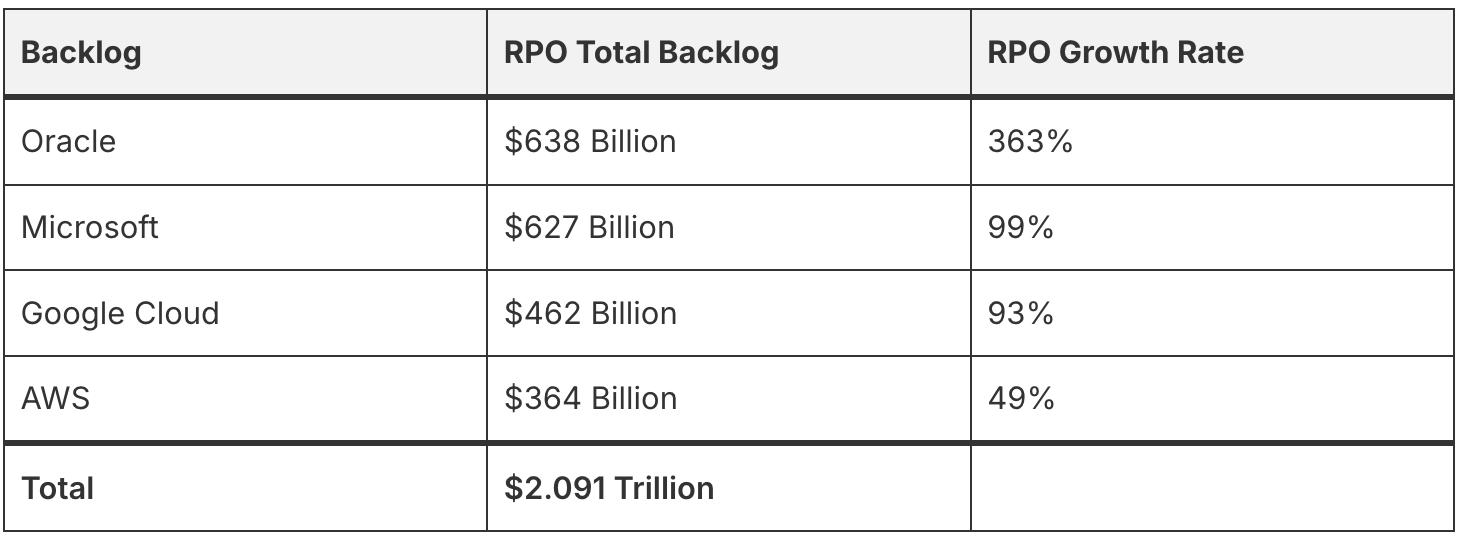
And in just three weeks’ time, I expect we’ll see that $2.1 total climb to $2.3 trillion following the release of calendar-Q2 financial results from Google Cloud, Microsoft, and AWS. I realize that the optics involved in the shift from “$2.1 trillion to $2.3 trillion” are fairly tame, so let me rephrase what’s coming: three weeks from now, the TAM these companies are pursuing will likely jump by $200 billion.
Now, it stands to reason that unprecedentedly massive opportunities require unprecedentedly imaginative approaches, and the four hyperscalers are certainly exercising their most-uninhibited imaginations as they try to figure out how to meet demand that has scaled into the trillions of dollars — trillions of dollars! — in just a few years, with no sign of that demand abating. Let’s look at a few of those efforts:
Google Cloud and Blackstone: One of the world’s largest asset managers is pumping a $5 billion equity investment into a joint venture with Google to add 500MW of data-center capacity in 2027. Google Cloud CEO Thomas Kurian offered this perspective in the announcement: “This joint venture with Blackstone helps meet growing demand for TPUs, which are optimized specifically for efficiency and performance in the AI Era. Together, we’re accelerating AI transformation and providing more options for organizations to access accelerated compute capability.” The new company will “offer efficient data center capacity, operations, networking, and Google Cloud’s Tensor Processing Units (TPUs) as a compute-as-a-service offering,” Blackstone said.
Amazon borrows $100 billion for AWS buildout: With Amazon planning to spend $200 billion on CapEx this year primarily to fund construction of AI data centers, the company has just committed to its latest in a series of debt raises going back to November of last year and totaling more than $100 billion, according to a report from CNBC:
Amazon plans to raise at least $25 billion through an eight-part bond sale, as it looks to continue its massive artificial intelligence buildout, sources told CNBC’s David Faber…. The debt sale comes after Amazon raised roughly $54 billion in bonds earlier this year in the U.S. and Europe, followed by a $10 billion bond raise in Canada in June. Amazon also raised $15 billion from a U.S. bond offering in November.
Oracle raising $50 billion via debt and equity financing: Early this year, Oracle announced its plans to seek external funding for its data-center expansions, which caused widespread panic among those Wall Street geniuses who seem unable to comprehend that Oracle has amassed a backlog of legally contracted customer commitments totaling $638 bilion and growing at a remarkable 363%. In the Oracle announcement, it outlined its intentions while also sharing a list of remarkable customers driving its move “Oracle is raising money in order to build additional capacity to meet the contracted demand from our largest Oracle Cloud Infrastructure customers, including AMD, Meta, NVIDIA, OpenAI, TikTok, xAI and others.”
Microsoft living large from OpenAI partnership: While OpenAI now works with all of the hyperscalers, Microsoft deserves great credit for being OpenAI’s original infrastructure and platform partner, a first-mover advantage that is providing huge financial returns to Microsoft. In April, OpenAI disclosed some terms of the new relationship between the companies, and here are a few highlights:
- Microsoft will no longer pay a revenue share to OpenAI.
- Revenue share payments from OpenAI to Microsoft continue through 2030, independent of OpenAI’s technology progress, at the same percentage but subject to a total cap.
- Microsoft continues to participate directly in OpenAI’s growth as a major shareholder.
Is Meta making run at hyperscaler market? Meta, which is certainly no piker when it comes to data-center buildouts — it plans to spend almost $150 billion this year on CapEx, largely to power its own services — might be ready to pull a vintage AWS move by selling excess capacity to enterprises, CNBC has reported. I don’t want to make too much of this just yet because strategically leaking an “idea” like this is a very far cry from establishing the rigorous, expensive, complex, and hugely challenging business capabilities that enterprise customers require. At the same time, with a TAM as massive as the one the hyperscalers are pursuing, plenty of outsiders might try to find ways to jump in.
Final Thought
As I’ve said a couple of times recently, the sheer magnitude of investments *and* revenue opportunities surrounding this market are unlike anything the world has ever seen.
The key now for the hyperscalers — and perhaps a few would-be hyperscalers — is to summon up the same levels of innovation and will and execution in novel approaches to overcoming the seemingly unsolvable problem of building enough AI data-center capacity to meet the demand.
And while those breakthroughs certainly involved advanced technology and engineering, they also require in equal measure deal-making instincts and risk-taking at levels we’ve never seen before.
Buckle up for an unforgettable ride, folks!
Community Summit North America
The largest independent innovation, education, and training event for Microsoft business applications delivered by Expert Users, Microsoft Leaders, MVPs, and Partners.
Register