


To ensure they can capitalize on the rapidly expanding footprint of proactive AI agents, customers need to revamp organizational structures that support innovation and retool websites for interaction with agents.
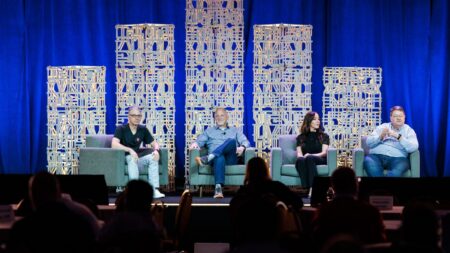
Those are key takeaways from Microsoft’s Dona Sarkar, Chief Troublemaker – Enterprise AI Advocacy at Microsoft, who delivered a keynote address at Community Summit and RSM’s VIP Frontier Customer Day on Wednesday.
Sarkar said we are now operating in the era of proactive AI – embodied in products from Microsoft, Meta, Sprock, Dot, and more – and she compared it to the advancement of spellcheck from a service you request to corrections being made automatically. “We are moving from the era of summoning AI to being able to have it act on our behalf,” she said.
Sarkar recommended two distinct ways that companies can position themselves for the era of proactive AI: the first speaks to organizing teams to develop and deliver proactive AI solutions, and the second entails updating the way companies engage with customers through the web – more specifically, optimizing their sites to enable product purchases by AI agents.
Fueling Innovation
From an organizational perspective, Sarkar said the need isn’t to shrink or radically alter innovation teams but, rather to “change the shape” of those teams. Companies need to combine humans and agents to solve new problems rather than trying to solve problems that have been addressed in the past.
Based on her experiences, Sarkar called for creation of three uniquely named roles:
- Tech stalker, whose job is to keep an eye on industry developments, see what is relevant, and identify those developments that could impact your company
- Pop-up lead, who takes a prototype and makes it more robust with extensibility, connections to company data sources, governance, and compliance – in short, all the things needed to address the questions that corporate executives will raise
- Growth lead, who is the individual that achieves buy-in within a company. Sarkar said this is one of the most sought-after – and unfilled – jobs in tech
Sarkar used the examples of an event she launched with a small team and a law firm customer that deployed this innovation model to drive outcomes and adoption. In the law firm, Copilot adoption reached 97% as the team promoted a message of AI reducing cognitive load on attorneys.
Supporting Agents as Buyers
The emergence of AI that proactively takes actions on behalf of a user also requires companies to revamp their websites so agents can easily find and purchase products. “The next customer for your product may not be a person clicking around on a website. It may be an agent,” she said.
This necessitates restructuring a site for discovery by agents rather than Google, and Sarkar recommended a specific approach to understand how agents see your site: enter your product website into an agent and ask it for specific feedback on how to make it more discoverable to agents.
“You need to think 1995 simple. We have a lot of bells and whistles on our pages,” she said. The underlying needs: make sure products that can be purchased on your website are available to agents and make buying “boring” – optimized for agents that love lists and tables. “So reverse-engineer the experience to get to your agent.”
Additional Thoughts
In addition to recommendations for optimizing teams and websites for proactive AI, Sarkar weighed in on a number of hot AI topics surrounding people, the evolution and preservation of jobs, and the economics of AI.
On recent assertions that AI could take human lives:
“Yeah, it’s here to kill us. It’s like, you couldn’t have told us that before you made $15 million from this ‘kill us all’ AI? The AI bros will AI bro because they’re deeply motivated for us to buy their nonsense products, and then they’re deeply motivated for us to not buy their nonsense products.”
On the threat of AI-driven job losses:
“The thing we have to remember is that AI is not coming for our jobs; it’s already in our jobs. We’re all AI bros now…We lost more jobs to things moving to the cloud, to things moving to mobile, to COVID than we did to AI taking your job.”
On token economics and AI cost concerns:
“This token business will get solved in the next five years. We can’t go say, ‘Oh, we’re not going to use anything till tokens get cheaper…you need to play a bit more of an infinite game where you think, if tokens were not the biggest issue in the world, what would we build?”