
New features enhance positioning of Teams as a platform to support humans, agents working together to accelerate GitHub-powered dev projects.
New features enhance positioning of Teams as a platform to support humans, agents working together to accelerate GitHub-powered dev projects.

Microsoft, Salesforce, and UiPath are taking different approaches to free developer AI capacity as consumption emerges as an increasingly important metric for the enterprise technology industry.

AI monetization is moving upstream as rising agentic development costs push Microsoft and other vendors to charge builders for creating, testing, and executing AI-powered products.

AI security is becoming an ecosystem problem, and Workday is joining forces with major technology companies to share knowledge and strengthen protections across enterprise AI.

Gmail, Calendar, and Drive users can now access data and perform tasks directly from their Claude conversations, accelerating integration of AI tools and productivity tools.

Microsoft is reportedly tightening controls on internal AI token consumption, urging employees to choose models based on tasks and focus on business outcomes. The shift highlights growing enterprise pressure to balance AI performance with rapidly expanding infrastructure costs.

After proving its custom silicon strategy with Maia 200, Microsoft is preparing a much larger Maia 300 push designed to support both AI training and inference.

Skill Recorder creates a foundation for AI to understand workflows, recommend improvements, and ultimately automate workflows, for on-demand or scheduled use cases.

Microsoft Research and Paige’s PRISM 2 combines nearly 2.5 million pathology images with clinical language, creating a versatile AI model for cancer detection, biomarker prediction, and research.

Agentic reasoning loops promise better AI answers, but could dramatically increase token consumption and costs as enterprise adoption grows.

Microsoft CEO Satya Nadella has confirmed plans for a Copilot super app that will unite chat, coding, Cowork and autonomous AI agents, creating a single flagship experience spanning both Microsoft’s consumer and commercial AI offerings.

AI vendors are moving toward consumption-based billing as rising token costs make traditional flat-fee and user-based licensing increasingly difficult to sustain.

AI vendors are increasingly turning to forward deployment engineers as enterprises struggle to move AI pilots into production and consumption-based models grow.
Project Perception represents Microsoft’s push beyond reactive cybersecurity, coordinating red, blue, and green AI agents in a closed-loop system designed to continuously identify vulnerabilities, assess risks, implement fixes, and strengthen enterprise defenses.

AI’s unprecedented growth is forcing even the world’s best-run companies to rethink traditional risk management and embrace massive, calculated bets on the future.

July updates extend the company’s commitment to make a range of AI models and choices available to users. Models from OpenAI and Anthropic have been added.
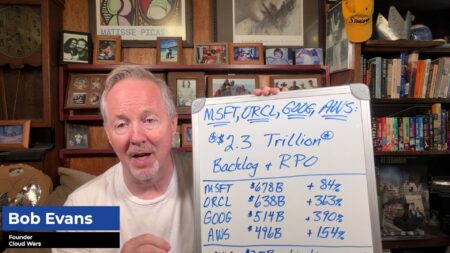
Microsoft, Oracle, Google Cloud, and AWS have amassed $2.3 trillion in contracted backlog, underscoring unprecedented demand across the booming cloud and AI economy.

Google Cloud’s Q2 revenue reached $24.8 billion, up $4.8 billion sequentially. Microsoft Cloud also added $4.8 billion, while AWS added $4.6 billion, suggesting remarkably close competition for incremental customer spending among the three hyperscalers.

Google Cloud delivered standout Q2 momentum, adding as much new quarterly revenue as Microsoft and more than AWS despite operating from a significantly smaller revenue base.

AI agents are beginning to outpace Copilot licenses, signaling that organizations are creating increasingly valuable custom automation across the Microsoft ecosystem.