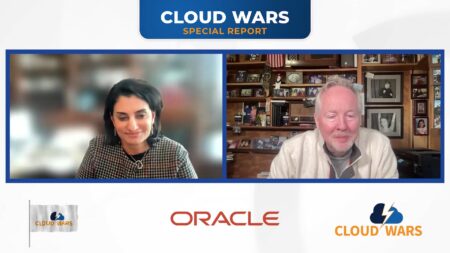



In this special episode of Cloud Wars Live, Bob Evans speaks with Chad Wahlquist, Architect, Palantir, about the company’s standout third-quarter results and the accelerating transformation of enterprise AI. Wahlquist explores how AI is creating competitive haves and have-nots, why customers are abandoning lengthy technology evaluations, and how AI sovereignty is reshaping business ownership and control.
Palantir’s New AI Playbook
The Big Themes:
- AI Creates Competitive Haves and Have-Nots: Chad Wahlquist argues that artificial intelligence is creating a widening competitive divide between organizations that fundamentally transform their operations and those that maintain traditional business practices. He illustrates this with an insurance example: a company capable of producing complex underwriting quotes in three hours rather than three weeks gains a substantial competitive advantage. However, Wahlquist emphasizes that the greatest opportunity isn’t reducing headcount or eliminating costs. Instead, AI offers virtually unlimited upside by enabling employees to accomplish exponentially more.
- Continuous Learning Becomes a Business Imperative: Wahlquist describes the importance of establishing continuous learning loops that connect business data, decisions, actions, and measurable outcomes. Rather than treating AI deployment as a one-time technology project, organizations must create systems that constantly evaluate performance and adapt to changing conditions. These learning loops enable companies to compare intended results with actual outcomes and refine their processes accordingly. Wahlquist likens this approach to an evergreen factory that continuously improves as the business evolves.
- Forward-Deployed Engineering Redefines Vendor Accountability: Wahlquist emphasizes the importance of forward-deployed engineers who work directly with customers to solve operational challenges and deliver measurable results. Unlike traditional technology relationships in which customers purchase software and subsequently assume responsibility for implementation difficulties, this model places the vendor alongside the customer throughout the process. Engineers encounter practical challenges, identify emerging requirements, and translate those lessons into improvements that can benefit other customers.
The Big Quote: “Stop worrying about the contract. Go worry [about] the value you’re creating. Everything else will be downstream. And so, for us and for me, what I am focused on is that customer outcome.”
More from Chad Wahlquist and Palantir:
Connect with Chad on LinkedIn or learn about Palantir Artificial Intelligence Platform (AIP).