


Palantir’s Q2 2026 results reveal 93% growth, a bold AI sovereignty strategy, and how its customer-first approach is reshaping enterprise AI.
Palantir’s Q2 2026 results reveal 93% growth, a bold AI sovereignty strategy, and how its customer-first approach is reshaping enterprise AI.

AWS delivered its strongest quarter in years, reshuffling hyperscaler growth rankings and intensifying competition with Microsoft and Google Cloud in the AI economy.

SAP delivered 24% cloud revenue growth in Q2 while expanding its cloud backlog to $26.3 billion, with CEO Christian Klein crediting the company’s global partner ecosystem and AI strategy for accelerating customer adoption and positioning SAP for $30 billion in cloud revenue next year.

While Microsoft generated $59.3 billion in quarterly cloud revenue, Google Cloud’s much faster growth suggests the AI revolution is rapidly reshaping the competitive landscape.

During a conversation with Bob Evans, Oracle EVP Chris Leone outlined how Fusion Agentic Applications automate business processes using teams of AI agents, enabling organizations to improve productivity while executing work directly inside Oracle’s system of record.

Microsoft’s partnership with 3M demonstrates that the next competitive frontier in AI infrastructure extends well beyond GPUs, with networking and optical connectivity emerging as critical strategic differentiators.

Microsoft says AI sovereignty is about maintaining national control while embracing the world’s best AI technologies, rather than isolating countries from global innovation.

Ahead of Microsoft and AWS earnings, Google Cloud has established a commanding growth advantage, with revenue increasing 82% and backlog soaring 390%, signaling strong customer confidence and significant future revenue opportunities.

Customers will be able to capitalize on data from ZoomInfo, Dun & Bradstreet, Gong, and others in the flow of their Dynamics 365 sales processes.

Despite investor concerns over rising CapEx, Alphabet believes aggressive AI infrastructure spending will generate multiyear returns as enterprise AI adoption accelerates across industries.

Google Cloud’s $4.8 billion sequential revenue increase establishes a new benchmark for Microsoft Cloud and AWS as investors prepare for their upcoming earnings reports.
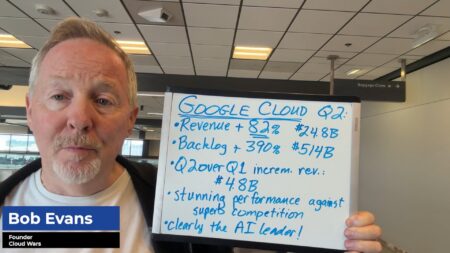
Explosive Q2 results suggest Google Cloud is outperforming rivals where it matters most—winning new AI business and accelerating faster than Microsoft Cloud and AWS.

In a fireside chat with John Siefert, Dewain Robinson explains how reasoning models are transforming Copilot Studio into an intelligent orchestration platform for enterprise AI.

Google Cloud and Palantir are accelerating faster than many AI competitors because customers value measurable business transformation over technical benchmarks such as model size or context windows, creating exceptional momentum in the rapidly expanding AI economy.

Google Cloud and Palantir are entering Q2 earnings with industry-leading growth, driven by AI-native strategies, customer trust, and differentiated execution.

As Q2 earnings approach, Palantir, Google Cloud, and Oracle lead the Cloud Wars Top 10 in revenue growth, highlighting the extraordinary pace of the AI market and the massive backlog fueling future expansion.

AI is dramatically accelerating software development, but Cedric Wells argues that organizations must balance rapid innovation with architecture, security, governance, and quality assurance to safely move AI-generated solutions into production.

The world’s largest cloud providers are embracing innovative financing, partnerships, and infrastructure strategies as unprecedented AI demand drives what may become the largest industrial construction effort in modern history.

Hyperscalers are embracing unprecedented financing strategies and partnerships as AI demand forces massive investments in next-generation data center infrastructure.

As digital transformation enters the AI era, ServiceNow and Accenture are helping organizations move beyond cloud migration by embedding AI agents into cybersecurity, compliance, and enterprise risk management workflows.