

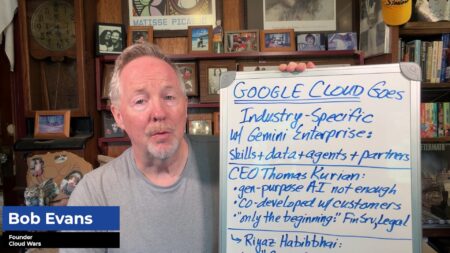
Google Cloud is taking Gemini Enterprise deep into vertical industries, beginning with financial services and legal and combining skills, data, agents, and partners into one AI system.
Google Cloud is taking Gemini Enterprise deep into vertical industries, beginning with financial services and legal and combining skills, data, agents, and partners into one AI system.

Instead of searching across laboratory results, medications, and specialist documentation, clinicians can prompt Epic and receive required information inside ChatGPT using new OpenAI connector.
Since returning as CEO, Aneel Bhusri has reshaped Workday’s agentic AI strategy, eliminating or combining simpler agents while prioritizing sophisticated AI systems capable of solving complex HR and finance problems and delivering measurable customer ROI.
OpenAI prominently outlined plans for a unified AI superapp in March, but CFO Sarah Friar’s August description of the company’s AI-native stack makes no mention of it, raising questions about whether OpenAI has changed its strategy.

ServiceNow CEO Bill McDermott is positioning cybersecurity as a major growth engine, combining rapid security-business expansion, strategic acquisitions, new leadership, and Autonomous Security while maintaining the company’s broader identity as the AI control tower for business reinvention.

ServiceNow is rapidly building its cybersecurity presence, and three recent developments suggest Bill McDermott may see security as the company’s defining long-term opportunity.

Salesforce CEO Marc Benioff says the company’s Claudeforce partnership with Anthropic can unlock decades of customer data and business value previously “trapped” inside Salesforce systems, creating what he calls an unprecedented enterprise AI opportunity.

Law firms that collaborated in platform design highlight industry AI opportunities to eliminate manual work and drive innovation for better client service.

Workday CEO Aneel Bhusri is increasingly bullish as rapid AI adoption, strong revenue growth, trusted enterprise context, and faster innovation strengthen Workday’s competitive advantage.

On the strength of customer design partnerships and an expansive ecosystem, Google Cloud delivers AI platforms that could unlock AI innovation in support of vertical use cases.

With AI run rate approaching $600 million and 5,500 customers using AI solutions, Workday is seeing powerful early evidence that its AI strategy is gaining traction.

Consolidated AI chatbots raise order values up to 26% at Albertsons, while WalMart’s in-store AI use requires employees to further train AI models with business context.
OpenAI has responded to the GPT-5.6-Sol security incident involving Hugging Face by strengthening cybersecurity safeguards, expanding its Daybreak program, and introducing GPT-5.6-Cyber for vetted defenders conducting advanced vulnerability research and security testing.

Microsoft CEO Satya Nadella has confirmed plans for a Copilot super app that will unite chat, coding, Cowork and autonomous AI agents, creating a single flagship experience spanning both Microsoft’s consumer and commercial AI offerings.

ServiceNow CEO Bill McDermott is positioning the company as the enterprise AI Control Tower, combining governance, cybersecurity, workflow orchestration, integration, and automation to help customers manage the growing complexity and risks of enterprise AI.

AI’s unprecedented growth is forcing even the world’s best-run companies to rethink traditional risk management and embrace massive, calculated bets on the future.

Google has introduced Gemini 3.6 Flash, Gemini 3.5 Flash-Lite, and Gemini 3.5 Flash Cyber, focusing on lower costs, faster AI agents, improved coding, and specialized cybersecurity capabilities for enterprise customers.

AI agents are beginning to outpace Copilot licenses, signaling that organizations are creating increasingly valuable custom automation across the Microsoft ecosystem.

Microsoft and more than 20 tech companies urge U.S. lawmakers to protect open-weight AI models, arguing openness drives innovation and competition.

Palantir’s Q2 2026 results reveal 93% growth, a bold AI sovereignty strategy, and how its customer-first approach is reshaping enterprise AI.