


Akrites coordinates disclosure and remediation as discovery of open-source vulnerabilities in the AI Era is outrunning defense.
Akrites coordinates disclosure and remediation as discovery of open-source vulnerabilities in the AI Era is outrunning defense.

Microsoft is shifting Copilot Cowork to usage-based pricing while exploring lower-cost AI models, signaling a strategy focused on performance, economics, and customer choice.

Working with DynaTech Systems, Solmax standardized global business processes and created a single source of truth, helping eliminate data silos and improve financial and operational decision-making across multiple regions.

Enterprise AI growth increasingly depends on implementation expertise rather than model capabilities alone.

Dona Sarkar says AI has yet to find its defining mainstream use case, and the companies preparing now will be best positioned when that breakthrough moment arrives.

The AI market is entering a new chapter where execution and business outcomes matter more than proving technological capabilities.
As AI token demand surges, CEOs must take ownership of allocation strategy to ensure scarce AI resources drive business outcomes, not internal politics.

Addition to the company’s governance control plan eliminates a wide range of manual steps required to transition an agent from local usage to enterprise availability.
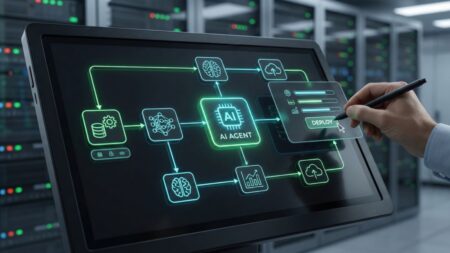
Google Cloud, OpenAI, and Anthropic are investing heavily in deployment capabilities, ecosystems, and forward-deployed engineers to help customers achieve measurable business outcomes and accelerate enterprise AI adoption beyond model selection.

Microsoft modernized employee device procurement with a centralized platform before adding agentic AI, cutting costs by $20M and simplifying the user experience.

IBM and Google Cloud have launched a new Google Cloud Practice designed to help organizations accelerate AI deployments by combining IBM Consulting expertise with Google Cloud’s Gemini Enterprise Agent Platform, cybersecurity capabilities, and advanced data technologies.

KPMG and Microsoft are expanding their partnership to help enterprises deploy agentic AI at scale through standardized governance, deployment, and management frameworks.
As organizations accelerate AI deployments, AWS is providing a practical solution to prevent rising technology costs. Continuous Modernization helps enterprises modernize applications while controlling the long-term impact of technical debt.
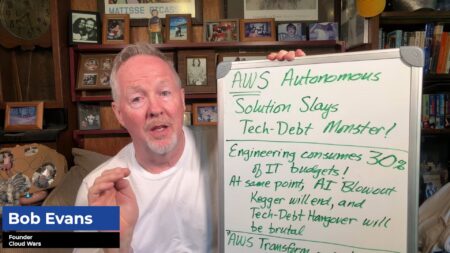
As AI spending surges, AWS argues that companies cannot ignore technical debt, which continues consuming substantial IT resources that could otherwise fuel innovation.

Mustafa Suleyman believes AI progress is accelerating dramatically, with model-training compute expected to increase another thousand-fold over the next three years.

Microsoft is testing new AI-powered workplace devices under Project Solara, aiming to create agent-first experiences that move AI interactions beyond traditional PCs and applications.

Google Cloud and Palantir are expanding their partnership to help businesses combine AI, data, and analytics for faster decision-making and stronger industry-specific outcomes.

The Hyperscaler Backlog Sweepstakes defines the top AI factories, ranking Google Cloud, Oracle, Microsoft, and AWS in the top four.
Pinterest has signed a $4 billion infrastructure agreement with AWS through 2031, marking the largest technology commitment in its history. The partnership will support AI innovation, improve discovery experiences, and provide scalable infrastructure for hundreds of millions of users.

Open Knowledge Format, or OKF, aims to become the MCP of representing knowledge and context so it can be consumed easily by AI agents without a translation layer.