


Oracle and Google Cloud are challenging conventional wisdom by using outside funding to support massive AI infrastructure investments driven by unprecedented customer demand.
Oracle and Google Cloud are challenging conventional wisdom by using outside funding to support massive AI infrastructure investments driven by unprecedented customer demand.

ServiceNow CEO Bill McDermott says the company is now AI-native and targeting five high-growth markets worth more than $600 billion, backed by strong momentum in AI, security, CRM, employee experience, and data management.
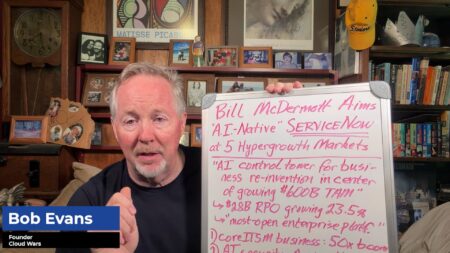
ServiceNow is betting its future on being AI-native, with Bill McDermott outlining five hyper-growth markets that could drive long-term expansion and strengthen its leadership position.

Christopher Lochhead explains how AI is making knowledge and execution increasingly free, shifting competitive advantage to agent-driven systems.

Google Cloud has launched Google AI Threat Defense, an AI-powered cybersecurity platform designed to help organizations proactively identify, prioritize, and remediate threats while keeping pace with increasingly sophisticated AI-driven cyberattacks.

Salesforce delivered strong Q1 results with $11.1 billion in revenue, driven by accelerating demand for Agentforce, AI-powered Slack, and AI-enhanced applications across its portfolio.

Workday’s strong Q1 performance highlights CEO Aneel Bhusri’s push to transform the company into an AI-native enterprise focused on agentic AI innovation, lawful governance, and accelerated product development to compete with SAP, Oracle, and Microsoft.

AI and Microsoft expert Paul Swider details a personal health assistant he’s built called Tula that unifies all of a patient’s data and aims to level the healthcare playing field.

The biggest AI opportunity in enterprise software may be reducing implementation friction, not simply adding generative features.
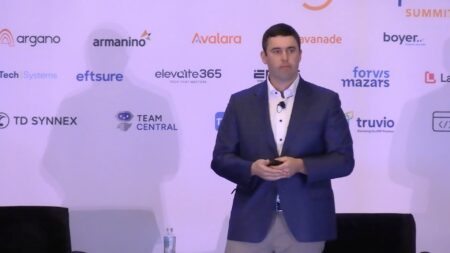
James Oleinik explains how Agent 365 provides the visibility, governance, and security foundation needed to manage AI agents across the enterprise.
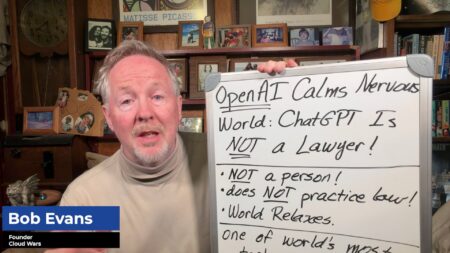
A recent court case pushed OpenAI to specifically define ChatGPT as “not a lawyer.” How does this impact the future of AI?
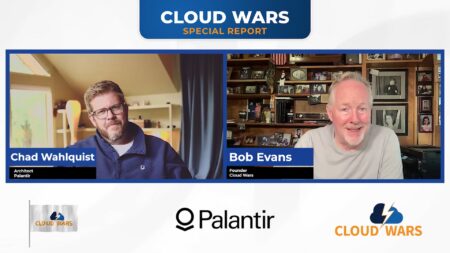
The enterprise AI battleground is shifting from model access to operational context, governance, and differentiated execution infrastructure.
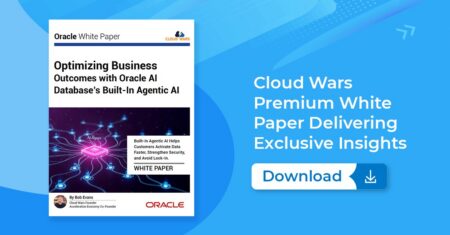
How Oracle is embedding agentic AI directly into its database platform to help enterprises accelerate innovation, strengthen security, and reduce architectural complexity.

Christopher Lochhead explains how AI is accelerating category-level shifts that create entirely new kinds of jobs while rapidly reshaping the future of work.

Anthropic’s reported $200 billion Google Cloud commitment highlights the staggering scale of AI infrastructure demand and the increasingly collaborative relationships between traditional hyperscale competitors.
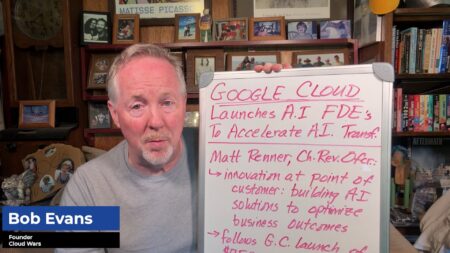
Google Cloud is accelerating enterprise AI adoption with specialized AI engineers and a $750 million ecosystem fund, signaling a more aggressive customer execution strategy.

SAP and Palantir are helping redefine enterprise technology, as Christian Klein and Alex Karp both argue that AI-driven execution has moved their companies beyond the traditional definition of software vendors.

Enterprise AI success depends not just on innovation speed, but on governance, interoperability, migration readiness, and organizational change.
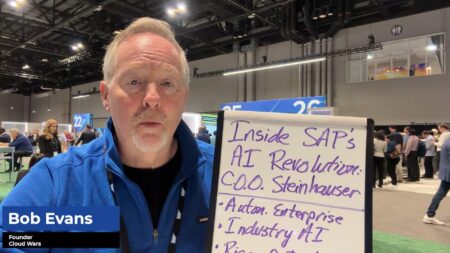
SAP is accelerating its autonomous enterprise strategy with agents, Business Data Cloud, and industry-specific innovation in what could be its most ambitious transformation yet.

New feature rollout includes support for tapping — or building — reusable skills that Cowork can invoke to complete a task or workflow on a user’s behalf.