



Microsoft executive Dona Sarkar delivered a pointed reality check on a number of widely held AI beliefs while offering a concrete set of recommendations — and tactics to avoid — when it comes to driving enterprise AI success in the enterprise.
In a keynote session at AI Agent and Copilot Summit titled “Who’s Afraid of Little Old Copilot,” Microsoft’s Chief Troublemaker Copilot & AI Extensibility (who very much lived up to her title) took aim at much-hyped themes including vibe coding and job elimination “opportunities” presented by AI.
The reality check flowed into a discussion of things companies should do (tap employees’ business expertise to deliver mainstream use cases) and not do (ill-conceived GenAI deployments for the sake of demonstrating forward progress).
Her slides contained a zinger that summed up the perspective she brought to bear: “AI is a force multiplier, which becomes a force reducer in the hands of delusional management.”
Reality vs. Hype
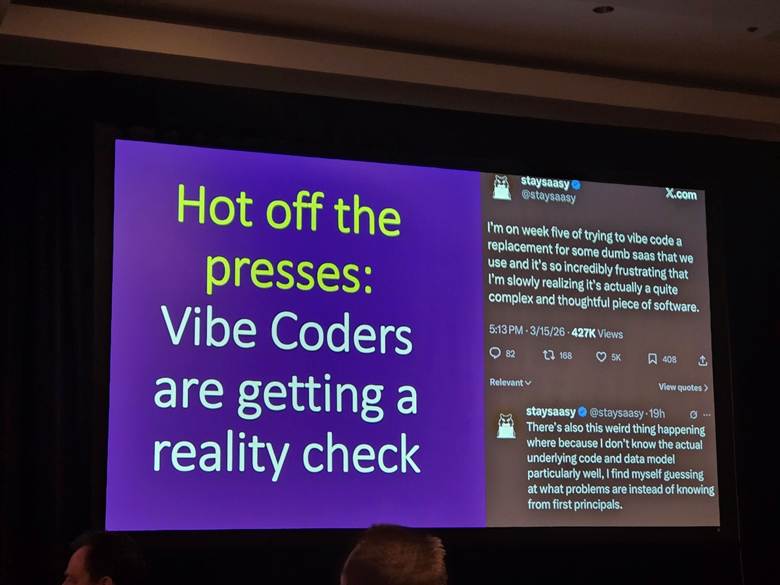
Sarkar took aim at one of the oft-cited AI trends that clearly delivers value – but perhaps not at the level the hype may suggest. That is, vibe coding. The slide below depicts online commentary from a developer absorbing the reality that a SaaS package they set out to replace is actually complex and thoughtful while their approach fails to capture actual business insight in support of their work.
“They’re realizing it’s not as easy as it looks on Twitter” to vibe-code and replace business software, she said.
Sarkar also called out tech and business execs who take highly charged positions touting the ability to eliminate jobs and solve underlying business problems in wildly optimistic or aggressive timeframes. For instance, she noted that Anthropic CEO Dario Amodei stated publicly in early 2025 that 50% of office jobs will disappear in the next year; in reality, “I think we have 50% more jobs this year because everyone’s trying to do AI.” Then three months ago, Amodei said at a conference that software engineering won’t exist in a year – even though Anthropic was actively recruiting software engineers at the same conference. “He definitely needs someone to vet his spiels,” Sarkar said.
One more example of executives buying into – and even promulgating — AI hype: airlines embracing chatbots that are the brand’s customer-facing engagement tool, an approach that strains under the weight of widespread flight disruptions. While airlines are quick to encourage customers to message their chatbot, “I want to talk. The hold time is six hours? I don’t care. I’ll talk to a person,” Sarkar said.
The result of such inflated expectations that don’t reflect business reality or what’s best for the customer? A reckoning when executives come to realize they still need people to do customer-facing work.
In fact, Sarkar asserted that “there’s no mainstream use case of AI in the world today” — but noted that’s not a bad thing because companies are gathering tools and knowledge while they await lower-priced tokens and more predictable AI responses. In fact, she told conference attendees their participation in the event indicated they are actively working to increase their expertise while they await additional technical and cost advances.
Sarkar’s examples of AI reality checks playing out were interspersed with commentary on strategies and tactics destined to produce poor results if not failures:
- Touting headcount reductions and/or cost reduction opportunities rather than new, previously impossible things a business can do with AI
- Trying to do too many things with AI by tackling a wide range of use cases at the same time
- Randomly deploying LLMs to a team without identifying useful and relevant use cases
Winning Approaches
Sarkar laid out three concrete ways that companies can put their business on a more direct path to success.
First, she advises breaking AI projects into three categories: 1) easy wins such as meeting notes, 2) hard problems that, when fixed, will positively impact the business (example: finding the right customers or fixing the most important software bugs) and 3) a problem that was impossible to solve that AI makes possible to solve for the first time.
Instead of casting a wide net for AI use cases, she called for choosing a single workflow, fixing existing bugs in that process, ensuring data within that workflow is current, then applying AI with human guardrails to enhance the process.
In a recommendation that conflicts with some other speakers at the event, Sarkar said AI adoption must be initiated on a top-down basis. She also called for setting one metric per quarter per organization.
Against these guidelines, she cited one example of a winning AI use case and another of a winning product to support the type of approach she advocates:
- Use case: Coding agents, which typically can leverage up-to-date data from one source and perform niche activities with expert oversight. Coding agents, of course, are being highly touted for the productivity enhancements they unlock.
- Product: Waymo self-driving car service, which features clear ROI, an AI model closely tied to the city in which it operates, clear instructions, multiple agents working together, well-defined guardrails and humans in the loop in the form of a rider support button in the app.
Closing Thoughts
Sarkar debunked a good deal of AI orthodoxy with a refreshing, reality-driven take on the state of AI. I suspect she would agree with other event speakers who noted there’s real danger in not acquiring AI skills and moving forward with AI initiatives. Still, it was clear she doesn’t view AI as a destroyer of jobs in the near term.
“Everyone’s saying, hey, AI is going to take all your jobs tomorrow and replace all of you…I don’t think so. Things take a lot longer than you think.”
Related Microsoft and AI Insights:
- Microsoft Exec: With Latest AI Tools, Agents Positioned to Make Up 20% of Every Team
- Microsoft Agent Framework Enables Complex, Multi-Agent Actions
- Copilot’s Advantage vs. Stand-Alone Chatbots
- Becoming Frontier at Microsoft AI Tour NYC: Inside the Agent-First Enterprise
- Agents, Custom GPTs Find Their Way Into Org Charts