


A major runup in its market cap places Microsoft in elite company, and demonstrates the company placed the right bet when it went all in on AI.
A major runup in its market cap places Microsoft in elite company, and demonstrates the company placed the right bet when it went all in on AI.

Andy Jassy claims AWS had the cloud market’s highest incremental revenue gain, overlooking Microsoft’s superior figures, leading to questions about his perception of cloud services.

Amazon CEO Andy Jassy’s remarks on cloud providers raise questions about whether the company is evolving in line with customer requirements.

SignUp Software maintains a laser focus on accounts payable automation for Microsoft customers, while addressing their cost, compliance, and control requirements.

Gain a deeper understanding of the future business landscape with Wayne Sadin’s break down of the nuances of SaaS and AI.

Google Cloud’s making a significant investment of $50 billion in technical infrastructure for the year 2024 to power its AI products and services.

Cloud Wars Top 10 companies are investing outside technology centers, increasing those locations’ profile in tech and helping them build a more tech-savvy workforce.
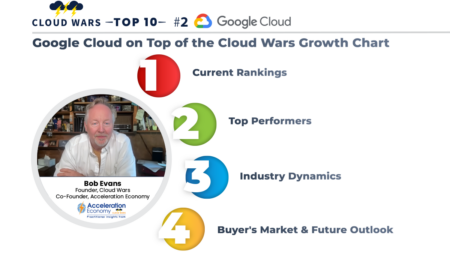
Google Cloud claims the #1 spot in the Cloud Wars growth chart with a 25.7% growth rate and $9.2 billion in revenue, amid shifting industry dynamics.

Google Cloud has a narrow lead on the Cloud Wars growth chart; Microsoft’s growth is remarkable; and the GenAI Revolution continues to impact the top cloud vendors.

Google Cloud CEO Thomas Kurian discusses the company’s growth, attributing it to customer trust and a focus on delivering innovation.

Under Satya Nadella’s leadership, Microsoft has successfully adopted a cloud-first approach and achieved remarkable growth in cloud revenue, market cap, partnerships, and much more.

Five process mining products to watch — from Abbyy, IBM, Mehrwerk, Microsoft, and ServiceNow — underscore the category’s increasing reach into automation, task mining, unstructured data, and more.

AWS, once the undisputed leader, is struggling to keep pace with the rapid growth and customer-focused innovations of Microsoft, Google, and Oracle in the cloud market.

The cloud hyperscalers are splitting into two distinct groups: sprinters (Microsoft, Google Cloud, and Oracle) and plodders (AWS).
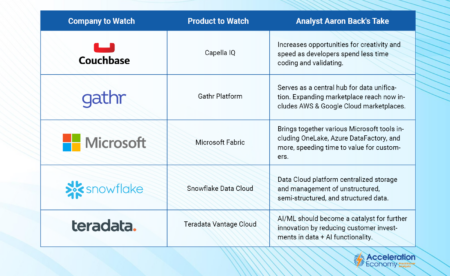
Discover our 5 data products to watch — from Couchbase, Gathr, Microsoft, Snowflake, and Teradata — and how they can support your company’s AI strategy in 2024.

Overview of business intelligence and reporting tools to watch delivers an explanation of key features such as AI-enhanced analytics, data visualization, and cloud functionality.

A look at the dynamic state of AI adoption in the cloud through a Wiz report revealing trends, adoption rates, and the rise of power users in both managed and self-hosted AI services.

IBM CEO Arvind Krishna emphasizes customer-centric innovation and co-creation, shifting from traditional selling to shared thinking, innovation, and opportunity with partners for mutual growth.

Innovation often comes from start-ups, but several of the biggest software firms — AWS, IBM, Microsoft — are able to prove their technology in their own complex supply chains.

A look at five automation products that can transform businesses, including offerings from Microsoft, UiPath, Automation Anywhere, and more.