

Dona Sarkar explains why coding agents succeed first in AI adoption thanks to structured data, clear validation, and measurable outcomes.
ai
Agentforce helped Salesforce unlock $42 million in pipeline from previously untouched leads, demonstrating the practical impact of agentic AI.
Thales explains how organizations can use AI-driven competitive intelligence to identify market weaknesses, exploit operational gaps, and respond faster than competitors.
Microsoft and EY’s expanded partnership combines AI-native engineering with business consulting to help organizations scale transformative AI initiatives.
Workday’s strong Q1 performance highlights CEO Aneel Bhusri’s push to transform the company into an AI-native enterprise focused on agentic AI innovation, lawful governance, and accelerated product development to compete with SAP, Oracle, and Microsoft.
AI and Microsoft expert Paul Swider details a personal health assistant he’s built called Tula that unifies all of a patient’s data and aims to level the healthcare playing field.
James Oleinik explains how Work IQ powers Copilot with real-time enterprise context, turning AI into an intelligent execution layer for work.
Case involving Nippon Life Insurance and OpenAI highlights ChatGPT’s status as a non-person AI tool, not a lawyer, amid alleged legal misuse.
James Oleinik explains how Agent 365 provides the visibility, governance, and security foundation needed to manage AI agents across the enterprise.
A recent court case pushed OpenAI to specifically define ChatGPT as “not a lawyer.” How does this impact the future of AI?
Despite strong optimism around AI adoption, Workday found that most enterprise users still act as intermediaries between AI tools, reducing productivity and undermining the promise of automation.
Sachin Gandhi explains how AI agents are transforming supply chains by autonomously planning and executing logistics operations.
Microsoft says the future of AI success depends less on individual readiness and more on organizational culture, management support, and redesigned workflows.
The enterprise AI battleground is shifting from model access to operational context, governance, and differentiated execution infrastructure.
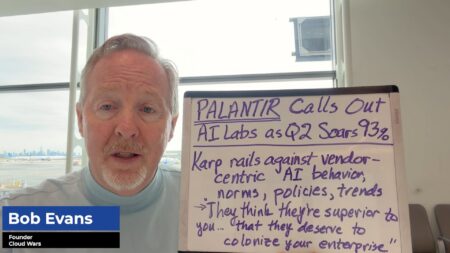
Palantir’s 70% growth highlights how outcome-based AI pricing and rapid enterprise expansion are creating a new playbook for cloud success.
How Oracle is embedding agentic AI directly into its database platform to help enterprises accelerate innovation, strengthen security, and reduce architectural complexity.
Christopher Lochhead explains how AI is accelerating category-level shifts that create entirely new kinds of jobs while rapidly reshaping the future of work.
Anthropic’s reported $200 billion Google Cloud commitment highlights the staggering scale of AI infrastructure demand and the increasingly collaborative relationships between traditional hyperscale competitors.
Enterprise AI has shifted from experimentation to urgent execution, forcing cloud providers to deliver measurable business outcomes faster than ever.
SAP and Palantir are helping redefine enterprise technology, as Christian Klein and Alex Karp both argue that AI-driven execution has moved their companies beyond the traditional definition of software vendors.