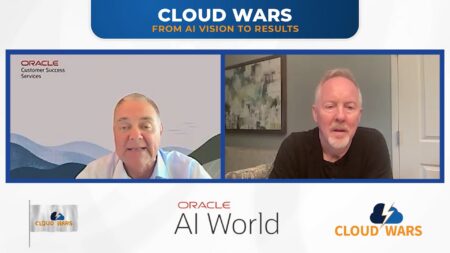



John Siefert sits down with Christopher Jones, Vice President of Ecosystems and Partner Alliances at T-Mobile, to explore why enterprise connectivity is becoming foundational to the AI Era. Jones explains how T-Mobile for Business is moving beyond the traditional perception of a telecommunications provider to become an infrastructure layer supporting distributed workforces, AI agents, enterprise applications, and data at the edge.
AI Runs on Connectivity
The Big Themes:
- Connectivity Underpins Enterprise AI: AI may dominate enterprise conversations, but Jones argues that connectivity remains the foundation that makes AI useful. Applications, agents, enterprise data, and mobile workforces all depend on networks capable of delivering reliable access wherever work happens. That makes connectivity increasingly important as AI pushes workloads and data beyond traditional office environments and toward the edge. T-Mobile for Business is positioning itself not simply as a telecommunications provider but as an underlying infrastructure layer supporting whatever technologies enterprises deploy today and tomorrow.
- Co-Creation Replaces Technology Silos: The conversation repeatedly returns to co-creation. T-Mobile doesn’t want partners to build specifically into its solutions, nor does it necessarily want to embed itself deeply inside an SI’s technology. Instead, Jones describes a co-sell and co-creation model in which different providers contribute their respective expertise toward a common customer outcome. An SI may own the application or industry solution while T-Mobile provides the connectivity that allows that solution to operate reliably across locations and devices. That distinction matters as enterprise architectures become more complicated. Rather than expecting one vendor to provide every component, customers can benefit from ecosystems that combine networking, applications, cloud, AI, consulting, and domain expertise while keeping each participant focused on what it does particularly well.
- Resilience Requires Multiple Paths: One example of T-Mobile’s infrastructure strategy is SuperBroadband, which Jones describes as pairing its 5G network with Starlink in a managed connectivity solution. The objective is to provide two independent connectivity paths rather than leaving an organization dependent on one. T-Mobile‘s current materials describe SuperBroadband as integrating its 5G Advanced network with Starlink and supporting capabilities including failover and load balancing. This reinforces the broader message of the conversation: as organizations place more mission-critical workflows on cloud applications and AI systems, network resilience becomes inseparable from business resilience.
The Big Quote: “No one owns the whole solution. It’s how do you bring together a variety of partners that have their own individual expertise [to] work together for the joint customer outcome.”
More from T-Mobile:
Learn more about T-Mobile for Business Advanced Network Solutions and T-Mobile SuperBroadband.