


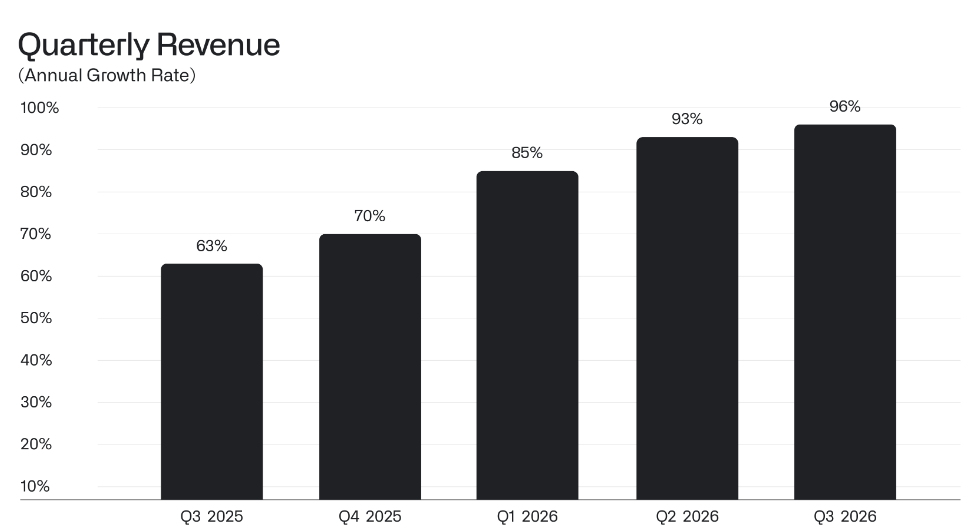
With Palantir’s U.S. Commercial business soaring 148% in Q3 and becoming the primary driver of the company’s explosive 96% growth, CEO Alex Karp warns that business leaders dragging their feet on AI transformations will face at best “a barren wasteland filled with those who were once legacy players who failed to heed the word and paid the ultimate price.”
And that’s for the lucky ones — those who manage some trifling successes and thereby tumble downward only to “the lonely middle.”
But, a far more disastrous fate, Karp says, awaits those whose free-fall extends all the way to “the crowded bottom…occupied by those who long ago lost their chance to build on what might once have been an insight or an edge, now marching inexorably toward irrelevance, their fate sealed, the envelope unopened.”
While those are indeed grim words from a guy whose company just posted some truly remarkable quarterly results, I believe Karp’s intent was not so much to criticize as to provide a 2×4-across-the-face wake-up call to CEOs who think they’ve got a few years to tinker and twiddle with this AI thing and see what happens.
The completely unfiltered Karp shared those thoughts in his Q3 letter to shareholders, and I’ll offer more context and excerpts from Karp’s missive in a moment but first want to share some of Palantir’s Q3 numbers to provide the grounding for why Karp feels qualified to dispense such existential counsel to CEOs across every industry.
- Total revenue up 96% to $2.31 billion, which marks a sequential increase of 20%;
- U.S. Commercial revenue up 148% to $984 million;
- U.S. Government revenue grew 96% to $954 million, marking the first time in the company’s 23-year history that the public sector did not account for the majority of Palantir’s revenue;
- Dizzying deal flow: closed 212 deals of at least $1 million, 107 deals of at least $5 million, and 64 deals of at least $10 million; and
- Rapidly rising re-signings: net dollar retention surged by 165%, an increase of 800 basis points compared to the prior quarter.
Powerful Real-World Use-Cases
Palantir’s booming U.S. commercial business has brought Karp and CRO Ryan Taylor and CTO Shyam Sankar into deep and intimate contact with leaders of major companies from across every industry, and as a result Karp’s perspectives are not speculative but rather forged in the red-hot reality of a true tipping point.
Here’s the full excerpt from his Q3 shareholders letter in which he lays out the ugly fate awaiting companies whose leaders fail to seize the moment:
“Such results as ours come as little surprise to those sensitive and curious enough to listen. But the most profound shifts in technology cannot be understood without reflection. Whoever has ears ought to hear.
“Every industry in the world—from banks to insurers to hospitals and even once-storied law firms—will either be remade or set briskly aside.
“The outcomes will increasingly be binary, with winners and losers, and nothing in between.
“The lonely middle will be little more than a barren wasteland filled with those who were once legacy players who failed to heed the word and paid the ultimate price. The crowded bottom will be occupied by those who long ago lost their chance to build on what might once have been an insight or an edge, now marching inexorably toward irrelevance, their fate sealed, the envelope unopened.”
Ask not for whom the bell tolls, eh?
What Took Years Now Happens in Quarters
And for those leaders who don’t want to see their companies slide down the slimy slope into the “barren wasteland” of the “lonely middle” or, worse yet, plunge headlong into the “crowded bottom” of doomed businesses “marching inexorably toward irrelevance,” Karp’s advice about the need for speed — the need for great and intensely focused urgency — could not be more clear:
“A sales cycle that once had been more akin to a long, unproductive, and unsatisfying flirtation has been condensed. What may have taken months and years—a slow, coy, and theatrical dance towards a contract—can now take days and weeks. Consummation happens quickly.
“Some leaders of business and government institutions believed they could delay the future; many simply gambled that they would not be around to reckon with the consequences of their inaction. The revolution is happening so quickly these leaders have been stunned to find that they cannot get out of town.”
The Future Is Not Written: How to Avoid the “Blast Radius That Tends Towards Infinity”
While enterprises have spent decades and many, many hundreds of billions of dollars stringing together disparate hardware and software and somehow managing to make it work, that formula is doomed when it comes to integrating LLMs into the wildly complex world of corporate technology, workflows, and processes, Karp says in his letter.
A new way forward is needed, he says — and the good news is that a growing number of customers are seizing on that new approach.
“And yet a broad swath of leadership across American industry has awakened to the significance of this moment.
“The questions surrounding the adoption of large language models force the world and its leaders to confront both a promise and peril that is totally unlike anything that has come before. In the best case, these models on their own generate limited value. In the far more likely outcome, they become agents of chaos. Lacking a grounding in the means of interfacing with the labyrinth of datasets, people, business units, use cases, and critical safeguards scattered across the modern enterprise, the LLM agent is a virtually unlimited liability, possessing a nearly unbounded destructive potential and a blast radius that tends towards infinity.
“There is simply no means of effectively and reliably connecting the language models to large enterprises without the operating model and capabilities we have pioneered.”
Final Thought
Is Alex Karp intentionally trying to scare the crap out of business executives in the hope that they’ll pick Palantir to save them? Oh, you betcha he is! But the proof of what he’s saying lies in the (a) stunning quarterly results his company has been generating and (b) the ravenous appetite for *more* Palantir technology being exhibited by customers that have started with relatively small projects. As proof, look again at that Q3 net-dollar retention number cited above: “net-dollar retention surged by 165%, an increase of 800 basis points compared to the prior quarter.”
I believe that decline is a choice, and sometimes that choice expresses itself as misguided actions and other times it is manifest in hesitancy, uncertainty, inaction, and confusion.
Alex Karp and Palantir scare some people because their behaviors and the language they use and their metrics for success are radically different from the tech-industry norms for the last two decades. But it is also that exact and singular differentiation that is winning legions of passionate converts and pushing customer demand higher than just about any other company has ever experienced.
So whatever you do, don’t book that ticket to the “barren wasteland” of the middle or the “crowded bottom” of those “marching inexorably toward irrelevance.”