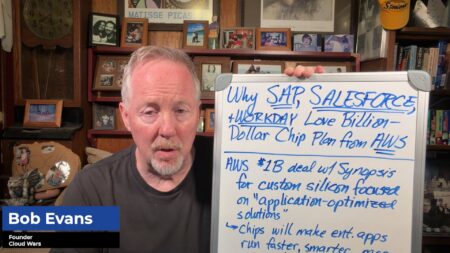


As AWS fuels its booming chip business with a $1 billion deal with longtime chip partner Synopsys, the primary beneficiaries will be SAP, Salesforce, Workday, and other apps vendors because a prime objective for these next-gen chips will be to highly optimize the apps running on AWS.
The key finding in AWS’s latest investment in its custom-silicon future is that it represents not only a big step forward for AWS’s own huge and fast-growing cloud infrastructure and AI infrastructure business but also makes it possible for AWS to claim that major enterprise apps achieve peak performance thanks to the custom chips now under development.
Here are the key comments from the joint AWS-Synopsys announcement about the proposed new chip, first from Amazon senior vice president for foundational AI, custom silicon, and quantum computing Peter DeSantis:
“From Graviton to Trainium, purpose-built chips deliver better performance at lower cost because they’re designed for exactly what customers need. As our chip designs grow more ambitious and AI reshapes the engineering process itself, Synopsys helps us move faster across the design cycle, helping us deliver more capable, efficient computing for customers worldwide.”
And then Synopsys CEO Sassine Ghazi revealed the big promise for apps vendors:
“Special-purpose silicon is at the heart of AWS innovation. As we expand into application-optimized IP solutions, we’re proud to have Amazon as our lead customer for this next phase of growth.”
Think about that: in addition to the incredibly powerful cloud infrastructure clusters and breakthrough AI clusters being developed by all of the hyperscalers and others, and in addition to the rapid and deep launches of agentic AI solutions, business customers will soon be able to deploy enterprise apps supercharged by the silicon that runs them.
In a competitive sense, this is another sign that AWS has indeed fought its way back into contention among the four hyperscalers — the other three being of course Google Cloud, Oracle, and Microsoft —and is looking to create high-value differentiation for both its ISV partners and for the business customers running those solutions.
Final Thought
This is a great step forward for AWS, and one that should help ensure it’s able to maintain the accelerating trajectory it’s been on for the past several quarters. A big factor in that return to prominence has been the AWS chip business, which as of three months ago had achieved a $25 billion annualized run rate while growing at more than 100%.
And I think it’s reasonable to expect that we’ll see the other hyperscalers take some steps to match or beat AWS’s attempt to help its critical ISV partners drive superb performance for customers who use the hyperscalers to run enterprise applications from SAP, Salesforce, Workday, and others.