

OpenAI’s decision to wind down its Cursor contract highlights how trust between technology providers is becoming increasingly critical as the AI ecosystem grows more interconnected.
OpenAI’s decision to wind down its Cursor contract highlights how trust between technology providers is becoming increasingly critical as the AI ecosystem grows more interconnected.

Google Cloud CEO Thomas Kurian says general-purpose AI alone cannot meet complex industry requirements, prompting the company to surround Gemini Enterprise with specialized skills, trusted data connections, agentic workflows, governance, and partner solutions.
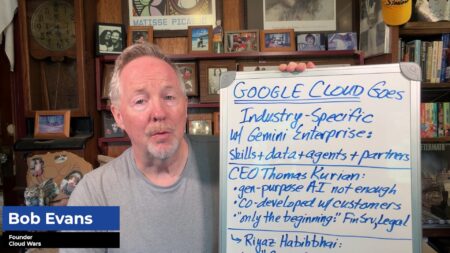
Google Cloud is taking Gemini Enterprise deep into vertical industries, beginning with financial services and legal and combining skills, data, agents, and partners into one AI system.

Since returning as CEO, Aneel Bhusri has reshaped Workday’s agentic AI strategy, eliminating or combining simpler agents while prioritizing sophisticated AI systems capable of solving complex HR and finance problems and delivering measurable customer ROI.

Law firms that collaborated in platform design highlight industry AI opportunities to eliminate manual work and drive innovation for better client service.

Salesforce’s Q2 growth slowed to 11%, but a major Anthropic partnership and the launch of Claudeforce could boost future growth and validate Marc Benioff’s AI ambitions.

Enterprise AI success increasingly depends on trusted, interoperable data that connects existing technology investments with autonomous processes and next-generation business models.

Oracle lands a major 10-year Pentagon contract worth up to $7 billion, strengthening its government credentials while creating a potentially significant stream of recurring revenue.

Google Cloud delivered standout Q2 momentum, adding as much new quarterly revenue as Microsoft and more than AWS despite operating from a significantly smaller revenue base.

Data breaches hit hardest in healthcare and financial services, while the firms that tap AI most aggressively are focusing on hunting threats and automating attack responses.

Nadella believes enterprises should have the freedom to choose AI providers, privately train models, manage costs, and retain complete control over their accumulated organizational intelligence.

SAP delivered 24% cloud revenue growth in Q2 while expanding its cloud backlog to $26.3 billion, with CEO Christian Klein crediting the company’s global partner ecosystem and AI strategy for accelerating customer adoption and positioning SAP for $30 billion in cloud revenue next year.
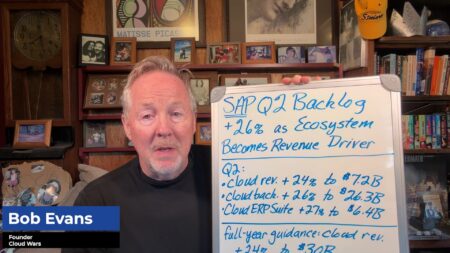
SAP is approaching a potential $30 billion cloud business as its partner-led strategy continues to outpace traditional enterprise software competitors.

Microsoft’s partnership with 3M demonstrates that the next competitive frontier in AI infrastructure extends well beyond GPUs, with networking and optical connectivity emerging as critical strategic differentiators.

Despite investor concerns over rising CapEx, Alphabet believes aggressive AI infrastructure spending will generate multiyear returns as enterprise AI adoption accelerates across industries.

Google Cloud’s $4.8 billion sequential revenue increase establishes a new benchmark for Microsoft Cloud and AWS as investors prepare for their upcoming earnings reports.

AWS is expanding Security Hub with AI-specific protections and Azure support to secure AI and multicloud environments from a single platform.

Google Cloud and Palantir are accelerating faster than many AI competitors because customers value measurable business transformation over technical benchmarks such as model size or context windows, creating exceptional momentum in the rapidly expanding AI economy.

The world’s largest cloud providers are embracing innovative financing, partnerships, and infrastructure strategies as unprecedented AI demand drives what may become the largest industrial construction effort in modern history.
A new generation of AI-powered enterprise applications combines reasoning, workflow automation, and transactional execution.