

As the digital-transformation phenomenon shifts from boardroom theory to full-blown execution, Salesforce is doubling down on its Customer 360 strategy.
As the digital-transformation phenomenon shifts from boardroom theory to full-blown execution, Salesforce is doubling down on its Customer 360 strategy.

The primary ingredient in digital transformation is optimizing the customer experience. Read how 2 Microsoft manufacturing customers describe their efforts.

Hear Cloud Wars Live with Joshua Greenbaum, an industry analyst and consultant who’s been following the enterprise software market for 30 years.

The cloud’s ability to completely revolutionize customer engagement & experience is the dominant topic for CEOs of many leading vendors in the Cloud Wars.

As competition among top cloud vendors intensifies, cloud customer success is rapidly emerging as strategic differentiator more important than snazzy tech.

Some of Microsoft’s largest customers are moving their production SAP workloads as well as other mission-critical applications to the Azure Cloud.
The enterprise AI battleground is shifting from model access to operational context, governance, and differentiated execution infrastructure.

Oracle’s Mike Sicilia explains how the company’s healthcare solutions offer its customers soup-to-nuts automation and privacy unrivaled by its cloud space competitors.

It’s both ironic and fitting that three so-called “legacy” vendors are battling for leadership in the modern and massive hybrid-cloud market.
“We’re starting to see things at this tipping point, after which unstoppable change occurs.” I spoke with SVP Steve Daheb about Oracle Cloud breakthroughs.

As SAP prepares to host 22,000 of its nearest and dearest next week in at its annual Sapphire event in…

Marc Benioff’s AI-centered vision combines enterprise data, autonomous software, major technology partnerships, and new use cases spanning logistics, IT service management, government, and other business functions.

Microsoft is targeting CRM vendor lock-in with Dynamics 365 Activate, an AI-powered migration tool designed to make moving from Salesforce faster, simpler, and less risky.

Amazon and Qualcomm Technologies have announced a multi-generational collaboration focused on customized silicon and connectivity for AI infrastructure, with Amazon potentially making up to $60 billion in payments for Qualcomm products, technology, systems and manufacturing services.
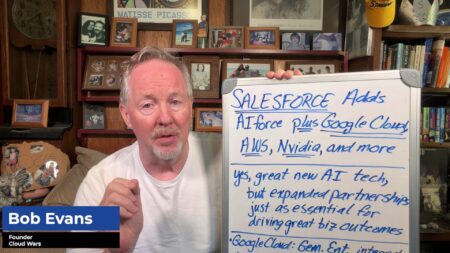
CEO Marc Benioff explained in his Dreamforce keynote how Salesforce unlocks value for customers beyond its AIforce through extended partnerships.

During Oracle’s Q1 earnings call, CEO Mike Sicilia’s comments provided great clarity to help customers better understand the interplay between apps and agents.

Google Cloud CEO Thomas Kurian says general-purpose AI alone cannot meet complex industry requirements, prompting the company to surround Gemini Enterprise with specialized skills, trusted data connections, agentic workflows, governance, and partner solutions.
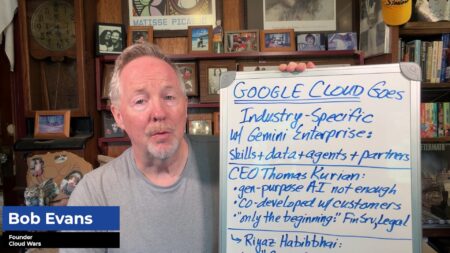
Google Cloud is taking Gemini Enterprise deep into vertical industries, beginning with financial services and legal and combining skills, data, agents, and partners into one AI system.
Since returning as CEO, Aneel Bhusri has reshaped Workday’s agentic AI strategy, eliminating or combining simpler agents while prioritizing sophisticated AI systems capable of solving complex HR and finance problems and delivering measurable customer ROI.

ServiceNow CEO Bill McDermott is positioning cybersecurity as a major growth engine, combining rapid security-business expansion, strategic acquisitions, new leadership, and Autonomous Security while maintaining the company’s broader identity as the AI control tower for business reinvention.