

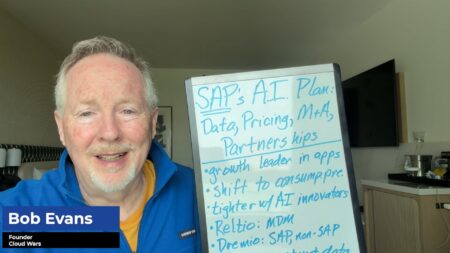
SAP’s AI plan includes strategic partnerships and acquisitions as well as major shifts toward consumption pricing and customer alignment.
SAP’s AI plan includes strategic partnerships and acquisitions as well as major shifts toward consumption pricing and customer alignment.
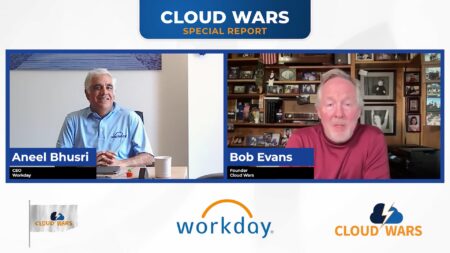
A conversation about enterprise AI readiness, governance challenges, and the next major growth opportunity in intelligent business applications.

OpenAI’s latest Codex upgrades show the company rapidly evolving from standalone AI tools toward a unified “super app” where persistent AI agents can work across apps, retain memory, automate workflows, and increasingly act on behalf of users.

Alexander Karp says Palantir is fighting “AI slop” by delivering disciplined, measurable, and outcome-focused AI solutions for enterprise customers.

Palantir delivered extraordinary Q1 results while arguing that enterprise AI must evolve beyond “software” into fully governed AI infrastructure capable of delivering measurable, auditable, and operational business outcomes at scale.

Google Cloud, Oracle, Microsoft, and AWS now hold more than $2 trillion in combined backlog and RPO, revealing massive contracted demand for AI and cloud services that will convert into future revenue.

Hyperscalers hit a $2 trillion backlog milestone, signaling unprecedented AI demand while exposing capacity constraints that could reshape infrastructure strategies across Microsoft, AWS, Google Cloud, and Oracle.

A major barrier to AI adoption isn’t willingness but governance, as leaders seek secure, observable, and controllable systems to confidently deploy AI across enterprise environments.

Microsoft and Publicis Groupe are expanding a long-running partnership to create a full-stack marketing solution powered by cloud, agentic AI, and identity-based data, helping marketers automate workflows, modernize legacy systems, and unlock faster, smarter growth opportunities.

AI agents are advancing rapidly, but compliance concerns persist, and Panopticore aims to solve this with deterministic governance and verifiable audit trails at the network infrastructure level.

Microsoft’s 2026 Release Wave 1 introduces deeper Copilot integration, expanded agentic AI experiences, and new governance and automation capabilities across Dynamics 365, Power Platform, and Microsoft 365 Copilot, accelerating the shift toward enterprise-wide agentic operations.

Agentforce Contact Center represents Salesforce’s next evolution in customer service, merging voice, digital channels, and AI into one system. It empowers autonomous AI agents while ensuring human operators receive full interaction context for faster issue resolution.

Larry Ellison steps back on earnings calls as Mike Sicilia and Clay Magouyrk take the lead, signaling a deliberate and confident leadership transition at Oracle.

OpenAI aims to scale revenue from $5B to potentially $280B by 2030, but a reported $800B cut in infrastructure spending raises questions about how compute-driven growth can sustain such aggressive enterprise expansion.

OpenAI’s ambitious 2030 revenue forecast collides with contradictory spending cuts, prompting concerns about strategy, execution, and credibility among enterprise customers and key infrastructure partners.

Microsoft Copilot Studio’s new features focus on improving agent evaluation, enabling organizations to assess performance at scale, compare versions, and refine AI systems faster with better feedback loops and auditing capabilities.

Oracle posted explosive Q3 results fueled by unprecedented demand for AI infrastructure. The company’s cloud business grew rapidly, while its data-center expansion strategy and financing plans attracted strong investor support and reinforced confidence in its long-term AI strategy.

Facing unprecedented pressure from customers navigating AI transformation, SAP, Oracle, and Workday are restructuring their sales organizations. Each company is simplifying customer engagement, flattening leadership structures, and aligning sales with services to deliver faster decisions and stronger outcomes.

OpenAI has secured $110 billion in funding from Amazon, NVIDIA, and SoftBank, valuing the company at $730 billion. The investment aims to expand global AI infrastructure, accelerate frontier model development, and scale enterprise and consumer AI adoption worldwide.

Financial services, manufacturing, and retail are leading AI agent implementation, demonstrating how operational use cases are driving measurable transformation across high-impact sectors worldwide.