


Steve Miranda outlines Oracle’s vision for agentic applications that don’t just assist — but actively drive business outcomes across sales, supply chain, and workforce operations.
Steve Miranda outlines Oracle’s vision for agentic applications that don’t just assist — but actively drive business outcomes across sales, supply chain, and workforce operations.
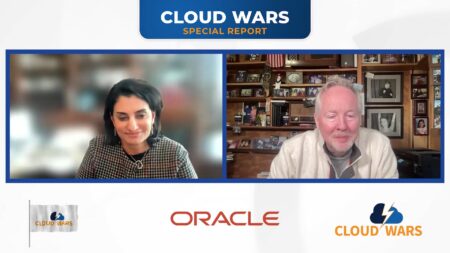
A unified, end-to-end approach is replacing fragmented healthcare systems with connected data and intelligent workflows powered by modern infrastructure.
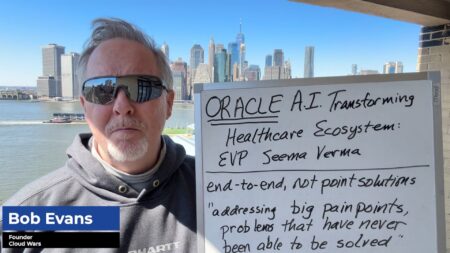
By leveraging AI, Oracle aims to shift healthcare from disconnected systems to a fully integrated ecosystem connecting providers, payers, and patients with improved efficiency and coordination.
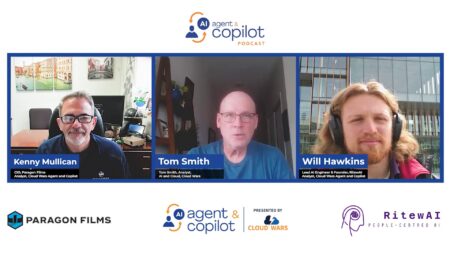
In their highlights from AI Agent and Copilot Summit, Kenny Mullican and WIll Hawkins explain the value of support for third-party tools, note the need for greater interoperability in the Microsoft stack.

Copilot Health transforms overwhelming health data into actionable insights by combining AI with physician oversight — pointing to a future of smarter, more secure healthcare.
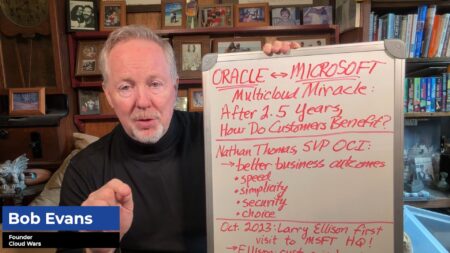
Oracle and Microsoft’s once-unthinkable partnership has become a mainstream “multi-cloud miracle,” unlocking faster innovation, improved security, and simpler architectures while reshaping how competitors collaborate for customer success.
Multi-cloud databases are enabling faster AI adoption by bringing enterprise data closer to cloud-native tools and services.
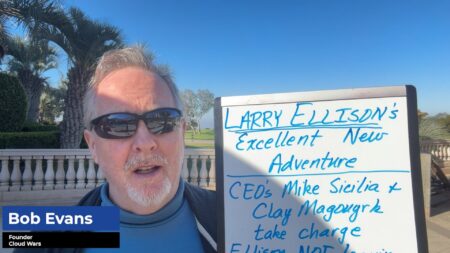
Oracle’s leadership transition signals a new chapter, with Larry Ellison focusing on technology vision while the new CEOs take the lead.
Massive Google Cloud customer use cases and the emergence of patient agency supported by AI are early highlights of HIMSS 2026, according to healthcare tech exec Paul Swider.
The conversation explores how orchestration—both technical and human—is becoming a critical capability, with organizations increasingly treating AI agents as part of the workforce that must be coordinated and managed effectively.

Google Cloud and CVS Health launch Health 100, an AI-driven platform unifying patient data and enabling agentic healthcare workflows, signaling a major shift toward personalized, interoperable healthcare ecosystems.
OpenAI aims to scale revenue from $5B to potentially $280B by 2030, but a reported $800B cut in infrastructure spending raises questions about how compute-driven growth can sustain such aggressive enterprise expansion.

Dona Sarkar calls out the “tech bro”-driven AI hype machine and shares a blueprint to push AI into mainstream use cases that will deliver on the tech’s considerable promise.
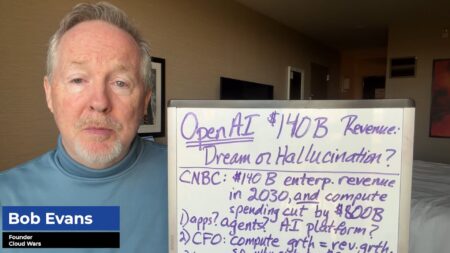
OpenAI’s ambitious 2030 revenue forecast collides with contradictory spending cuts, prompting concerns about strategy, execution, and credibility among enterprise customers and key infrastructure partners.
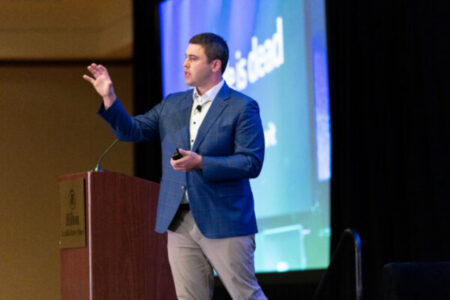
WorkIQ-powered Copilot Cowork orchestrates complex tasks to the point it could take over one-fifth of any team’s work in the near term, while hastening the end of app-powered work.
Microsoft is redefining enterprise productivity by positioning Copilot, agents, and unified AI platforms as the operational backbone of next-generation “frontier firms.”
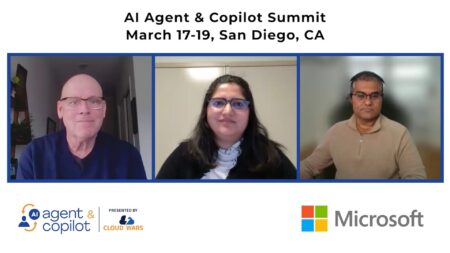
Microsoft data scientists share how AI is transforming cyber defense by enabling intelligent assistants that analyze attacks, suggest detection rules, and help organizations stay ahead of increasingly sophisticated AI-enabled attackers.
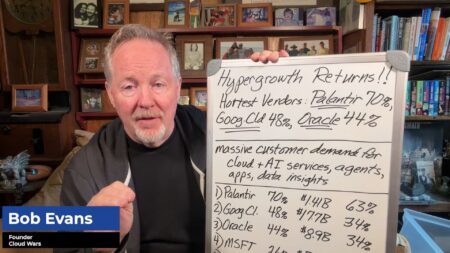
Explosive enterprise demand for AI and cloud services is driving a resurgence of hypergrowth across the Cloud Wars Top 10, led by Palantir, Google Cloud, and Oracle.

AI agents are starting to handle purchases, and companies like Google and Mastercard are racing to build the systems that make those transactions safe and trusted.
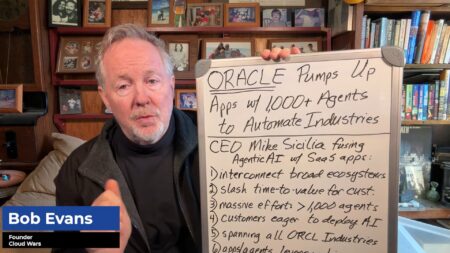
Oracle is rejecting the “end of SaaS” narrative, arguing that AI agents will dramatically expand the power and value of enterprise applications.