


On the strength of customer design partnerships and an expansive ecosystem, Google Cloud delivers AI platforms that could unlock AI innovation in support of vertical use cases.
On the strength of customer design partnerships and an expansive ecosystem, Google Cloud delivers AI platforms that could unlock AI innovation in support of vertical use cases.

New features enhance positioning of Teams as a platform to support humans, agents working together to accelerate GitHub-powered dev projects.

Consolidated AI chatbots raise order values up to 26% at Albertsons, while WalMart’s in-store AI use requires employees to further train AI models with business context.

Palantir’s rapid growth reflects an enterprise AI strategy centered on measurable customer outcomes, operational transformation, sovereignty, and deep long-term partnerships.

Enterprise AI’s next breakthrough will come from evaluating agents against real business workflows and continuously improving their performance with proprietary organizational knowledge.

Microsoft CEO Satya Nadella has confirmed plans for a Copilot super app that will unite chat, coding, Cowork and autonomous AI agents, creating a single flagship experience spanning both Microsoft’s consumer and commercial AI offerings.

Enterprise AI success increasingly depends on trusted, interoperable data that connects existing technology investments with autonomous processes and next-generation business models.

A screenless AI companion from OpenAI could redefine smart home technology by combining conversational AI with contextual awareness and adaptive personalization.

Google Cloud and Palantir are accelerating faster than many AI competitors because customers value measurable business transformation over technical benchmarks such as model size or context windows, creating exceptional momentum in the rapidly expanding AI economy.

Palantir leads the latest Cloud Wars rankings as Bob Evans previews Q2 earnings and explains why cloud and AI remain the world’s fastest-growing technology market.

As AI transforms cybersecurity, Oracle is helping customers protect data through faster patching, stronger resilience, and database-first security.

Enterprise AI growth increasingly depends on implementation expertise rather than model capabilities alone.
As AI token demand surges, CEOs must take ownership of allocation strategy to ensure scarce AI resources drive business outcomes, not internal politics.
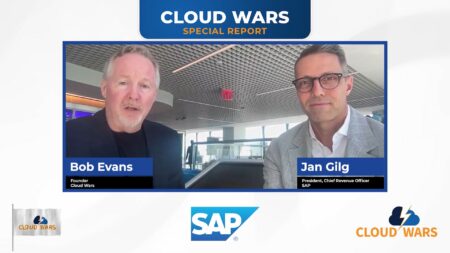
Enterprise AI is entering a new phase where trust, governance, and measurable outcomes matter more than experimentation.

ServiceNow CEO Bill McDermott says the company is now AI-native and targeting five high-growth markets worth more than $600 billion, backed by strong momentum in AI, security, CRM, employee experience, and data management.

An exploration of why future agility, rather than future-proofing, is becoming the defining characteristic of successful digital businesses.

Christopher Lochhead explains how AI is making knowledge and execution increasingly free, shifting competitive advantage to agent-driven systems.

OpenAI’s enterprise business is emerging as the company’s primary growth engine, already accounting for 40% of revenue and expected to reach 50% by the end of 2026, according to CRO Denise Dresser.

OpenAI’s enterprise business now accounts for 40% of revenue and could reach 50% by year-end, signaling a major shift toward enterprise AI leadership.

Enterprise AI success depends not just on innovation speed, but on governance, interoperability, migration readiness, and organizational change.